Life events
| Born | 1741 | Chambers’ Mill, near Harrisburg, Pennsylvania; son of Simon Girty and Mary Newton |
|---|
| Event | about 1756 | Captured with his family by a war party; lived about three years among the Senecas (Mingos) of the upper Ohio |
|---|
| Event | spring 1778 | Left Pittsburgh with Alexander McKee and Matthew Elliott for Detroit; appointed interpreter to the Six Nations in the British Indian Department |
|---|
| Married | August 1784 | near the mouth of the Detroit River, to Catherine Malott |
|---|
| Event | 20 August 1794 | Present at the battle of Fallen Timbers, near Waterville, Ohio |
|---|
| Event | 1800 | Broke his leg in a fall from his horse; lame afterwards |
|---|
| Event | 1804 | Met by William Clark, who found him rheumatic and nearly blind |
|---|
| Event | autumn 1813 | Retreated with the British from the Detroit frontier and is said to have sheltered with a band of Mohawks; American troops nearly burned his farm until Simon Kenton stopped them |
|---|
| Event | about 1816 | Returned home, nearly blind, cared for by Catherine and their children |
|---|
| Died | 18 February 1818 | Amherstburg, Upper Canada (now Ontario); buried on his farm |
|---|
| Event | 2001 | Pennsylvania state historical marker placed near his birthplace |
|---|
From Douglas Leighton, “Girty (Geraghty), Simon,” Dictionary of Canadian Biography, vol. 5 (1983), and, for the marriage, William P. Marlatt, Families of Peter Malott and Joseph Malott (2002). The events of 1800 to 1816 are from his modern biographers, as summarized in David White, “He Whooped to See Them Burn” (2020).
History and lore
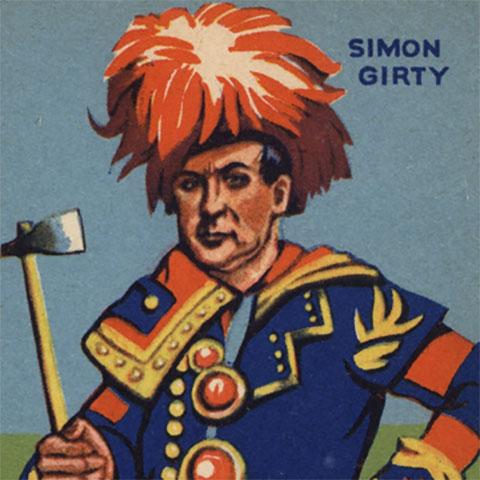
Captured as a boy and raised for three years among the Senecas, Simon Girty grew up between two worlds. During the Revolution he went over to the British at Detroit and served as their interpreter with the Indian nations of the Ohio country, and Americans came to hate him as “the White Savage.” In 1784 he married Catherine Malott, who had been taken captive on the Ohio River with her mother and siblings about 1780. They farmed in Malden Township, near Amherstburg, and had five children. The family remembered him as a hard drinker and a hard husband, and Catherine lived apart from him for some years. Nearly blind in old age, he was cared for by Catherine and their children until his death in 1818. His biographers argue that much of his fearsome reputation was wartime propaganda, and that he saved more prisoners from the stake than he ever helped to kill.
Read the story: Captured on the Ohio: The Malott Family’s Ordeal of 1780