
Research paper
Lineage Proof for D. Kipp Melat
Establishing His Patrilineal Descent from Gedeon Merlet, b. ca. 1624. By William P. Marlatt, with significant assistance from D. Kipp Melat. Marlatt–Merlet DNA Project, November 2026 (final version 16 November 2026, revised 20 November 2026).
Posted with permission. This paper is shared on Malott.net with the permission of its author, William (Bill) Marlatt. It is reproduced here in full as a web page, with the numbered Supporting Notes, images, abbreviations and glossary of the original. The author’s own PDF is the authoritative copy.
Overview of Lineage Proof
Background and the Marlatt–Merlet DNA Project
The purpose of this study is to determine the direct paternal lineage of D. Kipp Melat and to evaluate whether the evidence supports extending that lineage through the Marlatt and Merlet families to Gedeon Merlet, b. ca. 1624. Kipp’s Lineage Proof was developed under the auspices of the Marlatt–Merlet DNA Project, a surname DNA project established at FamilyTreeDNA in 2011 (Supporting Note 183). The project brings together people researching Marlatt, Marlett, Marlette, Merlet, Malott, Melat, Mellott, and related surname variants. Its principal goals are to identify common paternal ancestors among these families and to identify and document descendants of Gedeon Merlet (Supporting Note 183).
The project combines conventional genealogical research with DNA testing. This combination is especially useful when surviving records do not directly identify a parent and child or when several people with similar names lived in the same general period. Y-DNA is particularly valuable because it is passed from father to son and can therefore be used to study the same direct paternal line examined in this proof (Supporting Note 138). Autosomal DNA, which is inherited from many ancestral lines, can provide additional evidence through matches with descendants of related branches of a family (Supporting Note 87).
Purpose and Research Question
This lineage proof was prepared to bring together the documentary, genetic, and other evidence concerning Kipp’s proposed paternal ancestry and to evaluate that evidence as a whole. The central research question is:
What is the patrilineal lineage of D. Kipp Melat extending back to Gedeon Merlet, b. ca. 1624, and what evidence establishes each generation of that lineage?
Genealogical Proof Standard
The Genealogical Proof Standard (GPS) provides a practical framework for deciding whether the available evidence is strong enough to support a genealogical conclusion (Supporting Note 184). It is particularly important in a study extending into the seventeenth and eighteenth centuries, when records may be incomplete, surname spellings may vary, and a single document may not establish a relationship.
The GPS has five principal elements: reasonably exhaustive research; complete and accurate source citations; analysis and correlation of the evidence; resolution of conflicting evidence; and a soundly reasoned, coherently written conclusion. These principles guided this study. DNA evidence was not treated as proof by itself, but was evaluated together with documentary and other evidence.
Research Methodology and Evidence Used
Research proceeded generation by generation along Kipp’s proposed paternal line. Particular attention was given to generations for which a direct statement of parentage was not found. Documentary evidence included birth and baptismal records, marriage records, death and burial records, census records, land records, probate records, court records, church records, Bible records, tax records, oral histories and family lore, and local and county histories. Records were compared across time and place to distinguish people with similar names and to identify relationships, residences, family associations, and migration patterns.
Genetic evidence was integrated with this documentary research. It included autosomal DNA matches and shared-centimorgan (cM) assessments, the surnames and documented lineages of Y-DNA matches, Y-STR comparisons, and Big Y-700 haplogroup evidence. The genetic genealogy methods used in this study are described in reference works by Blaine T. Bettinger and J. David Vance (Supporting Notes 185 and 186). Other evidence, including naming patterns, family, associates, and neighbors (often called the FAN Club), family lore, geographic proximity, chronology, migration, and analysis of contemporary candidates, was also considered. The purpose was not to rely upon any one clue, but to determine whether different and largely independent forms of evidence pointed to the same relationships.
Scope and Limitations of the Study
This study is focused on Kipp’s direct paternal lineage. Some generations are supported by records that directly identify family relationships, while other generations—particularly those in the eighteenth century—must be established primarily through the correlation of indirect documentary and genetic evidence. The absence of a surviving record naming a parent does not necessarily prevent a relationship from being established, but it requires careful consideration of all available evidence and of reasonable alternative candidates.
The conclusions presented here are based on the records and DNA evidence located and evaluated during this study. Future discoveries or additional DNA testing may provide further evidence or refine particular relationships.
Overview of Lineage Findings
The research supports a paternal line extending from D. Kipp Melat through the Melat and Marlatt families to the Merlet family. The proposed lineage is:
D. Kipp Melat, b. 1964 → David Henry Melat, b. 1943 → Leonard Paul Melat, b. 1916 → Jesse Morrison Melat, b. 1874 → William Perry Melat, b. 1829 → Robert Melat, b. 1799 → George Marlatt, b. ca. 1775–1776 → George Marlatt, b. ca. 1749 → John Marlatt, b. ca. 1714 → George Merlet, b. ca. 1686 → Josias Merlette, bapt. 1645 → Gedeon Merlet, b. ca. 1624.
The more recent generations are supported principally by documentary records, supplemented in several places by autosomal DNA evidence. The earlier generations require greater use of indirect evidence and Y-DNA. Kipp’s Y-DNA results are especially important because they place his direct paternal line genetically with tested Marlatt–Merlet lines and provide an independent means of evaluating proposed paternal relationships.
Conflicting Evidence, Alternative Hypotheses, and Conflict Resolution
The Genealogical Proof Standard (GPS) requires significant conflicts in the evidence to be identified and resolved.
An apparent conflict arose concerning the identity of George Marlatt, who died in Trafalgar Township, Ontario, in December 1814. Conflicting Find a Grave memorials identify the deceased man as either George Marlatt, b. ca. 1749, son of John Marlatt, or Sgt. George Marlatt, b. 1781, son of Joseph Marlatt (Supporting Notes 154, 155, 156, and 157). This distinction is important because the older George is an ancestor in Kipp's proposed paternal lineage, and evidence suggests that he died by 1786.
Mary Mallet was identified as a widow in Washington County, Pennsylvania, in 1786, and the cumulative indirect evidence supports the conclusion that she was probably the wife of George Marlatt, b. ca. 1749 (Supporting Notes 53 and 54). Furthermore, the original 1814 Ontario will identifies the testator's wife as Rebeckah rather than Mary (Supporting Note 158). Correlation of this probate evidence with cemetery and military records strongly favors identifying the man who died in Ontario in 1814 as Sgt. George Marlatt, b. 1781. The conflicting Find a Grave identifications are therefore best explained by a probable conflation of the two men. The supporting evidence, alternative interpretations, and remaining uncertainties are evaluated in Supporting Note 54.
Organization and Content of the Lineage Proof
The Lineage Proof Summary Table that follows provides a concise, generation-by-generation overview of the proposed paternal lineage and serves as a roadmap to the evidence. Each row represents a generation, and the columns identify the individual, key birth and marriage information, spouse, relationship to the next generation, and the applicable Supporting Note numbers.
The numbers in the Note No. fields correspond to the numbered Supporting Notes that follow the Lineage Proof Summary Table. These Supporting Notes contain the underlying evidence and may include source citations, extracts, summaries, analyses, and commentaries related to the source information. This arrangement allows the reader to begin with the overall lineage and then examine the detailed evidence supporting individual facts and relationships.
Summary of Conclusions
The ultimate objective of this study was to reconstruct the paternal family history of D. Kipp Melat as accurately as the available evidence permits. The Genealogical Proof Standard (GPS), established by the Board for Certification of Genealogists (BCG), was adopted to provide a recognized standard for evaluating the evidence and determining whether the proposed family relationships could be considered proved.
The documentary and genetic evidence presented in this study establishes that the direct paternal ancestry of D. Kipp Melat extends through the Melat and Marlatt families to Gedeon Merlet, b. ca. 1624. This conclusion is based on the cumulative evaluation of evidence across successive generations rather than reliance upon any single record, DNA result, or family tradition. Each proposed parent-child relationship was evaluated in the context of the available documentary evidence, genetic findings, chronology, geography, family associations, and reasonable alternative hypotheses.
Two relationships required particularly careful examination: the identification of George Marlatt, b. ca. 1749, as the father of George Marlatt, b. ca. 1775–1776, and the identification of the younger George as the father of Robert Melat, b. 1799. No surviving document has been found that explicitly establishes either parent-child relationship. Nevertheless, the correlation of documentary, chronological, geographic, and genetic evidence, together with the investigation and evaluation of reasonable alternative hypotheses, supports both relationships. These conclusions illustrate the importance of evaluating indirect evidence collectively when direct evidence of parentage is unavailable.
The research satisfies the five elements of the Genealogical Proof Standard:
1. Reasonably Exhaustive Research: Extensive research was conducted using contemporary documentary records, published genealogical sources, historical accounts, and genetic evidence. Particular attention was given to generations lacking direct evidence of parentage. Reasonable alternative candidates and family relationships were investigated to determine whether the proposed lineage was supported by the available evidence.
2. Complete and Accurate Source Citations: The documentary and genetic evidence is documented through numbered Supporting Notes containing source citations and, where appropriate, extracts, summaries, analyses, and commentary. These citations provide the information necessary for readers to locate the underlying sources and independently evaluate the evidence.
3. Analysis and Correlation of Evidence: Documentary records were evaluated together with Y-DNA, autosomal DNA, geographic proximity, chronology, migration patterns, family associations, and naming patterns. The convergence of these different forms of evidence establishes relationships that could not necessarily be proved through individual records or genetic findings alone.
4. Resolution of Conflicting Evidence: Significant conflicts and reasonable alternative hypotheses were investigated and resolved through the evaluation of documentary, chronological, geographic, and genetic evidence.
5. Soundly Reasoned, Coherently Written Conclusion: The proposed lineage is established through a generation-by-generation evaluation of the evidence, with the supporting reasoning documented in the numbered Supporting Notes. The conclusions account for the relative strengths and limitations of the available evidence, including relationships established through the correlation of indirect documentary and genetic evidence.
Based on the research conducted, the evidence evaluated, and the resolution of significant conflicts and reasonable alternative hypotheses, this study concludes that the paternal lineage of D. Kipp Melat extending to Gedeon Merlet, b. ca. 1624, has been proved in accordance with the five elements of the Genealogical Proof Standard established by the Board for Certification of Genealogists.
Proof under the GPS does not require absolute certainty or preclude the possibility of future discoveries. Rather, it means that the available evidence has been sufficiently researched, documented, analyzed, correlated, and evaluated to establish a reliable genealogical conclusion. New documentary evidence or additional DNA results may refine or alter particular findings. Nevertheless, based on the evidence currently available and the analysis presented in this study, the proposed lineage meets the Genealogical Proof Standard and is considered proved.
Lineage Proof Summary Table
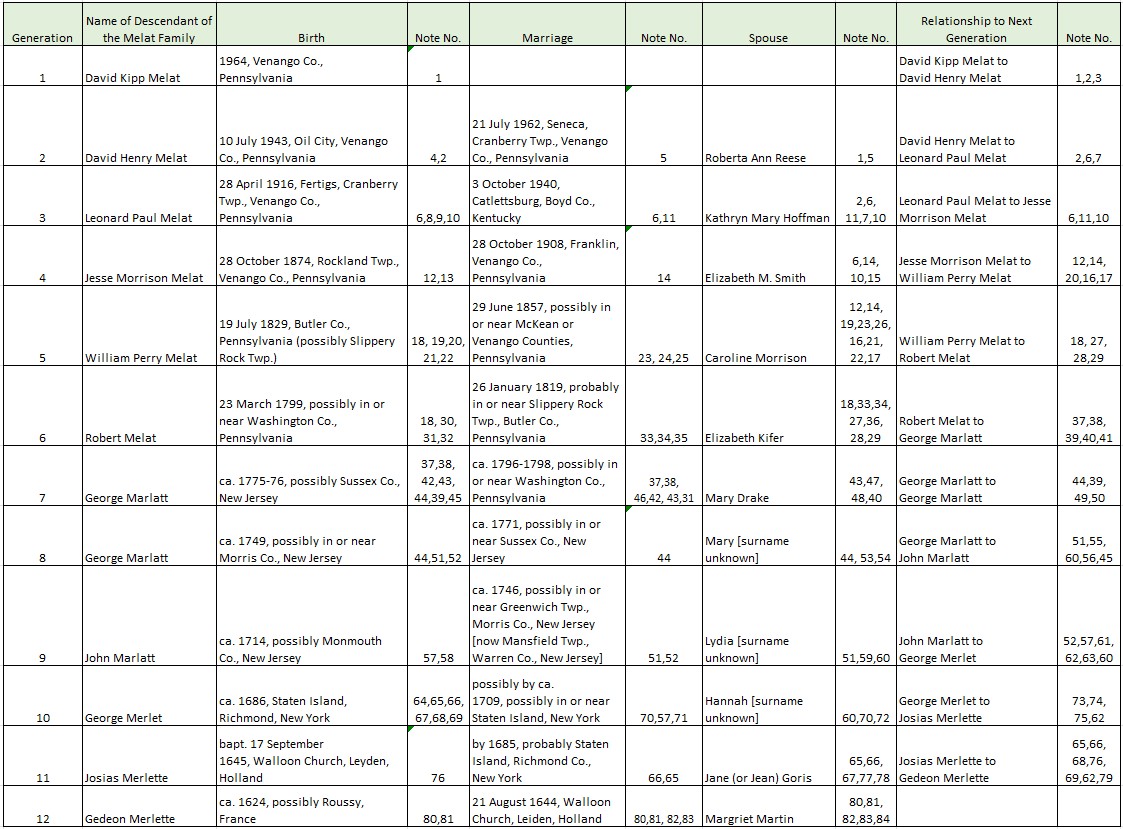
Select the table to open it full size.
6
Supporting Notes
Jump to a Supporting Note:
Supporting Note 1
Pennsylvania birth certificate, David Kipp Melat, 1964; privately held by D. Kipp Melat.
[Summary: David Kipp Melat was born in Venango County, Pennsylvania in 1964, son of David H. Melat and Roberta A. Reese.]
Supporting Note 2
Ancestry.com, “U.S., Obituary Collection, 1930–Current,” database (https://www.ancestry.com/…; Full URL : accessed 9 February 2020), entry for David H. Melat; citing Titusville Herald (Titusville, Pennsylvania), 8 March 2005, obituary of David H. Melat.
[Summary: David H. Melat, born 10 July 1943, Oil City, Pennsylvania, son of Leonard P. and Kathryn (Hoffman) Melat; died 5 March 2005, Titusville, Pennsylvania; survived by son D. Kipp Melat of Fairfax, Virginia.]
Supporting Note 3
[Analysis: This analysis provides genetic and genealogical evidence supporting the conclusion that Kipp Melat and his AncestryDNA match, Match A, are half-brothers who share the same father, David Henry Melat, b. 1943 (Supporting Note 85). AncestryDNA reports that Kipp Melat and Match A share 1,846 cM across 34 segments. The Shared cM Project (Supporting Note 86) identifies six possible relationship categories consistent with this amount of shared DNA.
The family tree provided by Match A indicates that a private male was the son of David Melat. The person at the base of the tree appears to be Match A, although this cannot be established with certainty from the information displayed. If Match A is one generation younger than David Melat, presumed to be David Henry Melat, b. 1943, the grandparent/grandchild and aunt/uncle–niece/nephew relationships become inconsistent with the apparent generational structure of the tree.
Kipp Melat was born in 1964 and is therefore about 62 years old. Although it is chronologically possible for Kipp to have an adult grandchild, the available information provides no indication that Match A is his grandson. Accordingly, a grandparent/grandchild relationship appears unlikely.
In comparing Kipp and Match A with their close shared matches, Kipp and Match A share very similar amounts of DNA with many of the same individuals. This pattern tends to indicate that Kipp and Match A occupy the same generation within the family, further reducing the likelihood of a niece/nephew or grandparent/grandchild relationship between them (Supporting Note 87).
An examination of their shared matches provides additional evidence. Essentially all of the identifiable shared matches are associated with Kipp's paternal family. This pattern indicates that the relationship between Kipp and Match A is through Kipp's paternal line. Among the relationship possibilities consistent with 1,846 cM, the half-sibling relationship best fits the combined genetic evidence, shared-match pattern, apparent generational placement, and family-tree evidence.
If Kipp and Match A are half-brothers and their common parent is on Kipp's paternal side, their shared parent would be Kipp's father, David Henry Melat, b. 1943. The identification of David Melat as the father of the private male in Match A's tree provides independent genealogical evidence consistent with this conclusion. Taken together, the evidence strongly supports the conclusion that Kipp Melat and Match A are paternal half-brothers and that David Henry Melat, b. 1943, was their common father.]
Supporting Note 4
Ancestry.com, “U.S., Social Security Applications and Claims Index, 1936–2007,” database (https://www.ancestry.com/…; Full URL : accessed 9 February 2020), entry for David Henry Melat.
[Summary: David Henry Melat, born 10 July 1943, Oil City, Pennsylvania; died 5 March 2005.]
Supporting Note 5
“Reese, Melat Nuptials Performed in Seneca,” The Derrick (Oil City, Pennsylvania), 25 July 1962, p. 7; digital image, Newspapers.com (https://www.newspapers.com/…; Full URL : accessed 9 February 2020).
[Summary: Roberta Ann Reese and David H. Melat married Saturday, 21 July 1962, in Seneca, Cranberry Township, Venango County, Pennsylvania.]
Supporting Note 6
“Leonard Paul Melat,” obituary, Warren Times-Mirror and Observer (Warren, Pennsylvania), 15 February 1971, p. 2; digital image, Newspapers.com (https://www.newspapers.com/image/56125400/ : accessed 8 August 2026).
[Summary: Leonard Paul Melat, 54, of Riverside Dr., R. D., Oil City, Pa., was pronounced dead, Feb. 14, 1971 by Venango County coroner James K. Haslet.
He was born April 28, 1916 at Fertigs, Pennsylvania, a son of Jesse M. and Elizabeth Smith Melat. On Oct. 3, 1940, he married the former Miss Kathryn Hoffman, who survives. He lived in the Oil City area all his life.
Also surviving are two sons, David of Seneca, Pennsylvania, and Dennis, at home; one daughter, Mrs. Ronald (Beverly) Sisson of Warren; two sisters, Mrs. Florence Teitsworth of Warren, Ohio, and Mrs. Helen Steffee of Philadelphia, Pennsylvania and six grandchildren.
Burial will be in Grove Hill Cemetery, Oil City.]
Supporting Note 7
[Analysis: This analysis provides support for the conclusion that Leonard Paul Melat, b. 1916 was the father of David Henry Melat, b. 1943.
In reviewing ThruLines for Kipp Melat, no matches were found with documented lineages extending back to Leonard Paul Melat, b. 1916 (Supporting Note 85). Such matches can be particularly useful because they identify a common ancestor from whom both Kipp and the DNA match may have inherited DNA. When supported by well-documented lineages, these matches can help support connections between proven generations and earlier, unproven ancestors (Supporting Note 87).
When suitable DNA matches cannot be identified through the ancestor of interest, an alternative approach is to examine DNA matches descending from ancestors of that person's spouse. These matches can provide genetic evidence supporting the lineage through the spouse, while documentary evidence can then be used to establish the relationship between the spouse and the ancestor of interest.
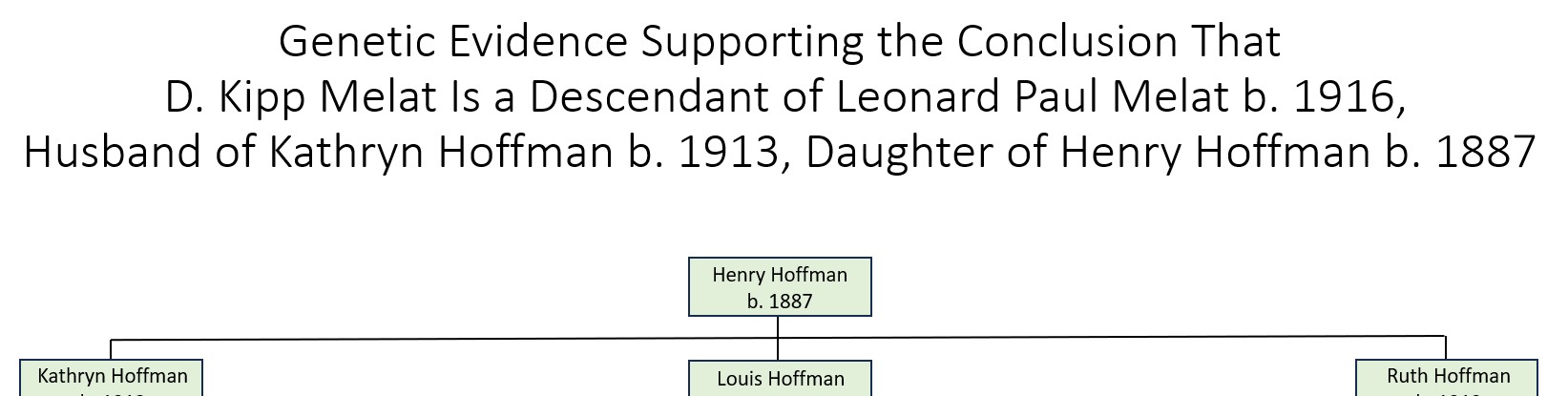
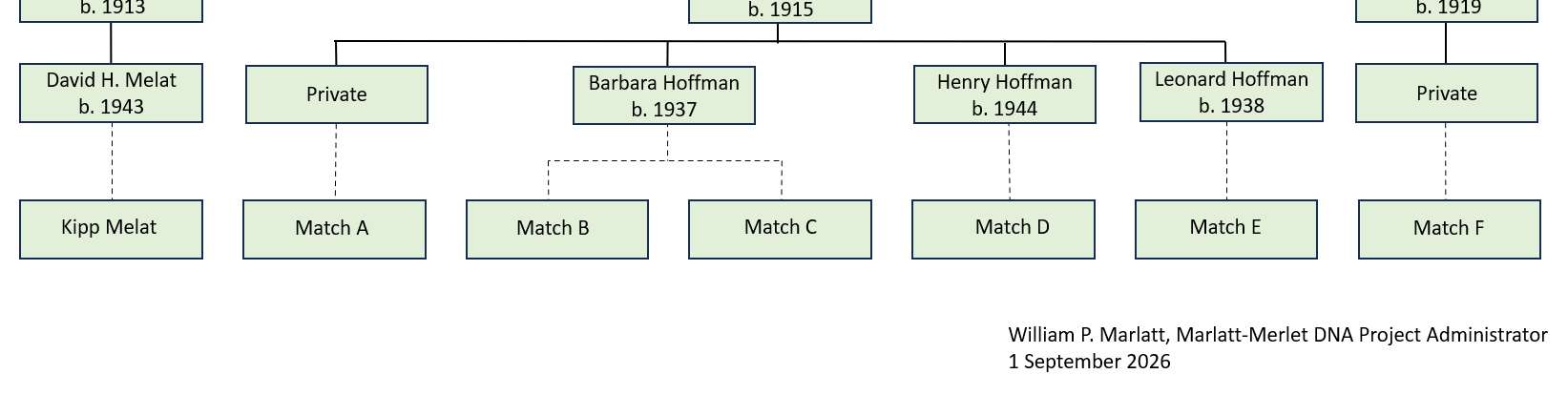
ThruLines charts for Kipp Melat identify several strong DNA matches whose lineages extend back to Henry M. Hoffman, b. 1887 (Supporting Note 85). Henry was the father of Kathryn Mary Hoffman, b. 1913, who married Leonard Paul Melat, b. 1916. The pattern of these matches is consistent with Kipp having inherited DNA through the lineage Henry M. Hoffman → Kathryn Mary Hoffman → David Henry Melat → Kipp Melat. Thus, although these matches do not provide genetic evidence that Leonard Paul Melat was David's father, they provide genetic evidence supporting Kipp's descent through Kathryn Mary Hoffman.
Documentary evidence provides the connection between this genetically supported maternal lineage and Leonard Paul Melat. The obituary for Leonard Paul Melat (Supporting Note 6) provides evidence that he married Miss Kathryn Hoffman in 1940 and that David was one of their children.
Taken together, the DNA and documentary evidence support the conclusion that Leonard Paul Melat, b. 1916 was the father of David Henry Melat, b. 1943. The DNA matches through Henry M. Hoffman, b. 1887 support Kipp's descent through Kathryn Mary Hoffman, b. 1913, while Leonard's obituary identifies Kathryn as his wife and David as one of their children. The correlation of these independent lines of evidence provides strong support for the parent-child relationship between Leonard Paul Melat, b. 1916 and David Henry Melat, b. 1943.]
Supporting Note 8
Ancestry.com, “U.S., World War II Draft Cards Young Men, 1940–1947,” database with images (https://www.ancestry.com/…; Full URL : accessed 10 February 2020), draft registration card for Leonard Paul Melat.
[Summary: Leonard Paul Melat, born 28 April 1916; mailing address/post office, Van, Pennsylvania.]
Supporting Note 9
Ancestry.com, “U.S., Social Security Applications and Claims Index, 1936–2007,” database (https://www.ancestry.com/…; Full URL : accessed 9 February 2020), entry for Leonard Paul Melat.
[Summary: Leonard Paul Melat, born 28 April 1916; died February 1971.]
Supporting Note 10
Pennsylvania Department of Health, death certificate no. 15897-71 (1971), Leonard Paul Melat; digital image, Ancestry.com, “Pennsylvania, U.S., Death Certificates, 1906–1972” (https://www.ancestry.com/…; Full URL : accessed 20 August 2026); citing Pennsylvania (State), Death Certificates, 1906–1972, series 11.90, box 11, Record Group 11, Pennsylvania Historical and Museum Commission, Harrisburg.
[Summary: Leonard Paul Melat, born 28 April 1916, Pennsylvania; died 14 February 1971, Harmony Township, Forest County, Pennsylvania; father, Jesse M. Melat; mother, Elizabeth Smith; spouse, Kathryn H. Melat.]
Supporting Note 11
Marriage announcement of Kathryn Hoffman and Leonard Melat, The News-Herald (Franklin, Pennsylvania), 8 October 1940, p. 11; digital image, Newspapers.com (https://www.newspapers.com/…; Full URL : accessed 25 October 2026).
[Summary: Kathryn Hoffman and Leonard Melat, son of Mr. and Mrs. J. Melat, married 3 October 1940 in Catlettsburg, Kentucky.]
Supporting Note 12
Pennsylvania Department of Health, Certificate of Death no. 92004, Jesse Morrison Melat, 25 September 1967; “Pennsylvania, Death Certificates, 1906–1967,” database with images, Ancestry.com (https://www.ancestry.com/…; Full URL : accessed 9 February 2020).
[Summary: Jesse Morrison Melat, born 28 October 1874, Rockland Township, Venango County, Pennsylvania; died 25 September 1967, Fertigs, Cranberry Township, Venango County, Pennsylvania; father, William P. Melat; mother, Caroline Morrison.]
Supporting Note 13
Ancestry.com, “U.S., World War I Draft Registration Cards, 1917–1918,” database (https://www.ancestry.com/…; Full URL : accessed 9 February 2020), entry for Jesse Morrison Melat.
[Summary: Jesse Morrison Melat was born 28 October 1874.]
Supporting Note 14
Ancestry.com, “Pennsylvania, Marriages, 1852–1968,” database with images (https://www.ancestry.com/…; Full URL : accessed 9 February 2020), marriage certificate for Jesse M. Melat and Elizabeth Smith.
[Summary: Jesse M. Melat and Elizabeth Smith married 28 October 1908 in Franklin, Venango County, Pennsylvania; Jesse was identified as a son of William and Caroline Melat.]
Supporting Note 15
The News-Herald (Franklin, Pennsylvania), 29 September 1967, p. 11, “Jesse M. Melat”; digital image, Newspapers.com, (https://www.newspapers.com/image/98117351/ : accessed 23 September 2026).
[Summary: Funeral services for Jesse M. Melat, age 92, of Fertigs, Pennsylvania, were held on Thursday, 28 September 1967, at the Osenider Funeral Home in Oil City. Jesse, the widower of Elizabeth Smith Melat, died Monday, 25 September 1967, at his home. Burial was in the Melat Cemetery at Rockland. Pallbearers included David and Dennis Melat, Robert and Edward Steffee, Ronald Sisson, and Dr. John Ziegler.]
Supporting Note 16
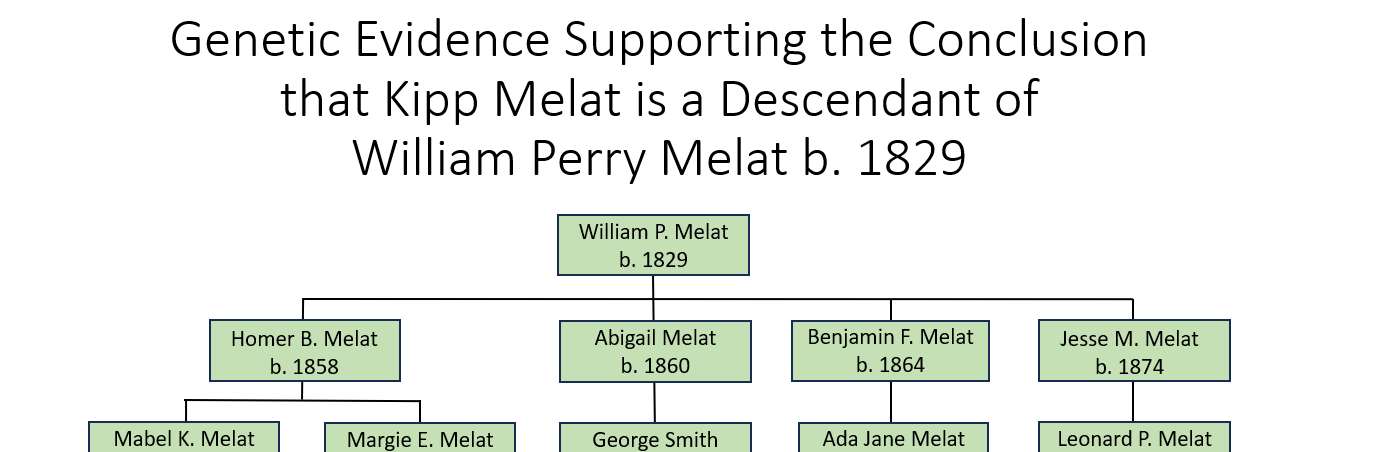
[Analysis: This analysis provides genetic evidence supporting the conclusion that D. Kipp Melat is a descendant of William Perry Melat, b. 1829. The 1860 and 1870 federal censuses for Venango County, Pennsylvania (Supporting Notes 21 and 22), were used to identify the apparent children of W. P. (William Perry) Melat, b. 1829 and Caroline (Morrison) Melat, b. ca. 1836. In addition, the will of William P. Melat also identifies his heirs (Supporting Note 17). The children identified were Homer B. Melat, b. ca. 1858, Abba (Abigail) Amanda Melat, b. ca. 1860, Flora Melat, b. ca. 1862, Frank (Benjamin Franklin) Melat, b. ca. 1864–1865, and Caroline Melat, b. 1869. In addition, a marriage record for Jesse M. Melat and Elizabeth Smith (Supporting Note 14) identifies Jesse as the son of William and Caroline Melat.
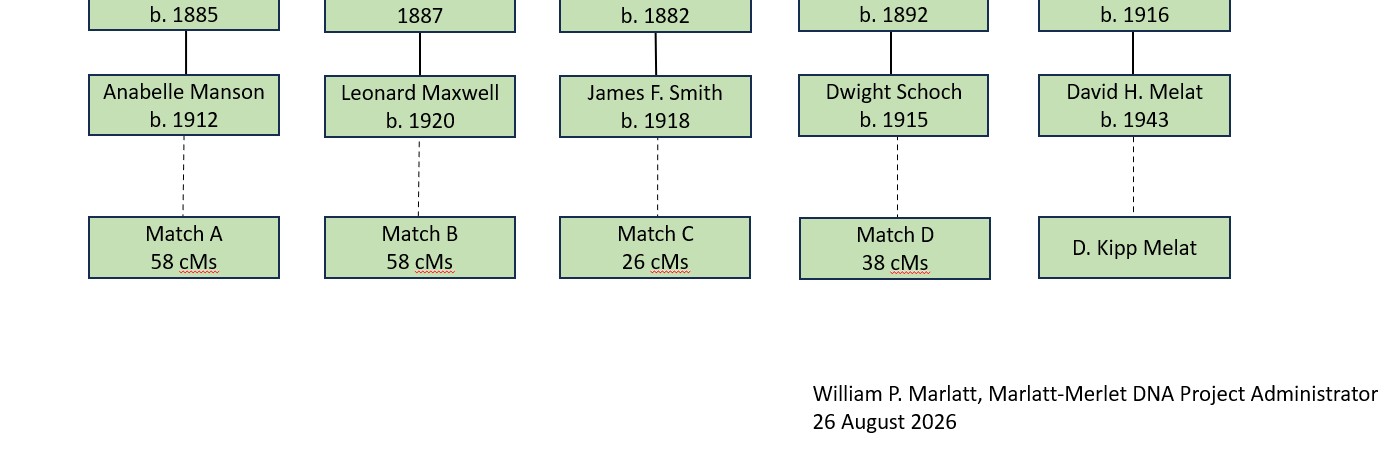
Ancestry ThruLines for Kipp Melat indicate that numerous DNA matches have lineages extending back to William Perry Melat, b. 1829 and Caroline (Morrison) Melat (Supporting Note 85). The figure below shows several of these matches with the larger centiMorgan values who descend through Homer B. Melat, b. 1858, Abigail Melat, b. 1860, Benjamin Franklin Melat, b. 1864, and Jesse M. Melat, b. 1874. These lines of descent are consistent with the children of William and Caroline identified through the census and marriage records.
For Kipp and these individuals to be genetic matches through this family, they must have inherited portions of DNA from a common ancestor or ancestral couple (Supporting Note 87). In Kipp's documented lineage, the line of descent is William Perry Melat, b. 1829 and Caroline (Morrison) Melat → Jesse M. Melat, b. 1874 → Leonard P. Melat, b. 1916 → David H. Melat, b. 1943 → D. Kipp Melat. The presence of DNA matches descending through several other children of William and Caroline provides independent genetic evidence consistent with Kipp's descent from this ancestral couple.
Kipp and Matches A and B are third cousins; each shares 58 cM with Kipp (Supporting Note 85). According to the Shared cM Project (Supporting Note 86), third cousins typically share between 0 and 234 cM, with a mean of 73 cM. Kipp and Match C are third cousins once removed, sharing 26 cM (Supporting Note 85). The Shared cM Project indicates that third cousins once removed typically share between 0 and 192 cM, with a mean of 48 cM (Supporting Note 86). Kipp and Match D are third cousins twice removed, sharing 38 cM (Supporting Note 85). Third cousins twice removed generally share between 0 and 166 cM, with a mean of 36 cM (Supporting Note 86). The amounts of DNA shared by these matches are therefore consistent with the expected ranges for the proposed relationships.
Taken together, the documentary and genetic evidence strongly supports the conclusion that D. Kipp Melat descends from William Perry Melat, b. 1829. The identification of DNA matches descending through multiple children of William and his wife, Caroline (Morrison) Melat, together with shared DNA amounts consistent with the proposed relationships, provides additional support for Kipp's documented line of descent through their son Jesse M. Melat, b. 1874.]
Supporting Note 17
Venango County, Pennsylvania, Register of Wills, Will Book 9 (1896–1900), pp. 237–238, will of William P. Melat, 16 April 1898, proved 29 July 1898; digital images, Ancestry.com, “Pennsylvania, U.S., Wills and Probate Records, 1683–1993,” images 131–132 of 267; (https://www.ancestry.com/…; Full URL : accessed 23 September 2026).
[Summary: William P. Melat of Rockland Township, Venango County, Pennsylvania, executed his will on 16 April 1898. He identified his wife as Caroline M. Melat and named six children: Homer B. Melat, Abba A. Smith, B. Franklin Melat, Caroline L. Melat, Jesse M. Melat, and Bessie M. Melat. He also named four grandchildren: Edna M. Carner, Grace M. Carner, Andrews E. Carner, and Alida T. Carner. William bequeathed one dollar to each of the named children and grandchildren and gave the residue of his estate to his wife, Caroline, for her lifetime. At Caroline's death, the unexpended remainder was to be divided into seven equal shares, one share to each of his six children, or their heirs, and the seventh share to be divided equally among the four named grandchildren or their survivors. William appointed his wife, Caroline M. Melat, executrix. The will was proved and admitted to probate on 29 July 1898.]
Supporting Note 18
D. Kipp Melat, e-mail to William P. Marlatt, “Re: Update of Source Citation 58 Regarding the Bible Transcript,” 21 August 2026; transmitting a verbatim transcript of a photocopy of the Birth page from the Robert Melat family Bible, formerly held by Ellsworth Melat (d. 2012); transcript and photocopy privately held by D. Kipp Melat; e-mail privately held by William P. Marlatt.
[Extract: “Robert Melat Sr. was Born March 23rd 1799 Elizabeth Melat was Born April 17th 1801 Enoch W. Melat was Born May 14th 1820 R. Melat Jr. Born July 21st 1823 Elizabeth Melat Born february 26 1825 John R. Melat Born Apr 21st 1827 W. P. Melat Born Jul 19th 1829 Maryann Born february 24th 1832 Susanna Born May the 21st 1834 Sara Born Sept 6th 1836 Jackson H. Melat Born March 21st 1839 Aaron Melat Born August 31 1849 C.A. Melat Born May 26th 1851 Joseph M. Melat Born April 5th 1855 J.M. died July 22 1863, age 8 years, 3 months, 17 days”]
[Commentary: The Birth page does not mention Robert Melat’s second wife, Charlotte Collingwood. Susan Brandon identified Charlotte Collingwood as Robert Melat’s second wife and stated that Robert and Charlotte had two children, Aaron and Charles (Supporting Note 28). D. Kipp Melat’s compiled family history identifies Elizabeth Kiffer as the mother of the first nine children listed on the Bible page and Charlotte Collingwood as the mother of the three youngest children—Aaron, Charles Alford, and Joseph M. Melat (Supporting Note 29).]
Supporting Note 19
“William Perry Melat,” memorial 95104645, Find a Grave, database with images (https://www.findagrave.com/memorial/95104645/ : accessed 9 February 2020), memorial for William Perry Melat, Melat Cemetery, Rockland Township, Venango County, Pennsylvania; memorial maintained by Allan L. Winger.
[Photo: Gravestone for William P. Melat and Caroline M. Melat; William P. Melat, born 19 July 1829, died 25 July 1898; Caroline M. Melat, born 12 January 1837, died 29 January 1916.]
Supporting Note 20
“Melat,” obituary for William P. Melat, Citizen-Press (Franklin, Pennsylvania), 28 July 1898, p. 4, col. 3; Pennsylvania Room, Franklin Library, Franklin, Pennsylvania; digital image transmitted by D. Kipp Melat to William P. Marlatt by e-mail, 31 October 2026; privately held by William P. Marlatt.
[Summary: William P. Melat died on 25 July 1898 at his residence at Smith's Corners, Rockland Township, Venango County, Pennsylvania, following an illness attributed to Bright's disease. The obituary states that he was born in Butler County, Pennsylvania, on 19 September 1829, and moved to Venango County at an early age. He was described as a highly respected longtime resident of the community. Surviving were his wife and six children: H. B. Melat, B. Frank Melat, Jesse M. Melat, Mrs. M. B. Smith, Carrie, and Bessie. His funeral was held on Tuesday, and he was buried in Melat Cemetery, Rockland Township.]
[Analysis: The obituary identifies Butler County, Pennsylvania, as William P. Melat's birthplace but does not specify Lucerne Furnace or Slippery Rock Township. In correspondence dated 31 October 2026, D. Kipp Melat stated that the identification of Lucerne Furnace as William's birthplace came from a letter written by William's son Homer, which is currently unavailable for examination. Kipp also noted that census and tax records place the family in Slippery Rock Township during the relevant period, making that township a plausible birthplace, although the obituary itself does not establish this location.
The obituary reports William's birth date as 19 September 1829, conflicting with the birth date of 19 July 1829 recorded in the Robert Melat family Bible and on William's gravestone (Supporting Notes 18 and 19). The obituary also states that William was in his seventieth year when he died on 25 July 1898. A birth date of 19 July 1829 would place him in his seventieth year, whereas a birth date of 19 September 1829 would place him in his sixty-ninth year. This age statement therefore favors the July birth date, although the discrepancy remains unresolved.]
Supporting Note 21
1860 U.S. census, Venango County, Pennsylvania, population schedule, Rockland Township, p. 109 (stamped p. 532), dwelling 701, family 701, Wm Melat household; digital image, Ancestry.com, “1860 United States Federal Census”, (https://www.ancestry.com/…; Full URL : accessed 20 September 2026); citing NARA microfilm publication M653, roll 1189.
[Summary: Wm Melat, age 31, farmer, born in Pennsylvania, was enumerated in Rockland Township, Venango County, Pennsylvania, with Caroline Melat, age 24; Homer B. Melat, age 2; and Amanda Melat, age six months. Wm reported real property valued at $600 and personal property valued at $150.]
[Analysis: Caroline is inferred to have been William's wife, and Homer B. and Amanda are inferred to have been their children. Wm Melat's reported age of thirty-one indicates an approximate birth year of 1828–1829 and is consistent with other evidence identifying him as William Perry Melat, b. 19 July 1829.]
Supporting Note 22
1870 U.S. census, Venango County, Pennsylvania, population schedule, Rockland Township, p. 37 (stamped p. 530A), dwelling 250, W. P. Melat household; digital image, Ancestry.com, “1870 United States Federal Census,” (https://www.ancestry.com/…; Full URL : accessed 20 September 2026); citing NARA microfilm publication M593, roll 1460.
[Summary: W. P. Melat, age 41 (b. ca. 1829), farmer, born in Pennsylvania, was enumerated in Rockland Township, Venango County, Pennsylvania, with Caroline Melat, age 32 (inferred wife); Hiomer [sic] B. Melat, age 12; Abba Melat, age 10; Flora Melat, age 8; Frank Melat, age 5; and Caroline Melat, age 1. W. P. Melat reported real property valued at $3,050 and personal property valued at $1,044 and was identified as a male U.S. citizen age twenty-one or older.]
Supporting Note 23
Caroline Melat family Bible; privately held by D. Kipp Melat.
[Extract: Inscription inside cover: “Married 29 June 1857.”]
Supporting Note 24
1850 U.S. census, McKean County, Pennsylvania, population schedule, Hamilton Township, dwelling 312, family 312, Zepheniah Morrison household, Caroline Morrison, line 36; database with images, Ancestry.com, “1850 United States Federal Census” (https://www.ancestry.com/…; Full URL : accessed 3 November 2026); citing NARA microfilm publication M432.
[Summary: Zepheniah Morrison, age 35, was enumerated in Hamilton Township, McKean County, Pennsylvania, with Hannah Morrison, age 26; Caroline Morrison, age 13; Cynthia Morrison, age 9; Amanda Morrison, age 7; Abigail Morrison, age 4; and Virginia Morrison, an infant. All were reported as born in Pennsylvania. Caroline was recorded as having attended school within the preceding year.]
[Analysis: This census places Caroline Morrison, b. 1837, in the household of Zephaniah Morrison in Hamilton Township, McKean County, Pennsylvania, in 1850. Caroline's death certificate identifies Zephaniah Morrison as her father (Supporting Note 26), corroborating the relationship inferred from the household composition.
Caroline subsequently married William Perry Melat on 29 June 1857 (Supporting Note 23). The 1850 census establishes that Caroline was living in Hamilton Township approximately seven years before the marriage. According to D. Kipp Melat's Speaking of Family website (Supporting Note 29), Zephaniah Morrison was also enumerated in Hamilton Township in the 1860 federal census, indicating that his household remained associated with the township after Caroline's marriage.
These records raise the possibility that William Perry Melat and Caroline Morrison married in or near Hamilton Township, McKean County, Pennsylvania, as an alternative to Rockland Township, Venango County, Pennsylvania, where William was associated with property in 1857 and where their eldest son, Homer B. Melat, was born in 1858. However, Caroline’s residence immediately before her marriage has not been established, and neither location can presently be identified as the actual place of marriage.]
Supporting Note 25
“Homer B. Melat Surveyor, Dies,” The News-Herald (Franklin, Pennsylvania), 13 August 1942; digital image, Newspapers.com (https://www.newspapers.com/…; Full URL : accessed 3 November 2026).
[Summary: Homer B. Melat, age 84, a former Venango County surveyor, died at his home in Rockland Township, Venango County, Pennsylvania, at 10 a.m. on 13 August 1942, following an extended illness. He was born in Rockland Township on 27 May 1858, the eldest son of William P. Melat and Caroline Morrison Melat. He resided in Rockland Township throughout his life except for approximately two years during his boyhood when he lived in Ohio.
Homer worked in the timber and petroleum industries before becoming a surveyor. He served as Venango County surveyor for five consecutive terms beginning in 1909, covering approximately twenty years, and was a member of the Pennsylvania Society of Civil Engineers.
He was survived by his wife, Hulda Mary Brown Melat; eight children, Mrs. Mabel Manson, Mrs. Margie Maxwell, Mrs. Frances Walker, Mrs. Josephine Blaine, Boyd E. Melat, Neal B. Melat, Charles A. Melat, and John D. Melat; two brothers, B. F. Melat of Shreveport, Louisiana, and J. M. Melat of Cranberry Township, Pennsylvania; and a sister, Mrs. George Peacock of Leominster, Massachusetts. Fourteen grandchildren and five great-grandchildren also survived. Funeral services were scheduled for the following Sunday, with interment planned in Melat Cemetery.]
[Analysis: The obituary provides evidence identifying Homer B. Melat, b. 27 May 1858, as the eldest son of William Perry Melat and Caroline (Morrison) Melat. This relationship is consistent with the 1860 and 1870 federal census records identifying Homer B. Melat in William Perry Melat's household (Supporting Notes 21 and 22) and William Perry Melat's 1898 will naming Homer B. Melat as one of his children (Supporting Note 17). The obituary also identifies J. M. Melat as Homer's surviving brother, providing additional evidence consistent with the documented family of William Perry and Caroline Melat.
Homer's birth in Rockland Township, Venango County, Pennsylvania, on 27 May 1858, approximately eleven months after the documented marriage of William Perry Melat and Caroline Morrison on 29 June 1857 (Supporting Note 23), provides evidence that the family was probably residing in or near Rockland Township shortly after their marriage. The obituary further states that Homer lived in Rockland Township throughout his life except for approximately two years during his boyhood. The 1860 federal census places William and Caroline Melat, together with Homer and his younger sister Amanda, in Rockland Township (Supporting Note 21). The proximity of Homer's birth to his parents' marriage, together with the family's documented subsequent residence, makes Rockland Township, Venango County, a plausible marriage location. Caroline's residence in Hamilton Township, McKean County, in 1850 (Supporting Note 24) identifies another plausible location. No marriage record establishing the location has been identified.
The obituary reports that Homer died on the day of publication, 13 August 1942, in Rockland Township, Venango County, Pennsylvania.]
Supporting Note 26
Pennsylvania Department of Health, death certificate for Caroline M. Melat, died 29 January 1916; digital image, Ancestry.com, “Pennsylvania, U.S., Death Certificates, 1906–1974,” database with images (https://www.ancestry.com/…; Full URL : accessed 14 November 2026); citing Pennsylvania (State), Death Certificates, 1906–1968, certificate number range 002561–005730, series 11.90, Records of the Pennsylvania Department of Health, Record Group 11, Pennsylvania Historical and Museum Commission, Harrisburg, Pennsylvania.
[Summary: Caroline M. Melat was born 12 January 1837 in Pennsylvania and died 29 January 1916 in Franklin, Pennsylvania; father, Zephaniah Morrison; mother, [given name unknown] Allen.]
Supporting Note 27
[Analysis: This analysis provides genetic evidence supporting the conclusion that D. Kipp Melat is a descendant of Robert Melat, b. 1799.
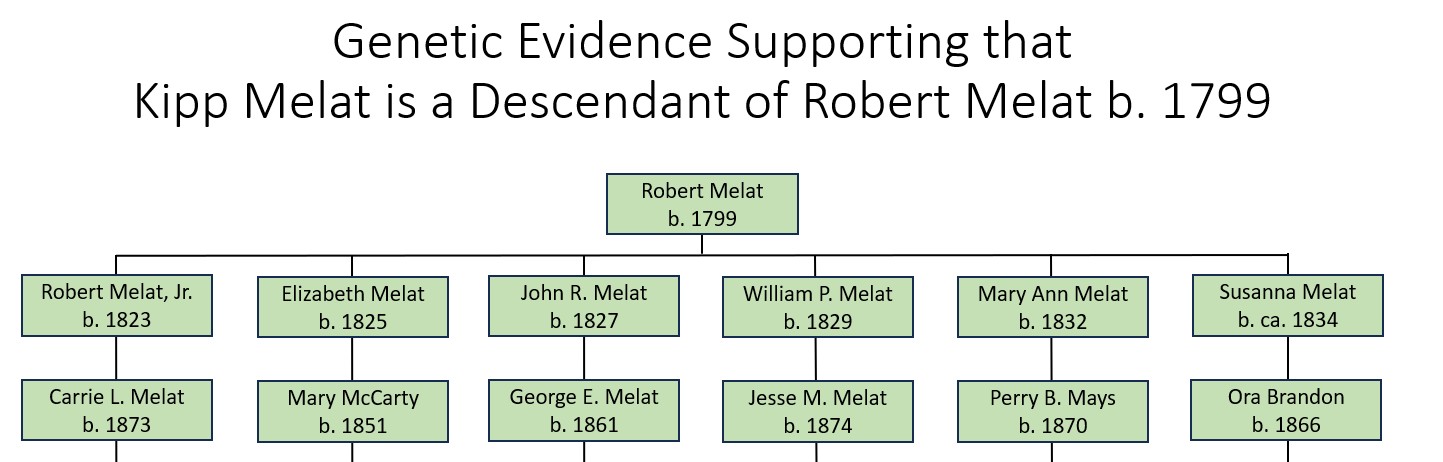
Documentary evidence shows that the children of Robert Melat, b. 1799 and his wife Elizabeth Kifer, b. 1801 were Enoch Melat, b. 14 May 1820, Robert Melat, b. 21 Jul 1823, Elizabeth Melat, b. 26 Feb 1825, John Ralston Melat, b. 21 Apr 1827, William Perry Melat, b. 19 Jul 1829, Mary Ann Melat, b. 24 Feb 1832, Susanna Melat, b. 21 May 1834, Sara Melat, b. 6 September 1836, and Jackson H. Melat, b. 21 Mar 1839 (Supporting Notes 18, 28, and 29). After Robert’s wife Elizabeth died in 1842 (Supporting Note 36), Robert married Charlotte Collingwood, with whom he had Aaron Melat, b. 31 Aug 1849, Charles Alford Melat, b. 26 May 1851, and Joseph M. Melat, b. 5 Apr 1855 (Supporting Notes 18, 28, and 29).
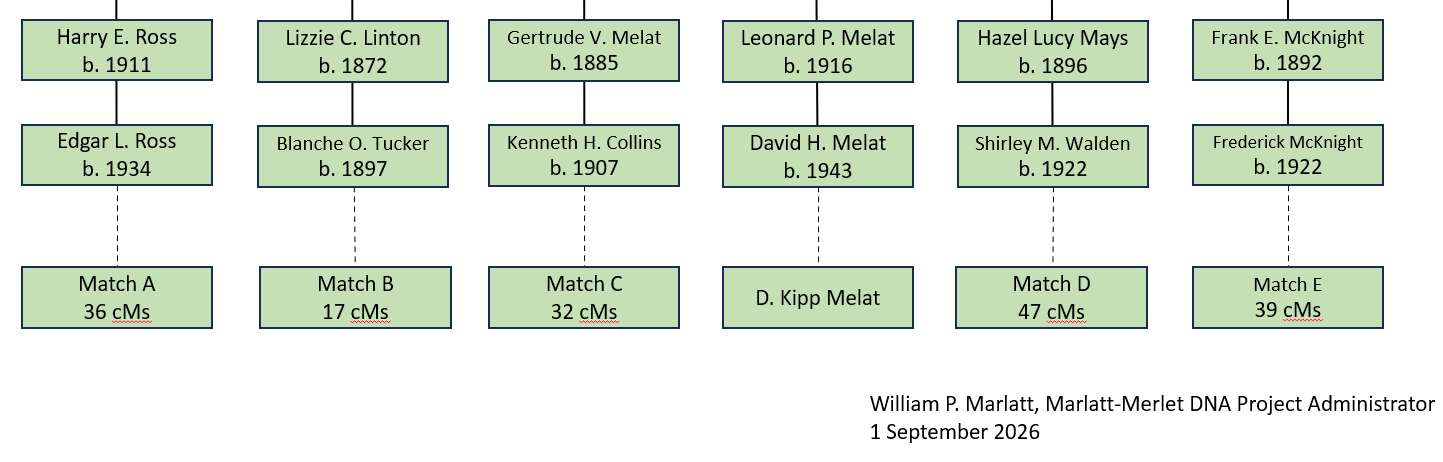
Ancestry ThruLines for Kipp Melat indicate that numerous DNA matches have lineages extending back to Robert Melat, b. 1799 and his wife Elizabeth Kifer, b. 1801 (Supporting Note 85). The figure below shows several of these matches with the larger centiMorgan values who descend through Robert Melat, b. 1823, Elizabeth Melat, b. 1825, John Ralston Melat, b. 1827, William Perry Melat, b. 1829, Mary Ann Melat, b. 1832, and Susanna Melat, b. 1838 (1834, Supporting Note 18). These lines of descent are generally consistent with the children of Robert and Elizabeth Melat identified through the census and Bible records.
For Kipp and these individuals to be genetic matches through this family, they must have inherited portions of DNA from a common ancestor or ancestral couple (Supporting Note 87). In Kipp's documented lineage, his line of descent is Robert Melat, b. 1799 and his wife Elizabeth Kifer, b. 1801 → William Perry Melat, b. 1829 → Jesse M. Melat, b. 1874 → Leonard P. Melat, b. 1916 → David H. Melat, b. 1943 → D. Kipp Melat. The presence of DNA matches descending through several other children of Robert and Elizabeth Melat provides independent genetic evidence supporting Kipp's placement within the Robert Melat family and is consistent with his patrilineal descent from Robert Melat.
Kipp and Match A are fourth cousins, sharing 36 cM (Supporting Note 85). According to the Shared cM Project (Supporting Note 86), fourth cousins typically share between 0 and 139 cM, with a mean of 35 cM. Kipp and Match B are fourth cousins once removed, sharing 17 cM (Supporting Note 85). The Shared cM Project indicates that fourth cousins once removed typically share between 0 and 126 cM, with a mean of 28 cM (Supporting Note 86). Kipp and Match C are fourth cousins once removed and they share 32 cM (Supporting Note 85). Kipp and Match D are fourth cousins and they share 47 cM (Supporting Note 85). Kipp and Match E are fourth cousins and they share 39 cM (Supporting Note 85). The amounts of DNA shared by these matches are consistent with the expected ranges for the proposed relationships.
Taken together, the documentary and genetic evidence strongly supports the conclusion that D. Kipp Melat descends from Robert Melat, b. 1799 and his wife Elizabeth Kifer, b. 1801. The identification of DNA matches descending through multiple children of Robert and his wife, Elizabeth Kifer, together with shared DNA amounts consistent with the proposed relationships, provides additional support for Kipp's documented patrilineal line of descent through their son William Perry Melat, b. 1829.]
[Commentary: ThruLines shows Susanna Melat as born 1838; however, the Melat family Bible records her birth as 21 May 1834 (Supporting Note 18). The Bible record is considered the more credible source for Susanna's birth date and 21 May 1834 is therefore used in this study. Also, during a pension deposition, Susan Brandon, daughter of Robert and Elizabeth Melat, stated that she was age 50 in March 1884, suggesting she was born about 1834 (Supporting Note 28).]
Supporting Note 28
National Archives and Records Administration (NARA), Civil War pension application file 249,214, Robert Melat, deposition of Susan Brandon, 24 March 1884, Cranberry, Venango County, Pennsylvania, before B. F. M. Hurley, Special Examiner of the Pension Office; Washington, D.C.; reproduced at the National Archives; PDF copy supplied by David Kipp Melat to William P. Marlatt, email, 22 September 2026; privately held by William P. Marlatt, Moorpark, California.
[Summary: Susan Brandon stated that she was a daughter of Robert and Elizabeth Melat and identified Elizabeth Melat as her mother. She stated that Elizabeth died about 1841 or 1842 at Slab Furnace, Venango County, Pennsylvania. Susan named her siblings as Robert, Betsy, John, William Perry, Mary Ann, and Jackson, and stated that a family record of the births of the children had existed. She further stated that Robert Melat later had a second wife, whose maiden name was Charlotte Collingwood of Rockland Township, Venango County, Pennsylvania, and that Robert and Charlotte had two children, Aaron and Charles. Susan did not know when Robert and Charlotte married.]
[Commentary: Susan Brandon’s testimony provides direct evidence concerning her own parentage. She identified Robert Melat as her father and Elizabeth Melat as her mother. She also identified Charlotte Collingwood as her stepmother and Robert Melat’s second wife, distinguishing Charlotte from her mother, Elizabeth. This testimony conflicts with Susan Brandon’s 1919 death certificate (Supporting Note 88), which identifies her mother as Mary Collingwood. Susan’s 1884 deposition was given by Susan herself and specifically addressed the identities of her parents and stepmother, whereas the information on her death certificate was supplied by another person after her death. Susan’s testimony therefore provides stronger evidence that Elizabeth Melat was her mother and that Charlotte Collingwood was her stepmother.]
Supporting Note 29
D. Kipp Melat, “Robert Melat,” Speaking of Family: Ancestry of David Kipp Melat and Cherie Lee Phillips, database and family history website, © 2012–2026, updated 18 February 2026 (https://www.speakingoffamily.com/p10.htm : accessed 11 August 2026).
[Summary: Robert Melat married first Elizabeth Kiffer and second Charlotte Collingwood. The family history identifies Elizabeth Kiffer as the mother of Robert’s children Enoch, Robert Jr., Elizabeth, John Ralston, William Perry, Mary Ann, Susanna, Sara, and Jackson H., and identifies Charlotte Collingwood as the mother of Aaron, Charles Alford, and Joseph M. Melat.
According to the Speaking of Family website, Robert Melat was born on 23 March 1799 (Supporting Note 18) and died 11 September 1887 (Supporting Note 89).]
Supporting Note 30
1860 U.S. census, Venango County, Pennsylvania, Rockland Township, p. 109, dwelling 706, family 706, Robert Melat household; digital image, Ancestry.com, “1860 United States Federal Census” (https://www.ancestry.com/…; Full URL : accessed 21 August 2026).
[Summary: Robert (“Robt”) Melat, age 58 (b. ca. 1802), farmer, born Pennsylvania; Charlotte Melat, age 48; Aaron Melat, age 12; Charles Melat, age 9; Joseph M. Melat, age 4; and Jackson Melat, age 21. Robert reported real property valued at $315 and personal property valued at $150. Charlotte is inferred to be Robert’s wife, and Aaron, Charles, Joseph M., and Jackson are inferred to be his children (Supporting Notes 18, 28, and 29).]
[Commentary: The 1850 census identifies an earlier household of Robert Molat in Rockland Township, Venango County, Pennsylvania, including Elizabeth, Jackson, and Hanson Molat (Supporting Note 90). The identities and relationships of these household members require correlation with the Robert Melat family Bible, Susan Brandon’s 1884 deposition, D. Kipp Melat’s compiled family history, and Susan Brandon’s 1919 death certificate (Supporting Notes 18, 28, 29, and 88).]
Supporting Note 31
Pennsylvania, U.S., U.S. Direct Tax Lists, 1798, Greene, Washington, and Allegheny Abstracts, entry for George Melatt of Nottingham Township, Washington County, Pennsylvania, line 89, reporting three dwelling houses valued at $150; digital image, Ancestry.com (https://www.ancestry.com/…; Full URL : accessed 7 August 2026), image 465 of 872; citing United States Direct Tax of 1798: Tax Lists for the State of Pennsylvania, M372, 24 rolls, Records of the Internal Revenue Service, Record Group 58, National Archives, Washington, D.C.
[Analysis: This entry is believed to refer to George Melatt, born ca. 1775–1776, who married Mary Drake. Supporting Note 42 establishes that a George Millatt acquired land in Washington County, Pennsylvania, in 1797, placing a man of that name in the county one year before this tax record. Jacob Drake appears on line 45 of the same 1798 tax list and may have been George Melatt’s father-in-law.
If this George Melatt was the man who married Mary Drake and had a son Robert Melat, born 1799, the geographic and chronological evidence suggests that Robert may have been born in or near Washington County, where George was living in 1798.]
Supporting Note 32
“Robert Melat,” memorial no. 13152697, Find a Grave, database with images, (https://www.findagrave.com/memorial/13152697/robert-melat : accessed 22 September 2026); citing Melat Cemetery, Rockland, Venango County, Pennsylvania; memorial maintained by Brian Ensley, contributor no. 47190867; gravestone photograph added by Ginger & Steve Bollinger.
[Summary: The memorial identifies Robert Melat as born 23 March 1799 and died 11 September 1883, aged 84, in Rockland Township, Venango County, Pennsylvania, and as buried in Melat Cemetery, Rockland, Venango County. A photograph of the gravestone shows the inscription “Robert Melat 1799–1883”. The death year of 1883 inscribed on Robert Melat's gravestone conflicts with the reported publication of his obituary in 1887 (Supporting Note 89).]
Supporting Note 33
National Archives and Records Administration, Civil War pension application file 249,214, Robert Melat; affidavit of Robert Melat, 21 April 1881; Washington, D.C.; copy privately held by D. Kipp Melat.
[Summary: Robert Melat stated that he and Elisabeth Kiffer married 26 January 1819.]
Supporting Note 34
“Kifer-Beighle Family Record,” family record dictated by Catherine Kifer Beighle (1810– 1892) to her daughter Melissa Adaline (Beighle) Gardner; copy privately held by D. Kipp Melat.
[Summary: Elizabeth Kiffer married Robert Molat in 1819.]
Supporting Note 35
1820 U.S. census, Butler County, Pennsylvania, Slippery Rock Township, p. 149, Robert Mullaate household; NARA microfilm publication M33, roll 98; digital image, Ancestry.com, “1820 United States Federal Census” (https://www.ancestry.com/…; Full URL : accessed 21 August 2026), image 165.
[Summary: Robert Mullaate was enumerated as a male age 26–44 (b. ca. 1776–1794) in Slippery Rock Township, Butler County, Pennsylvania. Frederic Kiefer was enumerated nearby.]
[Analysis: This Robert Mullaate is believed to have been Robert Melat, who married Elizabeth Kifer on 26 January 1819 (Supporting Note 33). The presence of Frederic Kiefer nearby strengthens the possibility that the entry refers to the same Robert Melat, particularly given the Kifer surname of Robert’s wife. If Robert Mullaate was Robert Melat, his apparent residence in Slippery Rock Township in 1820, approximately one year after his marriage to Elizabeth Kifer, raises the possibility that they were married in or near Slippery Rock Township, Butler County, Pennsylvania. The census does not, however, establish either Robert Mullaate’s identity as Robert Melat or the place of the couple’s marriage.
The census places the oldest male in the 26–44 age category, whereas Robert Melat, b. 23 March 1799, would have been age 21 in 1820. This discrepancy raises uncertainty about whether Robert Mullaate and Robert Melat were the same individual. It is possible that the census taker mistakenly placed the tally mark in the 26–44 age category rather than the 16– 25 age category.]
Supporting Note 36
National Archives and Records Administration (NARA), Civil War pension application file 249,214, Robert Melat, deposition of John M. Allison, 24 March 1884, Cranberry, Venango County, Pennsylvania, before B. F. M. Hurley, Special Examiner of the Pension Office; Washington, D.C.; reproduced at the National Archives; PDF copy supplied by David Kipp Melat to William P. Marlatt, email, 22 September 2026; privately held by William P. Marlatt, Moorpark, California.
[Summary: John M. Allison stated that he had known Robert Melat’s first wife, Elizabeth, and that she was buried on 6 February 1842. Allison explained that he knew the date because he had made her coffin and recorded the charge in his account books, which he had reviewed the night before giving his deposition. He did not know whether Jackson Melat was a son of Robert and Elizabeth Melat.]
Supporting Note 37
[Analysis: No document has been found identifying the father of Robert Melat, born in 1799; however, circumstantial evidence suggests that his father may have been George Marlatt, born about 1775–1776. Supporting Note 38 identifies a George Marlatt enumerated in Nottingham Township, Washington County, Pennsylvania, in the 1800 U.S. census. The oldest male in the household, presumably George, was age 16–25 (b. ca. 1774–1784). The oldest female was also age 16–25 and may have been George’s wife, Mary. The household also included one male age 10–15 and one male under age 10.
The identity of the male age 10–15 is unknown; he may have been a brother of George or Mary, or another relative or household member. The male under age 10 may have been a son of George and Mary and could have been Robert Melat, born in 1799. If so, his presence in the household would be consistent with the proposed relationship between George and Robert.
If the male under age 10 was George and Mary’s first child, and if he was born about 1798– 1800, the couple probably married by that period. Men commonly married in their mid-twenties (Supporting Note 91), making a birth for George in the mid-to-late 1770s plausible. This interpretation is consistent with his placement in the 16–25 age category in 1800 and with an estimated birth of about 1775–1776.
The narrower estimated birth range of about 1775–1776 should be regarded as an inference rather than a fact established by the census. It depends upon several reasonable but unproven assumptions concerning the identities and relationships of the household members, the approximate birth of the youngest male, and George’s probable age at marriage.]
Supporting Note 38
1800 U.S. census, Washington County, Pennsylvania, Nottingham Township, pp. 832–833, George Marlatt household; NARA microfilm publication M32, roll 44; digital image, Ancestry.com, “1800 United States Federal Census” (https://www.ancestry.com/…; Full URL : accessed 21 August 2026), image 82; FHL microfilm 363347.
[Summary: The household of George Marlatt contained one male under age 10, one male age 10–15, one male age 16–25, and one female age 16–25.]
[Analysis: The census identifies George Marlatt as the head of household but does not specify the ages or relationships of individual household members. It is reasonable to infer that George was the male enumerated as age 16–25. If that inference is correct, the census places his birth approximately between 1775 and 1784.
The male under age 10 may have been Robert Melat, b. 1799. Robert fits this age category, and research to date has not identified another Melat/Marlatt household enumerated in Pennsylvania in 1800 containing a male under age 10 who presents a stronger candidate for Robert.
Daniel Marlatt, b. 1772, is an unlikely candidate for Robert’s father. Daniel Malett sold property in Washington County, Pennsylvania, on 18 September 1792, by a deed recorded 24 June 1794 (Supporting Note 92) and had moved to Adams County, Ohio, by ca. 1796–1797 (Supporting Note 93). Because Robert was reportedly born in Pennsylvania in 1799, Daniel’s documented residence in Ohio by 1796 weighs against him being Robert’s father.
Joseph Marlatt also appears to be an unlikely candidate. In the 1810 U.S. census, a Joseph Marlatt was enumerated in Springfield Township, Mercer County, Pennsylvania, p. 934, NARA microfilm publication M252, roll 52, Ancestry image Pam252_52-0082. His household contained four males under age 10, one male age 16–25, and one female age 26– 44. The four younger males are believed to have been Joseph’s sons James, b. 1804; George, b. 1806; Robbins, b. 1808; and Joseph, b. 1810 (Supporting Note 130). No male age 10–15, the category appropriate for Robert Melat, b. 1799, appears in the household. Although the adult male’s reported age is inconsistent with Joseph Marlatt’s estimated birth in 1777, the surrounding documentary evidence supports the identification of this household with Joseph Marlatt, b. ca. 1777.
Another Joseph Marlatt household was enumerated in Hanover Township, Beaver County, Pennsylvania, in 1800 (Supporting Note 94). Based upon the household structure and the presence nearby of Samuel and Thomas Gerard, this man is believed to have been Joseph Marlatt, b. ca. 1752, son of John Marlatt, b. ca. 1714. Joseph reportedly moved his family to Ontario, Canada, about 1802 (Supporting Note 95). If Robert, then about age three, had been Joseph’s son, it would ordinarily be expected that he would have accompanied the family. Robert’s subsequent presence in Pennsylvania therefore weighs against this Joseph being his father, although it does not by itself exclude the possibility.
Taken together, this evidence does not establish that the male under age 10 in George Marlatt’s 1800 household was Robert Melat. It does, however, identify George as a plausible candidate for Robert’s father and, based on the evidence presently identified, a stronger candidate than Daniel or either of the Joseph Marlatt possibilities considered above.]
Supporting Note 39
[Analysis: The following analysis summarizes DNA, documentary, geographic, chronological, and naming-pattern evidence supporting the hypothesis that George Marlatt, b. ca. 1775–1776, was a son of George Marlatt, b. ca. 1749. Unless otherwise noted, the documentary and genealogical facts summarized below are based upon records and analyses cited herein or shared between the authors by email.
D. Kipp Melat’s Big Y-700 test results match with the results of a Big Y-700 test taker with a documented line of descent from George Marlatt, b. ca. 1749 (Supporting Note 62). Both men share the same terminal and ancestral haplogroups, consistent with a recent common paternal ancestor.
D. Kipp Melat’s Y-DNA test results match with the Y-DNA test results of other men who tested at FamilyTreeDNA bearing the surnames Marlatt and Marlett (Supporting Note 41). These matches are consistent with a patriline descending from John Marlatt, b. ca. 1714, through George Marlatt, b. ca. 1749.
Kipp has autosomal DNA matches descending through three proposed children of George Marlatt, b. ca. 1775–1776, and Mary (Drake) Marlatt—Robert, William, and Jacob—with shared DNA amounts consistent with the proposed relationships (Supporting Note 40). These DNA matches provide genetic evidence supporting Robert Melat, b. 1799, as their son and Kipp’s paternal-line descent through Robert from George and Mary.
Kipp’s DNA test proxy has autosomal DNA matches descending through three proposed sons of George Marlatt, b. ca. 1749—Daniel, George, and Joseph—with shared DNA amounts consistent with the proposed relationships (Supporting Note 49). These results provide genetic evidence supporting George Marlatt, b. ca. 1775–1776, as a son of George Marlatt, b. ca. 1749, thereby supporting the extension of Kipp’s paternal lineage back another generation.
Y-DNA STR results for marker DYS570 show that Kipp and test takers descending through two proposed sons of George Marlatt, b. ca. 1749, share a value of 17 (Supporting Note 50). These shared STR values provide additional genetic evidence supporting Kipp’s paternal-line descent through George Marlatt, b. ca. 1775–1776, to George Marlatt, b. ca. 1749.
George Marlatt, b. ca. 1775, is believed to have been born in New Jersey, where George Marlatt, b. ca. 1749, resided (Supporting Notes 44 and 45).
George Marlatt, b. ca. 1775–1776, apparently migrated from New Jersey to Washington and Allegheny Counties, Pennsylvania (Supporting Notes 44, 51, 42, 43, and 38). This migration is consistent with that of other members of the Marlatt family. For example, Joseph Marlatt, born ca. 1752, a son of John Marlatt, b. ca. 1714, was living in Allegheny County, Pennsylvania, by 1800 (Supporting Notes 94 and 96).
John Mallett was recorded as a freeman in Nottingham Township, Washington County, Pennsylvania, in 1793 (Supporting Note 97). George Melatt was recorded in the same township in 1798 (Supporting Note 31). Their geographic proximity and similar surnames suggest a possible family relationship, although no such relationship has been established. John Mallett may have been another son of George Marlatt, b. ca. 1749, but his identity and parentage remain uncertain.
Following the death of John Marlatt, b. ca. 1714, several of his children left Sussex County, New Jersey. Some settled in Upper Canada (Supporting Notes 98, 95, and 99), while John Marlatt, b. ca. 1751, appears to have migrated to North Carolina by 1775 (Supporting Notes 100 and 101). The available evidence also suggests that George Marlatt, b. ca. 1749, and members of his family relocated to Pennsylvania (Supporting Notes 38, 49, 94, and 102).
Jacob Drake, the father of the wife of George Marlatt, b. ca. 1775–1776, reportedly was born in Sussex County, New Jersey (Supporting Note 103), and later died in or near Peters Township, Washington County, Pennsylvania (Supporting Notes 104 and 48). Sussex County was also the residence of George Marlatt, b. ca. 1749 (Supporting Notes 51), and John Marlatt, b. ca. 1714 (Supporting Notes 51, and 52).
The estimated birth year of George Marlatt, b. ca. 1775–1776, falls naturally between those of two other alleged children of George Marlatt, b. ca. 1749: Daniel Marlatt (b. 9 January 1772, Supporting Note 105) and Joseph Marlatt (b. ca. 1777, Supporting Note 144).
The approximately twenty-six-year age difference between George Marlatt, b. ca. 1749, and George Marlatt, b. ca. 1775–1776, is entirely consistent with a father-son relationship.
George Marlatt, b. ca. 1775–1776, bears the same given name and surname as George Marlatt, b. ca. 1749, consistent with a father-son relationship and common naming practices (Supporting Note 107).
No other known son of George Marlatt, b. ca. 1749, was named George, making it reasonable that one son would bear his father's given name.
Several of the alleged children of George Marlatt, b. ca. 1749, were given names that also appear in the families of George Marlatt, b. ca. 1775–1776, and John Marlatt, b. ca. 1714. For example:
- Both George, b. ca. 1749, and John Marlatt, b. ca. 1714, had sons named George Marlatt (Supporting Notes 49 and 51).
- Both George Marlatt, b. ca. 1775–1776, and John Marlatt, b. ca. 1714 (Supporting Notes 47 and 51), had sons named Joseph.
- Both George Marlatt, b. ca. 1775–1776, and John Marlatt, b. ca. 1714, may have had daughters named Ann (Supporting Notes 108 and 51).
- George Marlatt, b. ca. 1775–1776, had a son named Jacob D. Marlatt, who may have been named after his maternal grandfather, Jacob Drake (Supporting Notes 109, 104, and 48).]
Supporting Note 40
[Analysis: This analysis provides documentary and genetic evidence supporting the conclusion that D. Kipp Melat is a descendant of George Marlatt, b. ca. 1775–1776.
Documentary evidence indicates that Robert Melat, b. 1799, a documented ancestor of D. Kipp Melat, was likely a son of George Marlatt, b. ca. 1775–1776 and Mary Drake. The proposed children of George and Mary (Drake) Marlatt are:
- Robert Melat, b. 1799, Pennsylvania (Supporting Notes 18 and 30); d. 11 September 1887, Rockland Township, Venango County, Pennsylvania (Supporting Note 89); bur. Melat Cemetery, Rockland Township, Venango County, Pennsylvania (Supporting Note 32); m. 26 January 1819, probably in or near Slippery Rock Township, Butler County, Pennsylvania (Supporting Notes 33 and 35), Elizabeth Kifer (Supporting Note 33).
- Joseph Marlatt, b. ca. 1800, Pittsburgh, Allegheny County, Pennsylvania (Supporting Notes 47 and 110); d. 12 January 1846; bur. Allegheny Cemetery, Pittsburgh, Allegheny County, Pennsylvania (Supporting Note 110); m. ca. 1825, Jane Harrison (Supporting Notes 47 and 111).
- Ephraim Marlatt (Supporting Note 108).
- William Marlatt, b. 4 October 1808, Pennsylvania (Supporting Notes 112 and 113); d. 19 May 1878, Fairfield Township, Columbiana County, Ohio (Supporting Note 113); bur. East Fairfield Cemetery, East Fairfield, Columbiana County, Ohio (Supporting Note 113); m. 1st, 8 October 1835, Pittsburgh, Allegheny County, Pennsylvania, Barbara E. Wallace (Supporting Note 114); m. 2nd, 4 June 1855, New Orleans, Orleans Parish, Louisiana, Louisa R. Mansker (Supporting Notes 113 and 115).
- Eli Marlatt, b. ca. 1810, Ohio (Supporting Note 116); d. after 1870 (Supporting Note 117); m. ca. 1832, Charlotte (Supporting Note 116).
- Jacob D. Marlatt, b. ca. 1816, Pennsylvania (Supporting Note 118); d. 17 October 1884, Cranberry, Butler County, Pennsylvania (Supporting Note 119); m. ca. 1848, Sarah Jane Emerick (Supporting Note 120).
The birth years of the proposed children are chronologically consistent with the estimated birth year of George Marlatt. In addition, George Millatt purchased land in Washington County, Pennsylvania, by an indenture dated 17 June 1797 (Supporting Note 42). Assuming George was at least twenty-one years old when he entered into this transaction, he would have been born no later than 17 June 1776. Taken together with the other chronological evidence, this supports an estimated birth date of ca. 1775–1776 for George Marlatt.
The documented residences of the proposed family members are geographically consistent with a family group residing and migrating within southwestern Pennsylvania.
- George Melatt was enumerated in the 1798 Tax List in the general area of Greene, Washington, and Allegheny Counties, Pennsylvania (Supporting Note 31).
- The household of George Marlatt was recorded in the 1800 Federal Census in Nottingham, Washington County, Pennsylvania (Supporting Note 38).
- Jacob D. Marlatt was born ca. 1816 in Pennsylvania (Supporting Note 118) and died in Cranberry, Butler County, Pennsylvania (Supporting Note 119).
- The household of Mary Marlett was enumerated in the 1820 Federal Census in Canton Township, Washington County, Pennsylvania (Supporting Note 121).
- Robert Mullaate was enumerated in Slippery Rock Township, Butler County, Pennsylvania. (Supporting Note 35).
- Robert Melat signed a petition from Butler County, Pennsylvania in 1823 (Supporting Note 122).
- The household of Joseph Marlet was enumerated in the 1840 Federal Census in Pittsburgh, Allegheny County, Pennsylvania (Supporting Note 123).
- The household of William Marlatt, b. 1808 was recorded in the 1840 Federal Census in Pittsburgh, Allegheny County, Pennsylvania (Supporting Note 124).
- Joseph Marlatt, b. ca. 1800 was buried in Allegheny Cemetery, Pittsburgh, Allegheny County, Pennsylvania in 1846 (Supporting Note 110).
- The household of Eli Marlatt was recorded in the 1850 Census in Pittsburgh, Allegheny County, Pennsylvania (Supporting Note 116).
- The household of Jane Marlatt, widow of Joseph Marlatt, b. 1800, was recorded in the 1850 Federal Census in Pittsburgh, Allegheny County, Pennsylvania (Supporting Note 125).
- The will of Jane Marlatt, widow of Joseph Marlatt, b. ca.1800 was probated in Pittsburgh, Allegheny County, Pennsylvania in 1875. (Supporting Note 111)
The repeated use of the given names Robert, George, Joseph, William, John and Jacob across successive generations is consistent with the naming patterns observed in the Marlatt family.
Relative to the name Robert:
- The 1793 Militia Census of the State of New Jersey mentions Robt. Malet (Supporting Note 126). Men subject to militia service were generally young or middle-aged adults, placing this Robert Malet in an earlier generation than Robert Melat, b. 1799. The relationship between the two men is unknown, but the similarity of their names suggests that a relationship is possible.
- Robert Melat, b. 1799 had a son named Robert Melat, b. 1823 (Supporting Notes 28 and 18).
Relative to the name George:
- Historical research has documented an increasing tendency for sons to be named after their fathers, regardless of birth order (Supporting Note 107). This practice is consistent with the possibility that George Marlatt, b. ca. 1775–1776, was named after his proposed father, George Marlatt, b. ca. 1749.
- Jacob D. Marlatt’s proposed father was named George, b. ca. 1775–1776 (Supporting Note 43) and his proposed grandfather was George, b. ca. 1749 (Supporting Note 49).
- The brother of Jacob D. Marlatt, b. ca. 1816, Eli Marlatt, b. ca. 1810, had a son named George, b. ca. 1833 (Supporting Note 127).
- Jacob D. Marlatt, b. ca. 1816 had a son named George, b. ca. 1855 (Supporting Note 128).
- Joseph Marlatt b. ca. 1777 had a son named George Oliver Marlatt b. 1806 (Supporting Notes 129 and 130)
Relative to the name Joseph:
- The brother of George Marlatt, b. ca. 1775–1776 was named Joseph Marlatt, b. ca. 1777 (Supporting Notes 49 and 131).
- Jacob D. Marlatt, b. ca. 1816 had a brother named Joseph Marlatt, b. ca. 1800 (Supporting Notes 47 and 43).
- Joseph Marlatt, b. ca. 1777 had a son Joseph, b. 1810 (Supporting Note 130).
- Jacob D. Marlatt, b. ca. 1816 had a son named Joseph, b. ca. 1848. (Supporting Note 118)
- Robert Melat, b. 1799 had a son named Joseph b. 1855 (Supporting Note 18)
- George Oliver Marlatt b. 1806, son of Joseph Marlatt, b. ca. 1777, had a son Joseph b. 1841 (Supporting Note 129)
Relative to the name John:
- Robert Melat, b. 1799 had a son named John Ralston Melat, b. 1827 (Supporting Note 18).
- Joseph Marlatt b. ca. 1777 had a son John b. 1805 (Supporting Note 130)
Relative to the name William:
- There was a Wm. Melat listed in the 1793 Militia Census of the State of New Jersey (Supporting Note 126). His surname was spelled identically to the form commonly used by Robert Melat, b. 1799. This shared spelling makes Wm. Melat potentially relevant to the investigation of the earlier Melat/Marlatt family, although the spelling alone does not establish a relationship.
- Joseph Marlatt, b. ca. 1800 had a son named William Wallace Marlatt, b. ca. 1826 . (Supporting Note 111)
- Robert Melat, b. 1799 had a son named William Perry Melat, b. 1829 (Supporting Notes 27 and 28).
- Eli Marlatt, b. ca. 1810 had a son named William A. Marlatt, b. ca. 1835 (Supporting Note 116).
- Daniel Marlatt, b. 1772 had a grandson named William Clinton Marlatt, b. 1841 (Supporting Notes 132 and 133).
- Joseph Marlatt, b. ca. 1777 had grandsons named William W. Marlatt, b. ca. 1850 (Supporting Notes 129, 130, and 134), William E. Marlatt, b. ca. 1860 (Supporting Notes 130 and 135), and William Curtis Marlatt, b. ca. 1875 (Supporting Notes 130 and 136).
Relative to the name Jacob:
- The father of Mary (Drake) Marlatt was named Jacob Drake (Supporting Note 47).
While naming patterns alone cannot establish parentage, they provide additional evidence supporting the proposed family reconstruction.
Several Ancestry autosomal DNA matches of D. Kipp Melat have lineages extending back to George Marlatt, b. ca. 1775–1776 and his wife Mary (Drake) Marlatt (Supporting Note 85). The figure below shows matches who descend through three proposed children of the couple: Robert Melat, b. 1799, William Marlatt, b. 1808, and Jacob D. Marlatt, b. ca. 1816. These lines of descent are generally consistent with the children of George and Mary (Drake) Marlatt identified through the census, marriage, death, obituary, Bible, Find a Grave, and Geneanet Community Tree records.
For Kipp and these individuals to be genetic matches through this family, they must have inherited portions of DNA from a common ancestor or ancestral couple (Supporting Note 87). In Kipp's proposed line of descent, the lineage is:
George Marlatt, b. ca. 1775–1776 and Mary (Drake) Marlatt → Robert Melat, b. 1799 → William Perry Melat, b. 1829 → Jesse M. Melat, b. 1874 → Leonard P. Melat, b. 1916 → David H. Melat, b. 1943 → D. Kipp Melat.
The presence of DNA matches descending through other proposed children of George and Mary is particularly significant because these collateral lines provide genetic evidence independent of Kipp’s proposed line of descent through Robert Melat, b. 1799. The convergence of matches through several proposed children is consistent with George and Mary being the ancestral couple connecting these branches.
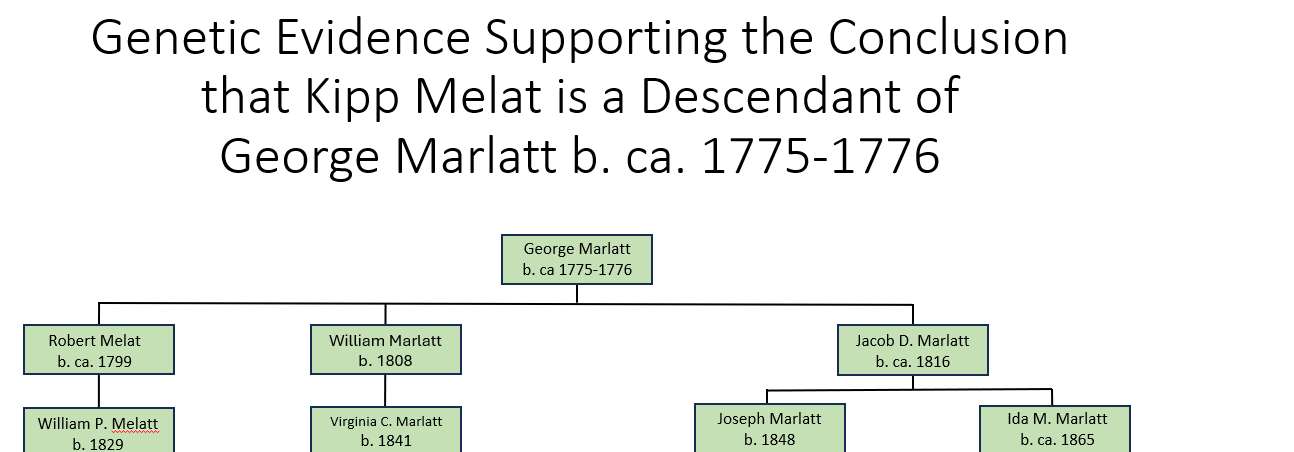
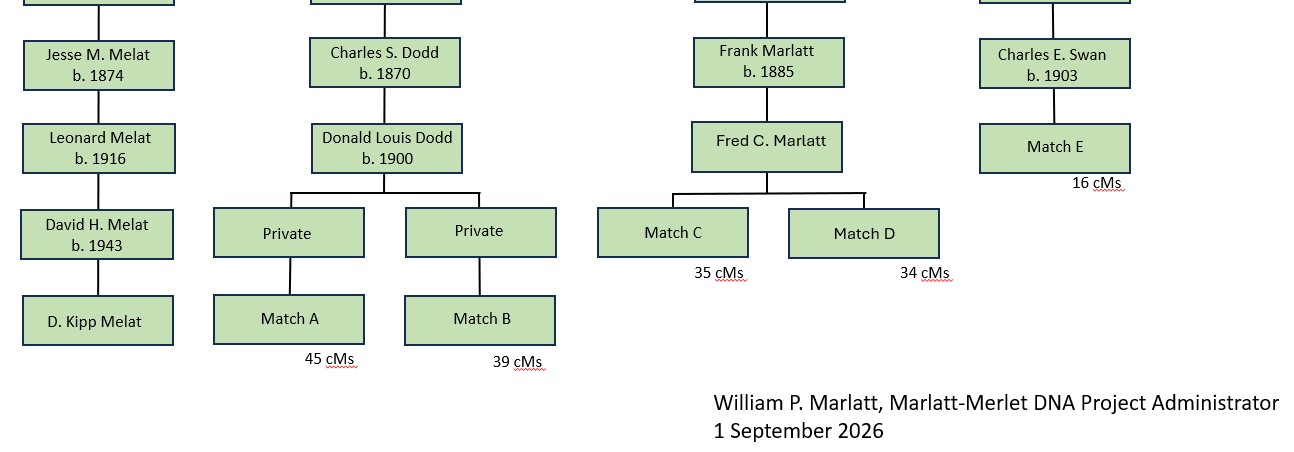
Kipp’s proposed relationships to Match A and Match B are fifth cousins; they share 45 cM and 39 cM, respectively (Supporting Note 85). According to the Shared cM Project (Supporting Note 86), fifth cousins typically share between 0 and 117 cM, with a mean of 25 cM. Kipp’s proposed relationships to Match C and Match D are fourth cousins once removed; they share 35 cM and 34 cM, respectively. According to the Shared cM Project, fourth cousins once removed typically share between 0 and 126 cM, with a mean of 28 cM. Kipp and Match E are proposed third cousins twice removed and share 16 cM. The Shared cM Project indicates that third cousins twice removed typically share between 0 and 166 cM, with a mean of 36 cM. The amounts of DNA shared by these matches are consistent with the expected ranges for the proposed relationships.
The documentary and genetic evidence strongly supports the conclusion that D. Kipp Melat descends from George Marlatt, b. ca. 1775–1776, and his wife Mary (Drake) Marlatt through their proposed son Robert Melat, b. 1799. The chronology and geographic distribution of the proposed family are consistent, and the recurring given names provide additional circumstantial support. More significantly, Kipp has autosomal DNA matches descending through multiple proposed children of George and Mary, and the amounts of shared DNA are consistent with the proposed genealogical relationships. The convergence of documentary evidence and DNA matches through multiple collateral branches provides substantial support for placing Robert Melat, b. 1799, as a son of George Marlatt and Mary Drake and, consequently, for extending D. Kipp Melat’s paternal lineage through this family.]
Supporting Note 41
[Analysis: The purpose of this assessment is to determine whether the surnames of D. Kipp Melat’s Y-DNA matches provide evidence concerning the earlier surname of his direct paternal line. This assessment focused on determining whether Melat was the historical surname of Kipp’s paternal line or whether it evolved from an earlier surname or spelling variant.
Y-DNA is particularly useful for this purpose because the Y chromosome is transmitted from father to son and therefore follows essentially the same inheritance path as surnames traditionally have in many European and American families (Supporting Notes 137 and 138). Examining the surnames of a man's Y-DNA matches can consequently provide clues about the surname of a common paternal ancestor, identify spelling variants that developed in different branches of a family, and sometimes reveal a possible non-paternal event (NPE) or other surname change.
D. Kipp Melat completed the Big Y-700 test at FamilyTreeDNA. FamilyTreeDNA also offers, or historically offered, Y-DNA tests based on smaller sets of STR markers, including the 111-, 67-, 37-, 25-, and 12-marker tests. These different testing levels reflect, in part, the evolution of Y-DNA testing. Earlier tests examined relatively small numbers of STR markers, while later tests incorporated increasing numbers of markers and, ultimately, extensive SNP testing through the Big Y (Support Note 137).
It is useful to examine Kipp's match lists at all available testing levels because not every FamilyTreeDNA participant has taken the same test (Supporting Note 139). Some men tested only 12, 25, 37, 67, or 111 markers, while others subsequently completed the Big Y-700. Restricting the assessment to Big Y-700 matches could therefore exclude potentially informative paternal relatives who tested at lower levels.
Kipp's FamilyTreeDNA Y-DNA match lists were examined separately for the Big Y-700, 111-marker, 67-marker, 37-marker, 25-marker, and 12-marker tests. The surnames appearing among his matches were recorded and grouped by surname spelling.
The public Marlatt–Merlet Family DNA Project results page also provides Y-STR results, reported paternal ancestors, and haplogroups for participating project members (Supporting Note 140).
The table below summarizes the seven surname forms identified in this assessment. The Maximum column represents the largest number of matches with a particular surname appearing on any one of the six match lists.
Number of D. Kipp Melat’s Y-DNA Matches by Reported Surname
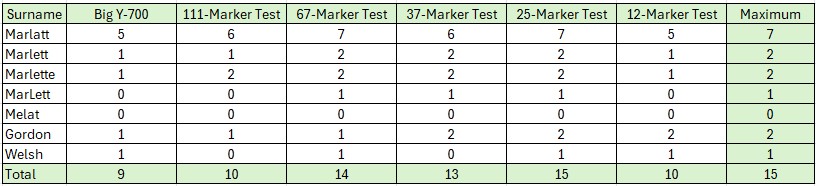
The most significant feature of the results is the strong and consistent predominance of the surname Marlatt. Marlatt is the most frequently occurring surname at every testing level. It reaches a maximum of seven matches at both the 67- and 25-marker levels and accounts for five of Kipp's nine Big Y-700 matches.
Closely related surname forms reinforce this pattern. Matches also appear under Marlett, Marlette, and MarLett. These surnames are known variants associated with the broader Marlatt/Merlet family. When considered together, the Marlatt-related surnames overwhelmingly predominate among the surnames represented in Kipp's Y-DNA match lists.
An especially noteworthy finding is the complete absence of the surname Melat. Despite Kipp himself carrying the surname Melat, none of the matches examined at any of the six testing levels carries that surname. This does not mean that no other living Melat male shares Kipp's paternal ancestry; rather, no such individual appears among the FamilyTreeDNA matches included in this assessment. Nevertheless, the contrast is striking: Kipp has numerous Y-DNA matches carrying Marlatt-related surnames but none carrying his present surname of Melat.
Matches also occur under the surnames Gordon and Welsh. These surnames initially appear inconsistent with the Marlatt/Merlet pattern. However, separate genealogical research into the Gordon and Welsh paternal lines indicates that these lines originated in the Marlatt family. Consequently, their different present-day surnames do not contradict the genetic evidence pointing toward a Marlatt/Merlet paternal origin.
Most of Kipp's relevant paternal matches are believed to descend from Gedeon Merlet, b. ca. 1624, whose descendants used a variety of surname spellings, including Merlet, Marlatt, Marlett, and Marlette. The recurrence of these surname variants among Kipp's Y-DNA matches is therefore consistent with his belonging to this same paternal family.
It is also important not to add the match counts from the six test levels together. The same individual may appear on several match lists because the Big Y-700 incorporates STR results comparable to those used at the lower testing levels. The table therefore represents the frequency and consistency of surnames across different match lists, rather than 71 independent DNA matches.
The Y-DNA surname evidence strongly supports the conclusion that D. Kipp Melat's paternal ancestry is associated with the Marlatt/Merlet family. Marlatt is consistently the most frequent surname among his Y-DNA matches, while the closely related Marlett and Marlette variants occur repeatedly at multiple testing levels. In contrast, no match examined in this assessment carries the surname Melat.
When these results are considered together with the genealogical evidence connecting several differently surnamed matches to the Marlatt family, the surname distribution provides significant genetic support for the conclusion that Melat was probably not the earlier surname of Kipp's paternal line. Rather, the evidence indicates that the surname Melat most likely developed from, or represents a later variant of, the Marlatt/Marlett/Marlette surname tradition. The results are also consistent with the broader hypothesis that Kipp's paternal lineage ultimately belongs to the family descended from Gedeon Merlet, b. ca. 1624.
The surname analysis alone does not establish precisely when, where, or with which ancestor the surname changed to Melat. That question must be resolved through correlation of the Y-DNA evidence with documentary records for the intervening generations. Documentary evidence presently suggests that the transition may have occurred between Robert Melat, b. 1799 and his proposed father George Marlatt, b. ca. 1775–1776.]
Supporting Note 42
Washington County, Pennsylvania, Deed Book 1N, pp. 391–393, William Cashman and wife Mary to George Millatt, indenture dated and acknowledged 17 June 1797, recorded 11 October 1797; “Washington, Pennsylvania, United States records,” digital images, FamilySearch (https://www.familysearch.org/…; Full URL : accessed 7 August 2026), image 213 of 416, DGS 008036007, FHL microfilm 862511; citing Pennsylvania, County Court (Washington County).
[Analysis: The 1797 deed establishes that a man identified as George Millatt acquired land in Washington County, Pennsylvania, on 17 June 1797. Although a minor could legally acquire and hold real property, the minor could potentially cancel the transaction after reaching the age of majority (Supporting Note 141). Because that possibility created additional uncertainty for a seller, it seems more likely that George had attained the age of majority when he purchased the property. If George was at least age 21 in June 1797, he would have been born no later than 1776. This inference is consistent with the estimated birth of George Melat as ca. 1775–1776, but the deed alone does not establish his age.
The deed identifies George Millatt as the purchaser but does not name a wife. Because a purchaser’s wife ordinarily would not have been required to join in a deed merely conveying property to her husband, the absence of a wife from this transaction provides little or no evidence concerning George Millatt’s marital status (Supporting Note 142). The deed therefore should not be used as evidence that George was unmarried in 1797.]
Supporting Note 43
William P. Marlatt, Records Pertaining to the Family of George and Mary (Drake) Marlatt of Pennsylvania and Ohio, draft, 23 August 2022, 39 pp.; privately held by William P. Marlatt, Moorpark, California.
[Summary: This draft document compiles and analyzes land, tax, census, church, probate, marriage, cemetery, and other records concerning George Marlatt, b. ca. 1775–1776, and Mary (Drake) Marlatt, b. ca. 1775–1781, who lived in Pennsylvania and Ohio.
The evidence places George in Nottingham Township, Washington County, Pennsylvania, by 1797–1800. He purchased a 1½-acre tract there in 1797, appears in the 1798 tax records, and was enumerated in Nottingham Township in the 1800 census. Analysis of the 1800 household suggests that George was born about 1775–1778 and had probably married by about 1798–1799.
By 1806, George and his wife Mary were living in Warren, Trumbull County, Ohio, when they sold the Pennsylvania property George had acquired in 1797. George subsequently disappears from the identified records. A Mary Marlett living in Washington County, Pennsylvania, in 1820 (Supporting Note 121) and a Mary Marlatt living in Allegheny County in 1830 (Supporting Note 187) may have been his widow, suggesting that Mary returned to western Pennsylvania after George's possible death.
The document correlates census ages, geographic proximity, church records, later family records, and other evidence to propose that George and Mary may have had six children: Joseph, Ann, Ephraim, William, Eli, and Jacob D. Marlatt. The evidence is strongest for Joseph Marlatt, b. ca. 1800, who is identified in a published lineage as the son of George Marlatt and Mary Drake. The proposed relationships of William, Eli, Jacob, Ann, and Ephraim are based principally on chronology, location, census reconstruction, and associated records and therefore remain less certain.
An important additional record is the 1824 will of Jacob Drake (Supporting Note 48), which names his daughter Polly Malatt; because Polly was a common nickname for Mary (Supporting Note 143), the document interprets this as additional evidence identifying Mary (Drake) Marlatt as Jacob Drake's daughter.
The resulting preliminary family reconstruction identifies George Marlatt and Mary Drake as the probable parents of Joseph, Ann, Ephraim, William, Eli, and Jacob D. Marlatt, while explicitly recognizing that further research is needed to establish several of these relationships.]
Supporting Note 44
William P. Marlatt, Overview of a Marlatt DNA Tester’s DNA Test Results, PowerPoint presentation [originally presented to the test taker], 14 November 2022, 22 slides; privately held by William P. Marlatt, Moorpark, California. [Title and identity of test taker anonymized for privacy.]
[Analysis: This presentation proposed that the brothers of George Marlatt, b. ca. 1775–1778, were Daniel Marlatt, b. 1772; and Joseph Marlatt, b. ca. 1777. This conclusion was based on their geographic proximity, similar birth years, recurring given names within their families, and the Marlatt lineages represented among the test taker’s autosomal DNA matches.
If the father of George was at least age 21 when his proposed son Daniel was born in 1772, he would have been born no later than about 1751. Records indicate that George and his proposed brothers were born in New Jersey (Supporting Notes: 51, 52, 45, and 144). Because numerous members of the Marlatt family were living in New Jersey during this period, it is plausible that their father was also born or living there.
If the family had not yet left New Jersey, the marriage may also have occurred there. These estimates depend upon the unproven assumptions that Daniel was their eldest child and that the couple married shortly before his birth.
In 1786, Mary Mallet of Nottingham Township, Washington County, Pennsylvania, was identified as a widow (Supporting Note 53). If Mary was the mother of George, her husband therefore must have died by 1786.
A Mary Melat was living in Muncy, Northumberland County, Pennsylvania, in 1786 (Supporting Note 145), the same year that widow Mary Mallet was recorded in Nottingham Township, Washington County, Pennsylvania (Supporting Note 53). It has not been established that these two records refer to the same woman. If they do, the records indicate that she was present in two Pennsylvania locations during 1786, but they do not establish the sequence or route of her migration. Records showing that Mary’s father may previously have lived in Sussex County, New Jersey (Supporting Note 103), provide additional evidence of a possible New Jersey connection. Taken together, this evidence suggests that George’s father may have died by 1786, but presently does not establish whether his death occurred in New Jersey or Pennsylvania.]
Supporting Note 45
New Jersey in the American Revolution, 1763–1783, “Enforcement of the Association in Sussex County, 1775,” pp. 158–159, New Jersey State Library Digital Collections (New Jersey State Library, https://dspace.njstatelib.org/items/cd915b9f-a586-4e77-acaa-a142b0ac7252 : accessed 14 November 2026), minutes of the Sussex County Committee, 10–11 August 1775, Mansfield Township entries for George Marlatt and Coonrad Phillips.
[Commentary: George Marlatt, b. ca. 1749, would have been about age 26 when this record was dated. No other man named George Marlatt known to have been living in Sussex County at this time appears to fit this record as well. This record, together with the estate papers of his father, John Marlatt, b. ca. 1714, d. 1780, indicates that George Marlatt, b. ca. 1749, was living in Sussex County, New Jersey, during the 1775–1780 period, and possibly well before this period. This suggests that George’s proposed children born before 1780, including Daniel Marlatt, b. 1772; George Marlatt, b. ca. 1775–1776; and Joseph Marlatt, b. ca. 1777, were likely born in or near Sussex County, New Jersey.]
Supporting Note 46
Supporting Note 47
Society of the Sons of the Revolution in the State of California, Spirit of Patriotism as Evidenced by the Revolutionary and Ancestral Records of the Society, Sons of the Revolution of the State of California, Orra Eugene Monnette, ed., assisted by Leon Le Lanne French (Los Angeles, California: Society of the Sons of the Revolution in the State of California, 1915), 199–200; digital images, Internet Archive (https://archive.org/…; Full URL : accessed 21 August 2012).
[Summary: Pages 199–200 present lineage sketches for Ephraim Drake (1732–1780) and Jacob Drake (1755–1840), identifying Mary Drake (1781–1845) as the wife of George Marlatt and the mother of Joseph Marlatt, b. ca, 1800, who married Jane Harrison.]
Supporting Note 48
Washington County, Pennsylvania, Will Book 4:255–257, will of Jacob Drake, dated 15 September 1824, proved 18 December 1826; Register of Wills, Washington, Pennsylvania; digital image, Ancestry.com, Pennsylvania, U.S., Wills and Probate Records, 1683–1993 (https://www.ancestry.com/…; Full URL : accessed 11 July 2026).
[Analysis: Jacob Drake’s will names “Polly Malatt” among his children. Because Polly was a common diminutive of Mary (Supporting Note 143) during this period, this record provides strong evidence that Mary Drake, daughter of Jacob Drake, was the wife of George Marlatt.]
Supporting Note 49
[Analysis: This analysis presents documentary and genetic evidence supporting the conclusion that D. Kipp Melat is a descendant of George Marlatt, b. ca. 1749.
Analysis of a test taker’s autosomal DNA matches can provide useful evidence supporting genealogical relationships. However, because the amount of DNA inherited from a particular ancestor generally decreases with each generation and inheritance occurs through the random process of recombination, a person may inherit only a small amount of DNA—or no detectable DNA at all—from a distant ancestor. Consequently, a test taker may have few or no identifiable DNA matches who descend from a particular distant ancestor (Supporting Note 87).
Other descendants of that same ancestor, however, may have inherited different portions of the ancestor’s DNA and may have several useful matches who also descend from that ancestor. When the original test taker does not have suitable matches for evaluating a particular ancestral relationship, another descendant can sometimes serve as a DNA proxy. The proxy’s DNA matches can then be analyzed to provide additional evidence for or against the hypothesized relationship (Supporting Note 87).
The AncestryDNA match list of D. Kipp Melat was reviewed for matches whose lineages extend back to George Marlatt, b. ca. 1749 (Supporting Note 85). No suitable matches were identified. However, a man was identified as a suitable DNA proxy because he has several autosomal DNA matches with documented lines of descent from men proposed to be sons of George Marlatt, b. ca. 1749. Kipp and his DNA test proxy are also Y-DNA matches who share the same haplogroup, and their most recent common ancestor on their direct paternal lines is hypothesized to be George Marlatt, b. ca. 1749 (Supporting Note 139). The test taker agreed to serve as Kipp’s DNA proxy for this study.
An email dated 22 April 2023 from William P. Marlatt to David P. Marlatt (Supporting Note 146) presented the hypothesis that Joseph Marlatt, b. ca. 1777, may have been the brother of Daniel Marlatt, b. 1772, New Jersey; George Marlatt, b. ca. 1775–1776; and that these men were sons of George Marlatt, b. ca. 1749, of Mansfield Township, Sussex County, New Jersey, and grandsons of John Marlatt, b. ca. 1714–1721, and Lydia (possibly Jarrad). The children in John and Lydia's family (Supporting Note 51) were:
- Hannah Marlatt, b. ca. 1747, Mansfield Township, Sussex County, New Jersey
- George Marlatt, b. ca. 1749, Mansfield Township, Sussex County, New Jersey
- John Marlatt, b. ca. 1751, Mansfield Township, Sussex County, New Jersey
- Joseph Marlatt, b. ca. 1752, Mansfield Woodhouse, Sussex County, New Jersey
- Nathan Marlatt, b. 1753, Mansfield Township, Sussex County, New Jersey
- Sarah Marlatt, b. ca. 1757, Mansfield Township, Sussex County, New Jersey
- Lydia Marlatt, b. ca. 1759, Mansfield Township, Sussex County, New Jersey
- Martha Marlatt, b. ca. 1761, Mansfield Township, Sussex County, New Jersey
- Ann Marlatt, b. ca. 1763, Mansfield Township, Sussex County, New Jersey
The recurrence of the given names George, Joseph, and John in both families is notable. In addition, the name Daniel, one of the proposed sons of George Marlatt, b. ca. 1749, also appears among the descendants of John and Lydia Marlatt's sons. John Marlatt, b. ca. 1751, Joseph Marlatt, b. ca. 1752, and Nathan Marlatt, b. 1753, each had grandsons named Daniel. Although naming patterns alone cannot establish family relationships, they provide supporting evidence when considered alongside the documentary and genetic evidence presented here.
Chronology also supports the proposed relationship. Daniel Marlatt was born ca. 1772. If his father was at least twenty-one years old when Daniel was born, his father would have been born no later than about 1751. This is consistent with the estimated birth year of George Marlatt, b. ca. 1749.
Documentary evidence indicates that George Marlatt, b. ca. 1775–1776, married Mary Drake (Supporting Notes 46, 43, 48, and 143). Available records place Mary's father, Jacob Drake, in Sussex County, New Jersey, at one time (Supporting Note 103). Consequently, both the family of George Marlatt, b. ca. 1775–1776, and the family of George Marlatt, b. ca. 1749, of Mansfield Township, Sussex County, New Jersey, have ties to the same county.
George Marlatt, b. ca. 1749, was named in his father's will dated 1780 (Supporting Note 51), establishing that he was alive at that time. No records for George have yet been identified after 1780. One possible explanation is that he left Sussex County and migrated to Pennsylvania, where members of the Marlatt family were subsequently recorded.
Such a migration would have been consistent with the movements of other members of this family. George's brother John Marlatt, b. ca. 1751, appears to have moved to North Carolina by 1775 (Supporting Note 100). His brothers Joseph Marlatt, b. ca. 1752, and Nathan Marlatt, b. 1753, subsequently settled in Ontario, Canada. Joseph died there in 1813 (Supporting Notes 98 and 147), while a man indexed as Nathaniel Malatt, probably Nathan Marlatt, was recorded in Mansfield Township, Sussex County, New Jersey, in the 1793 tax list index (Supporting Note 148). Nathan reportedly moved to Canada in 1797 (Supporting Note 147). These migrations demonstrate that members of the family were leaving Sussex County during this period.
Additional evidence places men bearing the Marlatt surname in western Pennsylvania. The 1802 taxables list for Hanover Township, Beaver County, Pennsylvania, identifies Joseph Morlatt among the general taxpayers and Joseph Marlatt among the single freemen (Supporting Note 149). One possibility is that these were Joseph Marlatt, b. ca. 1752, and his son Joseph, b. ca. 1780. In 1807 and 1808, another record identifies Joseph Marlatt in Springfield Township, Mercer County, Pennsylvania (Supporting Note 150). This Joseph is thought to have been a brother of George Marlatt, b. ca. 1775–1776. Although the identities of these men have not been conclusively established, the records document a Marlatt presence in western Pennsylvania during the period under investigation.
Taken together, these records suggest a possible migration pattern from Sussex County, New Jersey, to western Pennsylvania. George Marlatt, b. ca. 1749, disappears from the identified New Jersey records after 1780, while men bearing the Marlatt surname appear in western Pennsylvania during the following decades. This provides a plausible explanation for George's absence from later New Jersey records and supports the possibility that he or members of his family migrated westward.
This migration hypothesis is particularly relevant to the proposed ancestry of Robert Melat, b. 1799, Pennsylvania. It provides a possible geographical connection between the family of George Marlatt, b. ca. 1749, in New Jersey and the later Marlatt–Melat families of western Pennsylvania. When considered alongside the documentary and genetic evidence discussed elsewhere in this study, the migration pattern provides additional circumstantial support for the hypothesis that George Marlatt, b. ca. 1749, was an ancestor of Robert Melat, b. 1799.
To further evaluate the proposed family of George Marlatt, b. ca. 1749, and determine whether the autosomal DNA of Kipp’s test proxy provides additional support for his descent from this family, the DNA matches of Kipp’s test proxy were examined.
The value of these matches depends not simply on the amount of DNA Kipp’s test proxy shares with them, but also on whether their independently reconstructed family lines converge on the same Marlatt ancestor. For this reason, the genealogical lineages of the matches were examined to determine whether they descend through separate branches of the family of George Marlatt, b. ca. 1749.
The AncestryDNA match list for Kipp’s test proxy was reviewed, and several matches with documented lines of descent from men proposed to be sons of George Marlatt, b. ca. 1749, were identified. In some cases, the known lineages of these test takers had to be extended through additional generations to reach the relevant Marlatt ancestor. The matches identified with shared DNA values of 15 cM or greater were Match A (21 cM), Match B (15 cM), Match C (16 cM), Match D (19 cM), and Match E (18 cM).
The figure below illustrates lines of descent from three separate proposed children of George Marlatt, b. ca. 1749—Daniel Marlatt, b. 1772, George Marlatt, b. ca. 1775–1776, and Joseph Marlatt, b. ca. 1777—to Kipp’s DNA test proxy and five of his DNA matches. These three sons correspond closely with those identified in the aforementioned research memorandum dated 22 April 2023 (Supporting Note 146). These lines of descent were evaluated using christening records, birth registrations, marriage records, census records, land records, newspaper articles, death certificates and indices, obituaries, Find a Grave, and Geneanet to determine whether the proposed genealogical connections were supported by the available documentary evidence.
The shared match lists of Kipp’s DNA test proxy and these five matches were also searched for individuals associated with the Marlatt surname. Several additional matches were identified who also descend through branches proposed to descend from George Marlatt, b. ca. 1749. This clustering of Marlatt descendants provides additional evidence that the genetic relationships observed among Kipp’s DNA test proxy and these matches are associated with the Marlatt family rather than with unrelated ancestral lines.
In each case, Kipp’s DNA test proxy and his five matches are proposed fifth cousins or fifth cousins once removed. According to the Shared cM Project (Supporting Note 86), fifth cousins typically share between 0 and 117 centimorgans, with a mean of 25 centimorgans. Fifth cousins once removed generally share between 0 and 80 centimorgans, with a mean of 21 centimorgans. The amounts of DNA Kipp’s test proxy shares with these matches—15 to 21 cM—fall within the expected ranges for the proposed relationships.
The documentary evidence supporting the proxy’s proposed paternal lineage and the autosomal DNA evidence connecting him with descendants of men proposed to be sons of George Marlatt, b. ca. 1749, provide mutually reinforcing evidence for the proposed family reconstruction.
Particularly significant is the presence of DNA matches through three separate branches of the proposed family: Daniel Marlatt, b. ca. 1772, George Marlatt, b. ca. 1775–1776, and Joseph Marlatt, b. ca. 1777. This pattern is consistent with these three men being members of the same family and sharing George Marlatt, b. ca. 1749, as their father.
Another possible father of Robert Melat, b. 1799 is Daniel Marlatt, b. ca. 1772. However, the available geographic evidence makes this possibility less likely. Daniel sold property in Washington County, Pennsylvania, on 18 September 1792, by a deed recorded 24 June 1794 (Supporting Notes 92 and 151) and was identified as a settler in Adams County, Ohio, by 1796 (Supporting Note 152). Robert Melat, on the other hand, was reportedly born in Pennsylvania in 1799 (Supporting Note 18). If Daniel had relocated to Ohio by 1796 and remained there, he would have been living in Ohio approximately three years before Robert's birth in Pennsylvania. In contrast, George Millatt [Marlatt, b. ca. 1775–1776] purchased property in Washington County, Pennsylvania, in 1797 (Supporting Note 42) and was enumerated there in the 1800 federal census (Supporting Note 38), placing him in Pennsylvania both shortly before and shortly after Robert's reported birth there in 1799. Although the evidence does not eliminate Daniel as a possible father, no evidence has been found showing that he returned to Pennsylvania during this period. The known residences of George Marlatt, b. ca. 1775–1776, are therefore more consistent with Robert's reported Pennsylvania birth than are those of Daniel Marlatt, b. ca. 1772.
Joseph Marlatt, b. ca. 1777 was also considered as a possible father of Robert Melat, b. 1799. To evaluate this possibility, Kipp Melat's AncestryDNA match list was reviewed for matches with documented lines of descent from Joseph Marlatt, b. ca. 1777 through children other than Robert. No such matches were identified. Because autosomal DNA inheritance becomes increasingly variable over multiple generations, the absence of such matches does not eliminate Joseph as a possible father of Robert. Nevertheless, this review identified no autosomal DNA evidence independently supporting the hypothesis that Kipp descends from Joseph Marlatt, b. ca. 1777.
This proxy analysis is important because Kipp does not presently have suitable autosomal DNA matches with documented lineages extending back to George Marlatt, b. ca. 1749. Kipp and his DNA test proxy are Y-DNA matches, and their direct paternal lines are believed to share George Marlatt, b. ca. 1749, as a common ancestor. The proxy’s autosomal DNA matches provide additional evidence for this relationship because they descend through three men proposed to be sons of George Marlatt, b. ca. 1749—Daniel Marlatt, b. ca. 1772; George Marlatt, b. ca. 1775–1776; and Joseph Marlatt, b. ca. 1777. The presence of DNA matches through these three separate branches supports the hypothesis that these men were members of the same family and that George Marlatt, b. ca. 1775–1776, was a son of George Marlatt, b. ca. 1749. Because Kipp’s paternal lineage has been separately traced to the younger George, this evidence also supports extending Kipp’s paternal lineage back another generation to George Marlatt, b. ca. 1749. When considered with the Y-DNA and documentary evidence presented elsewhere in this study (Supporting Notes 41, 56, 61, 62, 79, 50, and 153), the proxy’s autosomal DNA evidence provides additional genetic support for the conclusion that D. Kipp Melat is a descendant of George Marlatt, b. ca. 1749.]
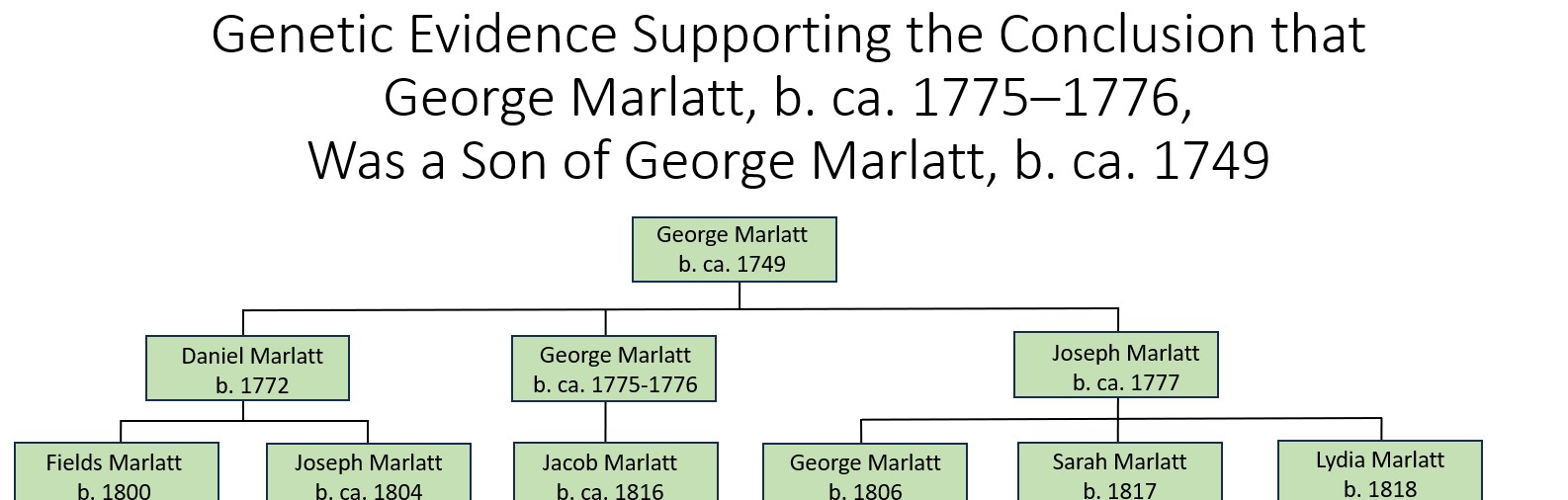
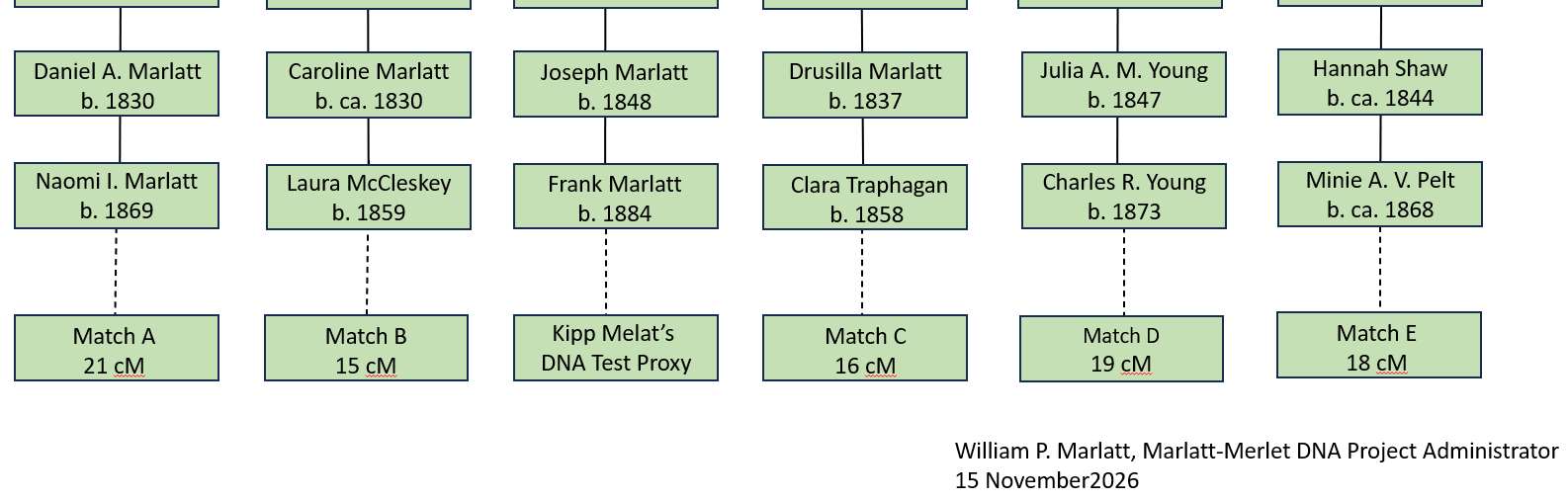
Supporting Note 50
[Analysis: This analysis provides genetic evidence supporting the conclusion that D. Kipp Melat is a descendant of George Marlatt, b. ca. 1775–1776, and George Marlatt, b. ca. 1749.
Y-chromosome short tandem repeat (Y-STR) markers are passed from father to son along the direct paternal line (Supporting Notes 137 and 138). Because these markers are generally inherited unchanged, men who descend through uninterrupted paternal lines from a common male ancestor typically have similar Y-STR profiles. Individual STR markers can, however, occasionally mutate, causing the marker value to increase or decrease. When such mutations occur in particular branches of a well-documented paternal lineage, comparison of the marker values among descendants can sometimes help identify where a mutation occurred and permit the probable marker values of earlier common ancestors to be reconstructed (Supporting Notes 137 and 138).
A review was conducted of Y-DNA test takers in the Marlatt-Merlet DNA Project who have reported values for STR marker DYS570 and whose documented paternal lineages extend back to Josias Merlet, bapt. 1645, son of Gedeon Merlet, b. ca. 1624 (Supporting Note 139). The purpose of this analysis was to determine whether the distribution of DYS570 values among the different paternal branches could provide additional genetic evidence concerning D. Kipp Melat's proposed descent from George Marlatt, b. ca. 1775–1776, and his proposed father, George Marlatt, b. ca. 1749.
The accompanying figure shows the relevant paternal lineages and the observed or inferred DYS570 values for the Y-DNA test takers and their paternal ancestors. The test results reveal considerable variation in DYS570 among descendants of the broader Marlatt-Merlet family, with values of 17 and 18 represented. Because of this variation, the DYS570 values of several earlier ancestors cannot be reliably reconstructed and are therefore shown as undetermined in the figure.
The results are more informative within the paternal branch descending through George Marlatt, b. ca. 1749. D. Kipp Melat and another test taker (Match D), whose lineages descend through his son George Marlatt, b. ca. 1775–1776, have a DYS570 value of 17. A test taker descending through another son, Joseph Marlatt, b. ca. 1777 (Match E), also has a value of 17. The presence of the same value in these two separate descendant branches supports the inference that George Marlatt, b. ca. 1749, carried a DYS570 value of 17 and transmitted it to both sons. Kipp's DYS570 value of 17 is therefore consistent with the value indicated for both George Marlatt, b. ca. 1775–1776, and his father, George Marlatt, b. ca. 1749, providing genetic evidence supporting Kipp's paternal-line descent from these men.
The DYS570 result alone does not prove a connection. This marker can change over time through mutation, and men from unrelated paternal lines can sometimes share the same value by coincidence. Its value comes from how well it fits with the other Y-DNA and genealogical evidence in this study.
The DYS570 findings are consistent with the documentary evidence supporting Kipp's proposed lineage and provide additional corroborating genetic evidence supporting paternal relationships identified above.]
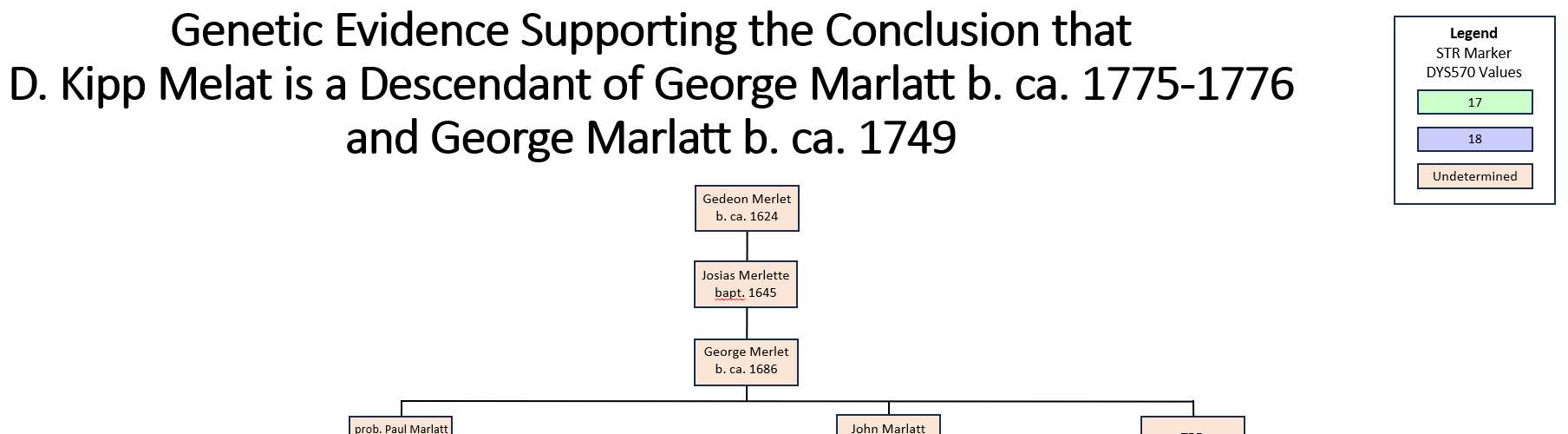
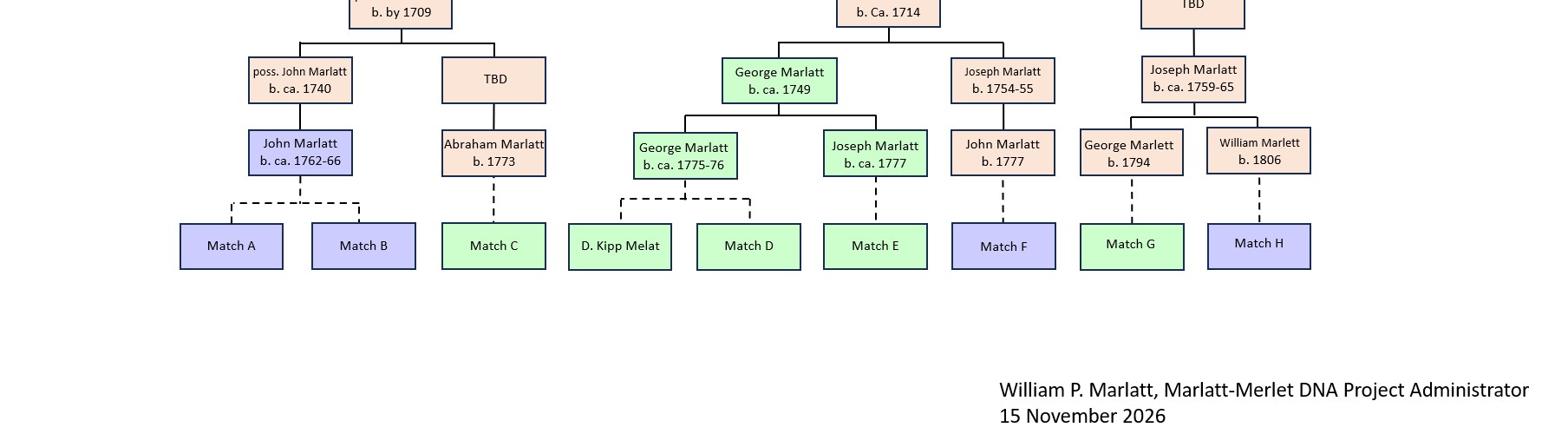
Supporting Note 51
New Jersey, Department of State, Record of Wills in New Jersey, 1705–1804; in Ancestry.com, “New Jersey, U.S., Wills and Probate Records, 1739–1991,” database with digital images (https://www.ancestry.com/…; Full URL : accessed 12 July 2026), entry for John Marlatt, will dated 10 August 1780, residence “Mansfield Woodhouse, Sussex, West Jersey,” item description “Wills, Vol. 21–22, 1779–1781”; citing original records of the New Jersey County, District, and Probate Courts.
[Analysis: The will names John Marlatt’s wife as Liddia and identifies his children as Hannah, described as his eldest daughter; George, described as his eldest son; John; Nathan; Joseph; Sarah; Lidia; Martha; and Ann. One of the witnesses was Andrew Jarrard, whom some researchers have suggested may have been Liddia’s brother or possibly her father; however, the will itself does not establish that relationship.
An approximate marriage date for John and Liddia can be estimated if the children were named generally in birth order and were born at intervals of about two years. Nathan was born 2 February 1753 (Supporting Note 99). Working backward at approximately two-year intervals would place John’s birth about 1751, George’s about 1749, and Hannah’s about 1747. If Hannah was the eldest child and John and Liddia married approximately one year before her birth, their marriage may have occurred about 1746. This estimate depends upon assumptions concerning the order and spacing of the children’s births and therefore should be treated as an approximation rather than an established marriage date.]
Supporting Note 52
Robert A. Williams, “New Jersey—The Lands of the Marletts,” unpublished research paper, 4 April 2013; attached to email from Robert A. Williams to William P. Marlatt, 13 April 2013; privately held by William P. Marlatt, Moorpark, California.
[Analysis: Williams states that John Marlett, identified in this study as the probable second-oldest son of George Merlet, (1) purchased 100 acres in Greenwich Township (now Mansfield Township), Morris County (now Warren County), New Jersey, in 1750 (Records of the Proprietors of the Western Division of New Jersey, Book E, p. 114, New Jersey State Archives, Trenton); (2) purchased an additional 200 acres in 1750 and 50 acres in 1753 in Sussex County (now Warren County), New Jersey (ibid., Book S6, p. 132); and (3) purchased two additional tracts containing 60.5 and 30.5 acres in Sussex County in 1755 (ibid., Book S6, p. 132). Williams further concludes that these purchases, totaling about 440 acres, appear to comprise the farm on which John later resided in Mansfield Township, Sussex County (now Warren County), New Jersey.
Although no marriage record has been found for John Marlatt and Lydia, the available evidence places John in the same general region in 1735 (Supporting Note 57) and again between 1750 and 1755, with no evidence presently identified that he established residence elsewhere during the intervening years. These records suggest that John established his household in the same general locality in which he later accumulated his principal landholdings. When this geographic evidence is considered together with the estimated birth of the couple’s eldest child about 1747 (Supporting Notes 51), it is reasonable to infer that John and Lydia probably married about 1746 in or near what was then Greenwich Township, Morris County, New Jersey. Their eldest known son, George Marlatt, b. ca. 1749, may likewise have been born in or near that community.]
Supporting Note 53
Pennsylvania Historical and Museum Commission, Records of the Office of the Comptroller General, RG-4, Tax & Exoneration Lists, 1762–1794, microfilm roll 340, Washington County, Nottingham Township, 1786, p. 236, entry for Mary Mallet, widow; digital image, Ancestry.com, “Pennsylvania, U.S., Tax and Exoneration, 1768–1801,” image 84 of 161 (https://www.ancestry.com/search/collections/2497/records/1521694 : accessed 1 September 2026).
[Commentary: This is thought to have been the widow of George Marlatt, b. ca. 1749. She could not have been the wife of George Marlatt, b. ca. 1775–1776, because the younger George would have been only about 10–11 years old in 1786.]
Supporting Note 54
[Analysis: The evidence concerning the death of George Marlatt, b. ca. 1749, presents a conflict between two men of the same name. Find a Grave identifies John Marlatt's son George as having lived from 1749 to 1814 (Supporting Note 154). The memorial for Joseph Nathaniel Marlatt states that Joseph's brother George was also buried at the Marlatt Family Farm Cemetery, while separately identifying Sgt. George Marlatt, b. 1781, as Joseph's son (Supporting Note 155). A memorial for George Marlatt, b. 1749, explicitly assigns him a death date of 28 December 1814 in Trafalgar, Ontario, and burial at that cemetery (Supporting Note 156). In contrast, a separate memorial identifies Sgt. George Marlatt, b. 1781, as Joseph's son and assigns him the same death date, 28 December 1814 (Supporting Note 157). These derivative memorials therefore attribute the 1814 death to both Joseph's brother and Joseph's son. The attribution to the older George also conflicts with evidence elsewhere in this study suggesting that he died by 1786 (Supporting Note 44).
The first question is what the contemporary records establish without assuming the deceased man's identity. George Marlatt of Trafalgar Township executed a will on 26 December 1814, describing his land as Lot 1 in the First Concession, north of Dundas Street, and naming his wife Rebeckah (Supporting Note 158). James Hunter testified on 22 February 1815 that he witnessed George execute that will (Supporting Note 159). On the same date, Samuel Pikeman and David Snyder swore that George had died “on, or about the twenty eighth of December last past,” placing his death on or about 28 December 1814 (Supporting Note 160). These original probate records establish the testator's property and approximate death date, but do not independently identify his father or year of birth.
The cemetery evidence provides a geographic connection. An account of the Marlatt Family Farm Cemetery places it at Lot 1, Concession 1 NDS, north of Dundas Street, in Trafalgar Township, and reports monuments for Joseph and George Marlatt showing deaths in 1813 and 1814, respectively (Supporting Note 161). The cemetery's reported location corresponds with the property described in the 1814 will (Supporting Note 158). This correspondence supports the conclusion that the George associated with the cemetery was the Trafalgar testator, although the cemetery account alone does not establish whether he was Joseph's brother or son.
The military evidence helps distinguish the two men. A Heritage Mississauga account identifies John, Joseph Jr., and George Marlatt as members of the Ontario Marlatt family who served during the War of 1812, reporting that only John returned home and that George died of disease in 1814 (Supporting Note 162). George Marlatt, b. ca. 1749, would have been approximately 63–65 years old during the war, whereas George Marlatt, b. 1781, would have been approximately 31–33. The younger man's age is considerably more consistent with service as a sergeant, although age alone does not establish identity. Transcribed records of the 2nd Regiment of York Militia identify “Qr Mstr. Sgt. George Marlatt” (Supporting Note 163). A separate historical compilation reports that Sergeant George Marlatt of the 2nd York died of disease on 28 December 1814 (Supporting Note 164). This date agrees with the contemporary probate affidavit (Supporting Note 160), strongly connecting the military sergeant with the Trafalgar testator. The independence of the later historical accounts from one another has not been established.
The evidence also weighs against identifying the Trafalgar testator as Joseph's brother George Marlatt, b. ca. 1749. Mary Mallet, identified as a widow in Nottingham Township, Washington County, Pennsylvania, in 1786 (Supporting Note 53), was probably the wife of the older George. This identification is supported by several converging lines of indirect evidence. Mary was living in the area associated with George and his family, and no records have been identified establishing that George remained alive during this period. The other known sons of John Marlatt, b. ca. 1714, either lived elsewhere or were married to women not named Mary, with the exception of Nathan Marlatt, b. 1753, whose wife reportedly was named Mary. Nathan is reported to have had children in Sussex County, New Jersey, before migrating to Ontario in about 1797. No evidence has been identified placing him or his wife in Washington County, Pennsylvania, during this period. Furthermore, the Marlatt surname appears to have been uncommon in the area, reducing the likelihood that the widow was an unrelated woman of the same name. Although no single record explicitly identifies Mary Mallet as George's widow, the combined geographical, chronological, and family evidence supports that conclusion. The residence, family comparisons, and reported migration require confirmation against their underlying records. If Mary was George's widow in 1786, he died before that year and could not have been the George Marlatt who died in Trafalgar Township in December 1814. In contrast, the original Trafalgar will names the testator's wife Rebeckah (Supporting Note 158), consistent with the identification of Rebecka Shain as the younger George's wife in the Find a Grave memorial (Supporting Note 157). The wife's name in the original will is contemporary evidence; the attribution of Rebecka Shain to the younger George remains derivative family-identification evidence.
The Find a Grave memorial for Sgt. George Marlatt identifies him as Joseph Nathaniel Marlatt's son, b. 1781 (Supporting Note 157). Taken together, the differences in the reported wives' names, the evidence suggesting the older George's death before 1786, the substantially more plausible military-service age of the younger George, and the agreement between the soldier's reported death date and the contemporary probate affidavit favor identifying the Trafalgar testator as the younger Sgt. George Marlatt, b. 1781. The competing attribution to Joseph's brother George, b. ca. 1749, is less consistent with this combined evidence.
The conflicting Find a Grave memorials are therefore best explained as a probable conflation of the two men. The Ontario death and burial should not be assigned to George Marlatt, b. ca. 1749, on the strength of those memorials.]
Supporting Note 55
Sussex County, New Jersey, Deed Book X:273–75, Philip Decenburgh and wife Dorothy to Abraham Groenendyke, deed dated 7 April 1788; “Sussex, New Jersey, United States Records,” FamilySearch (https://www.familysearch.org/…; Full URL : accessed 7 July 2026), image 177 of 334, Image Group No. 007896856.
[Commentary: This deed states that John Marlatt died owning the property and that, in his will dated 10 August 1780 (Supporting Note 51), he devised the lands to his eldest son, George Marlatt.]
Supporting Note 56
[Analysis: This analysis provides genetic evidence supporting the conclusion that D. Kipp Melat is a descendant of John Marlatt, b. ca. 1714.
Autosomal DNA matches can provide genetic evidence supporting or extending a lineage established through documentary research. When a test taker and multiple DNA matches have independently documented lineages that converge on the same ancestor or ancestral couple, and the amounts of shared DNA are consistent with the proposed relationships, the combined genetic and documentary evidence can strengthen the conclusion that the test taker descends from that ancestor (Supporting Note 87).
The table summarizes the documented lineages of D. Kipp Melat and nine of his AncestryDNA matches, together with the amount of autosomal DNA Kipp shares with each match (Supporting Note 85). Kipp’s lineage extends through George Marlatt, b. ca. 1749, and his proposed son George Marlatt, b. ca. 1775–1776, while the nine DNA matches descend through Joseph Marlatt, b. ca. 1752–1753 (frequently identified in compiled genealogies as Joseph Nathaniel Marlatt), another son of John Marlatt, b. ca. 1714 (Supporting Notes 40 and 49).The matches share between 12 and 14 cM of DNA with Kipp and descend through several different children and later branches of Joseph Nathaniel Marlatt’s family. Thus, the table shows that Kipp has multiple autosomal DNA matches whose independently traced lineages converge with Kipp’s lineage at John Marlatt, b. ca. 1714, providing genetic evidence consistent with the proposed relationship between the two family branches.
The table also provides Kipp’s estimated relationship to each match, the expected centiMorgan range and mean for that relationship based on empirical data collected by the Shared cM Project (Supporting Note 86), and the amount of DNA Kipp actually shares with the match as reported by AncestryDNA (Supporting Note 85). For all nine matches, the measured amounts of shared DNA fall within the expected ranges for the proposed relationships. The observed values of 12–14 cM are therefore consistent with the relationships predicted by the documented lineages. When considered together with the presence of multiple matches descending through several branches of Joseph Nathaniel Marlatt’s family, these results provide additional genetic evidence supporting the conclusion that D. Kipp Melat is a descendant of John Marlatt, b. ca. 1714.]
[Commentary: The name Joseph Nathaniel Marlatt is commonly used, however, no credible record has been found identifying the middle name of Joseph Marlatt b. ca. 1752, son of John Marlatt b. ca. 1714, as Nathaniel.]

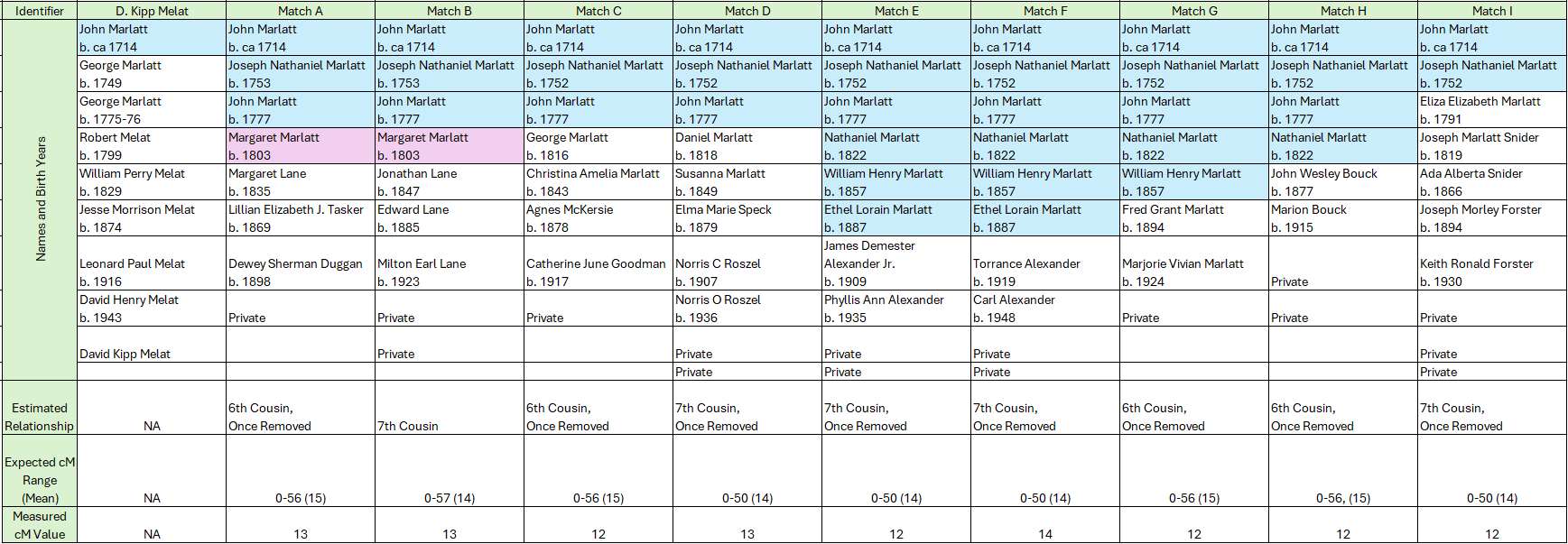
Supporting Note 57
Henry Race, M.D., “The West Jersey Society’s Great Tract in Hunterdon County,” The Jerseyman (Flemington, New Jersey) 3, no. 1 (April 1895): 45–53; consulted as a verbatim transcription by Rosalyn Bellis (July 2006), Hunterdon County NJGenWeb, The USGenWeb Project, (https://www.usgenwebsites.org/… Full URL : accessed 12 July 2026).
[Analysis: George Marbot, Paul Marlat, and John Merlatt were listed among the inhabitants of the West Jersey Society’s Great Tract in Hunterdon County, New Jersey, in 1735, each holding 100 acres of land. The documentary and genetic evidence presented elsewhere in this study (Supporting Notes 63, 60, and 62) supports the conclusion that Paul and John were the probable sons of George. Although a person under age twenty-one could acquire and hold real property (Supporting Note 141), the fact that Paul and John each held 100 acres in their own names makes it reasonable to infer that they had probably attained the age of majority by 1735. If they were at least age twenty-one, they would have been born no later than about 1714.
Other evidence supports estimating Paul's birth at about 1709 (Supporting Note 165). Although Paul and John could have been twins, twin births were uncommon, making it more likely that they were born in separate pregnancies. If their births followed the commonly observed interval of approximately two and a half years (Supporting Note 166), the available evidence is consistent with Paul being the elder brother and John being born somewhat later. Taken together, the evidence suggests that George was probably married by about 1709.]
Supporting Note 58
New Jersey Historical Society, Calendar of New Jersey Wills, 1670–1730, vol. 23 (Paterson, New Jersey: Press Printing and Publishing Co., 1901), 304.
[Analysis: George Marlett and Thomas Cherry, both described as yeomen, were named as fellow bondsmen in the administration of the estate of Joseph Marlett of Monmouth County, New Jersey, dated 23 May 1715. George’s documented presence in Monmouth County at this time falls within the period in which his son John was probably born (Supporting Note 57) and supports the possibility that John was born in or near Monmouth County.]
Supporting Note 59
Norma F. Jennings, “Andrew¹ Jarrard and His Family,” personal website, last updated and corrected 24 March 2003, (http://homepages.rootsweb.com/…; Full URL : accessed 26 October 2026).
[Analysis: Jennings states that Andrew Jarrard appeared as “Andrew Jarrett” on the 1800 tax list for Washington County, Pennsylvania. She further states that his sons Samuel and Thomas “Gerard” appeared in Beaver County, Pennsylvania, near Joseph Marlatt. Joseph was a son of John Marlatt, whose 1780 will was witnessed by Andrew Jarrard (Supporting Note 51). The geographic association between Andrew Jarrard’s sons and Joseph Marlatt provides additional evidence of an ongoing connection between the Jarrard and Marlatt families.
Some researchers have suggested that Lydia, wife of John Marlatt, was a member of the Jarrard family. Although no direct evidence has been found establishing Lydia’s maiden name or her relationship, if any, to Andrew Jarrard, the documented association between the Jarrard and Marlatt families is consistent with that possibility. Andrew Jarrard’s service as a witness to John Marlatt’s will does not, by itself, establish a familial relationship, as witnesses could be neighbors, friends, business associates, relatives, or other trusted members of the testator’s community.]
Supporting Note 60
Robert A. Williams Jr., “George and John (His Son) Marlatt of Hunterdon Co., NJ” (self-published manuscript, Huntington Beach, California, 18 April 2009).
[Summary: Williams states that the eldest son of John and Lydia Marlatt was named George and that their eldest daughter was named Hannah.]
[Analysis: The naming of John and Lydia Marlatt’s eldest son George and eldest daughter Hannah is consistent with the possibility that John was a son of George and Hannah Merlet. Although naming patterns alone do not establish parentage, they provide supporting evidence for the proposed relationship. John Marlatt's 1780 will independently identifies Hannah as his eldest daughter and George as his eldest son (Supporting Note 51).]
Supporting Note 61
[Analysis: This analysis provides genetic evidence supporting the conclusion that D. Kipp Melat is a descendant of George Merlet, b. ca. 1686.
Y-DNA STR (Short Tandem Repeat) markers are locations on the Y chromosome at which short DNA sequences are repeated a measurable number of times (Supporting Notes 137 and 138). Because the Y chromosome is transmitted from father to son with relatively few changes, men sharing a direct paternal ancestor generally have similar STR profiles. Occasionally, an STR value changes through mutation and the new value is subsequently transmitted to descendants. When the same distinctive STR value or combination of values is found among multiple men with independently documented paternal lines descending from a particular ancestor, those values can help identify a genetic signature associated with that branch of the family. An additional Y-DNA test taker who shares the broader family Y-DNA profile and the branch-specific STR values therefore has genetic evidence supporting his placement within that paternal branch (Supporting Notes 137 and 138).
The figure below shows a descendancy chart of Gedeon Merlet, b. ca. 1624 composed of 13 men who have taken Y-DNA tests at FamilyTreeDNA and have either proven lineages extending back to Gedeon Merlet, b. ca. 1624 or hypothesized lineages that are considered highly credible (Supporting Note 139). These men are identified as Matches A-L. Men who carry a value of 15 at STR marker DYS456 are designated by green highlighting in their designated box in the figure. Men who carry a value of 16 at this same marker are designated by blue highlighting.
As an example, Matches I–L all carry a value of 15 at STR marker DYS456 (Supporting Note 153), and all have lineages extending back to Abraham Marlatt, b. 1656. It is therefore likely that Abraham Marlatt, b. 1656 carried a value of 15 at DYS456 and transmitted it through the paternal lines descending through Thomas Merlet, b. ca. 1698 and Dirck Marlatt, b. 1708. These descendants, in turn, likely transmitted the same marker value through successive generations to the test takers. The boxes associated with ancestors on the paternal lines of these four test takers are therefore highlighted in green, indicating that they are inferred to have carried DYS456 = 15.
Now consider the lineages of Matches B and F. Match F has a proven paternal line extending back to George Merlet, b. ca. 1686. The lineage of Match B has been studied extensively and, although it has not yet been formally proven, is well documented and considered highly credible. This lineage also extends back to George Merlet, b. ca. 1686. Kipp and Matches A, C, D, G, and H also have paternal lines believed to descend from George Merlet, b. ca. 1686.
Together, these test results show a strong pattern within the George branch: eight of the nine test takers carry DYS456 = 16 (Supporting Note 153). The boxes for George Merlet, b. ca. 1686 and his descendants along the paternal lines of test takers carrying DYS456 = 16 are highlighted in blue.
Only one test taker descending from George Merlet, b. ca. 1686 does not carry DYS456 = 16. Match E carries a value of 15 and is therefore highlighted in green. Kipp and Match D both carry a value of 16 and, like Match E, descend from George Marlatt, b. ca. 1775–1776. This pattern strongly suggests that George Marlatt, b. ca. 1775–1776, carried DYS456 = 16. The most reasonable explanation for the value of 15 carried by Match E is that DYS456 mutated from 16 to 15 somewhere along that test taker’s paternal line after George Marlatt, b. ca. 1775–1776. STR markers can mutate more than once over successive generations, and a marker that changes from one value to another can later mutate back to a previously occurring value. Therefore, the value of 15 carried by Match E does not conflict with the evidence that his earlier ancestors in this branch carried DYS456 = 16.
Notice that the boxes for Gedeon Merlet, b. ca. 1624 and his son Josias Merlette, bapt. 1645 are shown as undetermined for STR marker DYS456. The available evidence indicates that Abraham Marlatt, b. 1656 likely carried DYS456 = 15, while George Merlet, b. ca. 1686 likely carried DYS456 = 16. The available test results, however, do not establish which value Gedeon and Josias carried or precisely where the mutation from one value to the other occurred. Their DYS456 values are therefore shown as undetermined.
In summary, the STR evidence shows a clear distinction between two major paternal branches descending from the early Merlet family. The four tested descendants associated with Abraham Marlatt, b. 1656 carry DYS456 = 15, while eight of the nine tested descendants associated with George Merlet, b. ca. 1686 carry DYS456 = 16. Although one descendant of the George branch carries a value of 15, the pattern can be explained by a later STR mutation within that descendant’s paternal line. The overall results therefore strongly support the inference that DYS456 = 16 was characteristic of the paternal line descending from George Merlet, b. ca. 1686 and provide additional genetic evidence that D. Kipp Melat belongs to that branch of the Merlet/Marlatt family.]
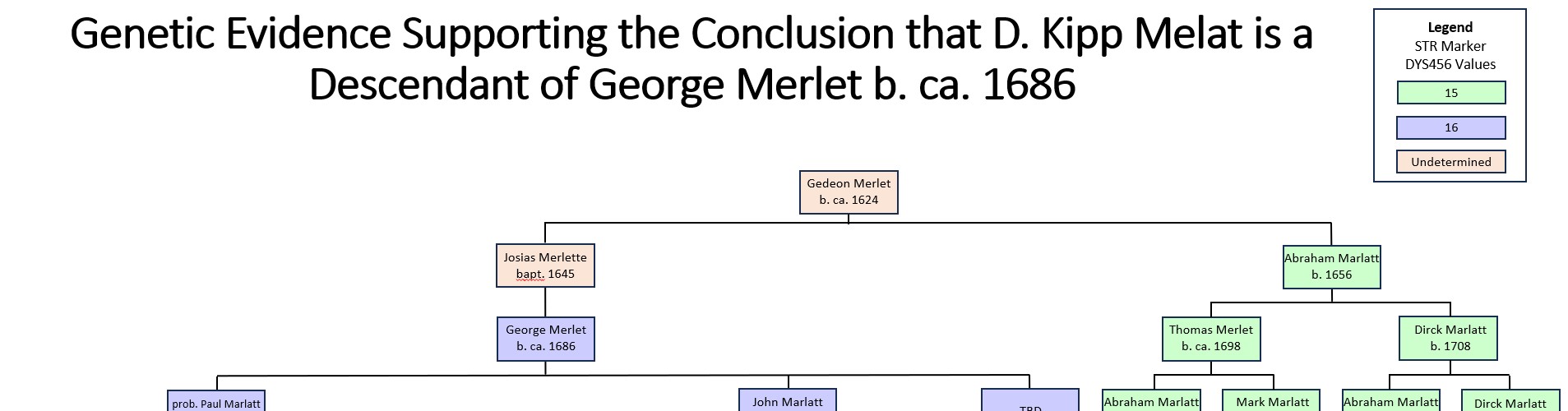
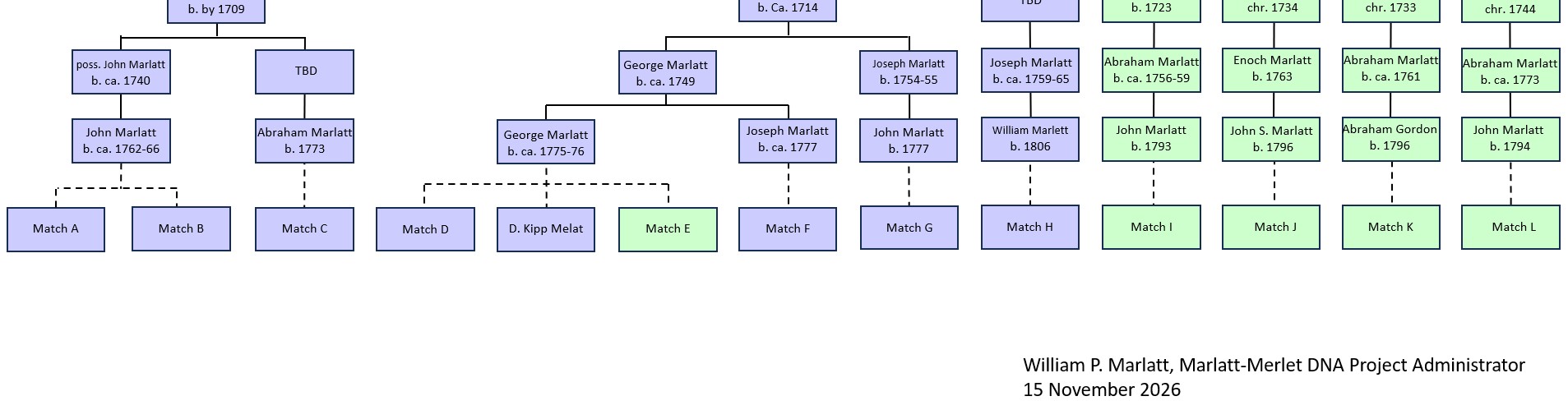
Supporting Note 62
[Analysis: This analysis provides genetic evidence supporting the conclusion that D. Kipp Melat is a descendant of George Merlet, b. ca. 1686 and Gedeon Merlet, b. ca. 1624.
A Y-DNA haplogroup is a genetically defined branch of the paternal family tree consisting of men who share a common paternal ancestor and specific Y-DNA mutations inherited from that ancestor. As mutations occur in successive generations, new branches, or haplogroups, are formed. Because the Y chromosome is passed from father to son with relatively little change, these mutations can be used to trace and distinguish different branches of a paternal family (Supporting Notes 137 and 138).
A terminal haplogroup is the most recent or most specific haplogroup assigned to a Y-DNA test taker. An ancestral haplogroup is an earlier haplogroup through which that same paternal line descended. Importantly, a man does not carry only the mutation or mutations that define his terminal haplogroup. He also carries the mutations that define his ancestral haplogroups. These mutations accumulated along his paternal line over successive generations and were transmitted from father to son. Thus, a test taker’s Y-DNA can provide evidence not only of his most recent paternal branch but also of the older paternal branches from which it descended.
The figure below shows a descendancy chart of Gedeon Merlet, b. ca. 1624 containing 10 men who have taken Big Y-700 DNA tests at FamilyTreeDNA (Supporting Note 139). These men have either proven paternal lineages extending back to Gedeon Merlet, b. ca. 1624 or hypothesized lineages that are considered highly credible. Each of the Y-DNA matches of D. Kipp Melat is identified as Match A–I, and the color of the box referring to Kipp and his matches identifies each test taker’s terminal haplogroup, as shown in the Haplogroup Legend.
For example, the blue color of Kipp’s box corresponds to terminal Haplogroup G-FT64375. Matches C, D and E also belong to terminal Haplogroup G-FT64375. Both Matches C and D have confirmed paternal lineages extending back to George Merlet, b. ca. 1686. Match E’s paternal lineage has not been proven, however, a lineage extending back to George Merlet, b. ca. 1686 is entirely possible. The combination of the documented or highly credible lineages of Kipp and Matches C, D, and E and their shared haplogroup provides genetic evidence associating G-FT64375 with the paternal branch descending from George Merlet, b. ca. 1686.
Documentary evidence indicates that Paul Marlatt, b. ca. 1709, was a son of George Merlet, b. ca. 1686 (Supporting Notes 165 and 63). The genetic evidence supports the inference that George carried the mutation or mutations defining Haplogroup G-FT64375, while the branch descending through his son Paul, represented by Matches A and B, belongs to the downstream Haplogroup G-FT64131. Because George and Paul represent successive generations, the Y-DNA mutation defining G-FT64131 must have occurred in the paternal line between George Merlet, b. ca. 1686, and his son Paul Marlatt, b. ca. 1709. Paul and his descendants continued to carry the mutation or mutations defining ancestral Haplogroup G-FT64375, while also carrying the newer mutation defining G-FT64131. Thus, G-FT64131 represents a distinct downstream paternal branch that appears to have originated with Paul Marlatt, b. ca. 1709.
The figure also shows an older genetic relationship connecting these branches. All of the test takers represented in the figure belong to Haplogroup G-FT64201, either as their terminal haplogroup or as an ancestral haplogroup. This demonstrates that their paternal lines ultimately converge on a man who carried the mutation or mutations defining G-FT64201. The documented lineages of these test takers support the identification of that shared paternal ancestor as Gedeon Merlet, b. ca. 1624, thereby providing genetic evidence consistent with their descent from him.
Matches F and G have G-FT64201 as their terminal haplogroup. Match G has a proven paternal lineage extending through Abraham Marlatt, b. 1656, supporting the conclusion that Abraham carried the mutation or mutations defining Haplogroup G-FT64201. Matches H and I share the common paternal ancestor Dirck Marlatt, b. 1708, son of Abraham Marlatt, b. 1656, and belong to the downstream terminal Haplogroup G-FT247721. Because Abraham and Dirck represent successive generations, the Y-DNA mutation defining G-FT247721 must have occurred in the paternal line between Abraham Marlatt, b. 1656 and his son Dirck Marlatt, b. 1708. Dirck and his descendants continued to carry the mutation or mutations defining ancestral Haplogroup G-FT64201, while also carrying the newer mutation defining G-FT247721. Thus, G-FT247721 represents a distinct downstream paternal branch that appears to have originated with Dirck Marlatt, b. 1708.
In summary, D. Kipp Melat and three other test takers (Matches C, D, and E) belong to terminal Haplogroup G-FT64375 and have paternal lineages extending back to George Merlet, b. ca. 1686. Kipp also carries the mutation or mutations defining the older ancestral Haplogroup G-FT64201, which is shared by all of the paternal branches represented in the figure. When the Y-DNA evidence is correlated with the documented and highly credible paternal lineages of these test takers, the haplogroup pattern provides genetic evidence supporting the conclusion that D. Kipp Melat descends through the paternal branch of George Merlet, b. ca. 1686 and ultimately from Gedeon Merlet, b. ca. 1624.]
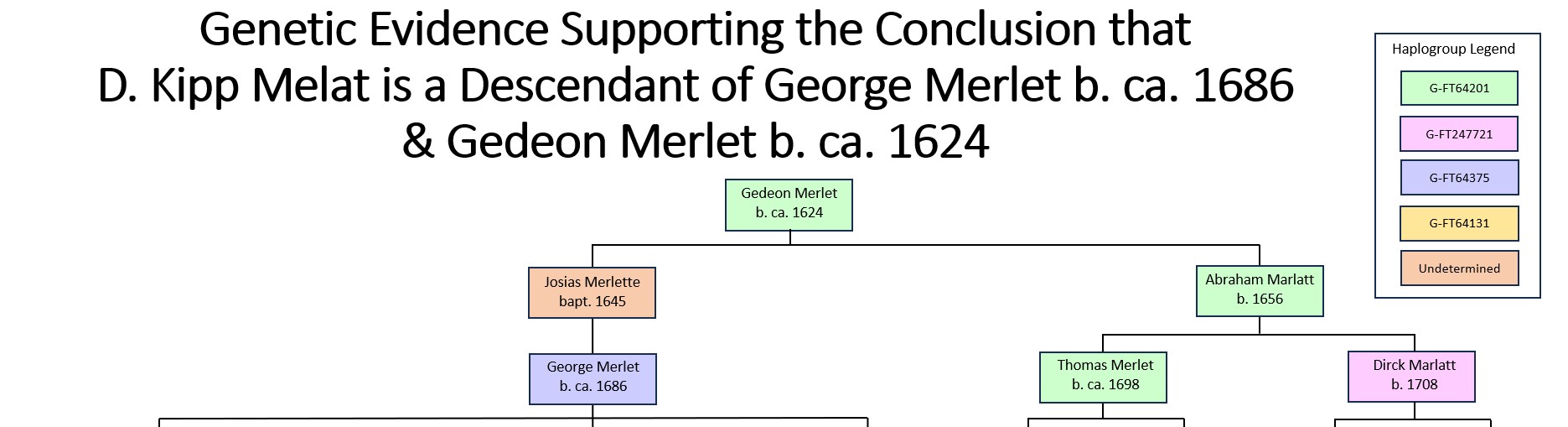
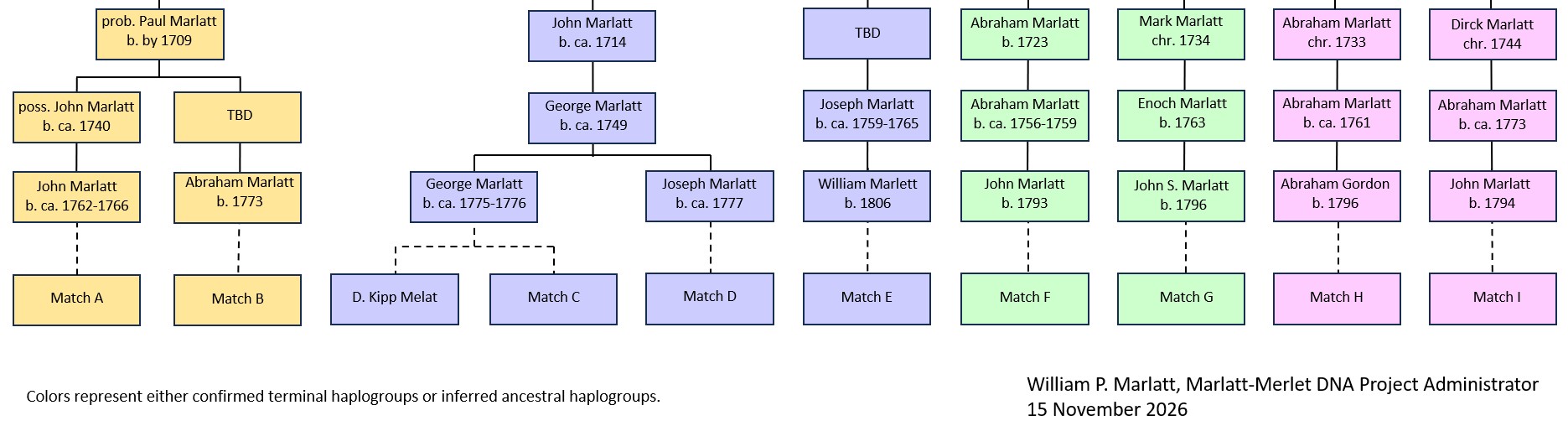
Supporting Note 63
Kenn Stryker-Rodda, "The Janeway Account Books, 1735–1746" (continued), The Genealogical Magazine of New Jersey 34, nos. 1–2 (January–April 1959): 41–48, entry for "Morlat (Morlatt, Morlet)," "Paul, Nov. 1736 ... 1745, Lebanon, son to George Sr."; digital image of microfilm, FamilySearch (Film No. 982045, Image Group No. 8621375, "The Genealogical Magazine of New Jersey," vols. 26–35), image 658; accessed 20 July 2021.
[Analysis: This published transcription of the Janeway Account Books identifies Paul Morlat (Morlatt, Morlet) of Lebanon, Hunterdon County, New Jersey, and explicitly describes him as the “son to George Sr.” These individuals were probably Paul Marlatt, b. ca. 1709, and his father, George Merlet (Marlatt), b. ca. 1686. The Janeway store appears to have been located near present-day Bound Brook, Somerset County, approximately 19 miles from present-day Lebanon Borough, Hunterdon County (Supporting Note 167). The identification of Paul with Lebanon is consistent with the 1735 Hunterdon County record naming George Marbot, Paul Marlatt, and John Merlatt (Supporting Note 57), and the 1753 trespass action involving Paul Marlatt in Lebanon Township. Together, these records provide chronological, geographic, and documentary support for the proposed father-son relationship.]
[Commentary: The Janeway Account Books explicitly identify Paul Morlat as a son of George Sr. Other evidence presented in this study supports the conclusion that John Marlatt, b. ca. 1714, was probably another son of George Merlet, b. ca. 1686, and therefore a brother of Paul Marlatt, b. ca. 1709 (Supporting Notes 57 and 60). Although the Janeway entry does not identify John or establish his relationship to Paul, it provides direct documentary evidence of the earlier father–son relationship upon which the proposed family reconstruction is partly based.]
Supporting Note 64
William Nelson, ed., Documents Relating to the Colonial History of the State of New Jersey, vol. 21, Calendar of Records in the Office of the Secretary of State, 1664–1703 (Paterson, New Jersey: Press Printing and Publishing Co., 1890), 49, abstract of the will of Andrew Bowne of Middletown, Monmouth County, dated 6 May 1707 and proved 26 June 1708; digital image, FamilySearch (https://www.familysearch.org/ark:/61903/3:1:3Q9M-CS9R-2N6T?view=explore : accessed 12 July 2026), image 558 of 808, Image Group No. 007809473
[Analysis: This published abstract summarizes the will of Andrew Bowne of Middletown, Monmouth County, New Jersey, dated 6 May 1707. George Merlet was one of the witnesses to the will, which was proved on 26 June 1708. If George had attained age twenty-one when he witnessed the will, he would have been born no later than 6 May 1686. No evidence has been identified establishing that New Jersey law required a will witness to have attained age twenty-one at that time; accordingly, this calculation should be treated as a chronological benchmark rather than a legal minimum. George's appearance as a witness nevertheless supports an estimated birth of ca. 1686 when correlated with other chronological evidence, including the reported age of probable relative Joseph Marlett in the 1706 Staten Island census and historical evidence concerning birth intervals (Supporting Notes 168 and 166). This is the earliest known record presently identified for George Merlet.]
Supporting Note 65
Matthew Ferricks, email to William P. Marlatt, 26 November 2016; privately held by William P. Marlatt, Moorpark, California; citing Richmond County, New York, Deed Book B:15–16, Josias Marlett and his wife Jane to Paulus Richards, indenture dated “the 29th day [first day] of [month missing] in the 36th year of the reign of Charles II,” conveying land on Staten Island for £95, originally granted by patent dated 1 November 1675.
[Summary: The email summarizes a deed recorded in Richmond County, New York, in which Josias Marlett of Staten Island, yeoman, and his wife Jane conveyed land to Paulus Richards of New York City, merchant, for £95. The land was described as having been granted by patent dated 1 November 1675 to Josias Marlett, his father Gideon, and his brother Paulus Marlett.]
[Analysis: The deed dates the indenture to the thirty-sixth regnal year (year of a monarch’s reign) of Charles II. Although Charles II did not exercise royal authority in England until the Restoration in 1660, his regnal years were reckoned from his legal accession on 30 January 1649. His thirty-sixth regnal year therefore extended from 30 January 1684 to 29 January 1685 (Supporting Note 169), placing the indenture within that period. The deed places Josias Marlett and his wife Jane on Staten Island at that time. Because George Merlet was born no later than about 1686 and is believed to have been a son of Josias and Jane, their documented residence on Staten Island shortly before his estimated birth supports Staten Island, Richmond County, New York, as a plausible birthplace for George. The deed does not, however, establish his birthplace.]
Supporting Note 66
Richmond County, New York, County Court, Deeds, Deed Book B, pp. 15–16, Josias Marlet and wife Jane to Paulus Richards, indenture, dated [August 1684], recorded 1 August [1684]; digital images, FamilySearch, “Richmond, New York, United States records” (https://www.familysearch.org/ark:/61903/3:1:3QSQ-G9WC-F7BC : accessed 20 December 2025), images 27–28 of 610, Image Group Number 007138172.
[Summary: This indenture, dated in August in the thirty-sixth year of the reign of King Charles II [August 1684], records a transaction between Josias Marlett of Staten Island in Richmond County, New York, yeoman, and his wife Jane, as grantors, and Paulus Richards of the City of New York, merchant, as grantee. For a stated consideration of £95 in money of the Province of New York, Josias Marlett and Jane conveyed to Paulus Richards, his heirs and assigns, all their right, title, and interest in various property, including messuages [dwellings], lands, meadows, pastures, woods, underwoods, rents, reversions, services, and appurtenances [rights and privileges associated with a property]. The conveyed property derived from a patent granted under the seal of the province by Edmund Andross on 1 November 1675 to Josias Marlett, his father Gideon Marlett, and his brother Paulus Marlett. The conveyance included all reversions, remainders, estates, rights, titles, interests, and demands of Josias Marlett and the dower right of Jane, together with all deeds, charters, and patents relating to the premises. The property was granted to Paulus Richards and his heirs and assigns for their sole use and benefit, subject to the payment of such rents, duties, and services as were due to the Crown. The instrument concludes with its execution by Josias Marlett and Jane by setting their hands and seals. The deed was witnessed by James Matt and Samuel Windor, sworn to by Samuel Windor, and entered of record on 1 August.]
[Analysis: Charles II reigned legally (de jure, in the view of Royalists) from 30 January 1649—the date of Charles I’s execution—through 6 February 1685, although he did not exercise governing authority until the Restoration in 1660. The regnal years, or years of his reign, were nevertheless calculated from 30 January 1649. A regnal year began on the anniversary of that date; the completion of one regnal year simply marked the beginning of the next and did not mark the end of the king’s reign. Accordingly, the “36th year” of Charles II’s reign extended from 30 January 1684 through 29 January 1685 (Supporting Note 169), placing an instrument dated in August of that regnal year in August 1684. The instrument therefore provides additional evidence that Josias Marlett and his wife Jane were residing on Staten Island during the period surrounding the estimated birth of their probable son George Merlet, born ca. 1686. When correlated with other records documenting Josias/Joshua Marlett on Staten Island from 1675 through 1699, the evidence supports Staten Island, Richmond County, New York, as George’s probable birthplace, although no record has been found that directly identifies his place of birth.
The 1675 patent is also significant because it explicitly identifies Gideon Marlett as Josias’s father and Paulus Marlett as his brother, providing direct evidence of those stated family relationships within a later land transaction.]
[Commentary: There is a potential discrepancy in the day the indenture was executed and recorded. The opening line appears to state that the indenture was made on the “ninet” of August, while the recording notation states that it was entered of record on the “1st day of August.” If “ninet” represents “ninth,” the stated recording date would precede execution, an apparent chronological inconsistency. Supporting Note 65 reports the execution date as 29 [Missing month], providing another interpretation of the difficult manuscript date. Reexamination of the image suggests that “ninet” might alternatively represent a poorly formed “first.” Until the handwriting or another version of the instrument resolves the discrepancy, the precise day should be treated as uncertain.]
Supporting Note 67
Richmond County, New York, County Court, Deeds, Deed Book B, pp. 348–351, Josiah Marlet and wife Jane to Christopher Garnetson, deed, dated [May 1699], acknowledged 9 August 1699, recorded 23 September 1699; digital images, FamilySearch, “Richmond, New York, United States records” (https://www.familysearch.org/ark:/61903/3:1:3QS7-89WC-F7WR : accessed 20 December 2025), images 188–189 of 610, Image Group Number 007138172.
[Summary: This deed records the conveyance by Josiah Marlet of Staten Island, yeoman, and his wife Jane to Christopher Garnetson, husbandman, of land and meadow on the south side of Staten Island, including references to “New Dorp” and “Great Kill,” together with the associated appurtenances and rights, for £120. The property description references lands associated with Samuel Curtis, Richard Doddiman, Lewis Lakeman, and John Wattson. Josiah and Jane warranted that they were lawfully seized of the property and that it was free of encumbrances except for rents owed to the Crown. The deed was sealed and delivered in the presence of Peter Lakeman, Theodore Le Roy, William Huddelston, and Paul Richards and was acknowledged on 9 August 1699 before Thomas Morgan, Justice of the Peace, in Richmond County.]
[Analysis: This deed documents Josias/Josiah Marlet and his wife Jane on Staten Island in 1699. When correlated with the 1675 patent and other records cited in this study, the evidence documents Josias/Joshua Marlett’s association with Staten Island from at least 1675 through 1699. George Merlet, born ca. 1686, is believed to have been a son of Josias/Joshua and Jane. Because Josias/Joshua is documented on Staten Island both before and after George’s estimated birth, the evidence supports Staten Island, Richmond County, New York, as George’s probable birthplace. No record has been found, however, that directly identifies George’s place of birth. The 1907 Skene map of Staten Island colonial land patents places landholders bearing the names Samuel Curtis, Richard Doddiman, Lewis Lakeman, and J. Watson—the names of landholders referenced in the property description—in the Great Kills vicinity (Supporting Note 170). The map also identifies Peter Lakeman and Paulus Richards, two of the witnesses to the deed, as Staten Island landholders. These geographic correlations provide additional support for locating the property described in the deed in the Great Kills vicinity and identify several members of the Marlet FAN network in that area.]
Supporting Note 68
New York (State), Secretary of State, Calendar of N. Y. Colonial Manuscripts: Indorsed Land Papers, in the Office of the Secretary of State of New York, 1643–1803 (Albany: Weed, Parsons & Co., 1864), 7; digital images, Internet Archive (https://archive.org/details/calendarofnycolo00alba : accessed 21 December 2025).
[Extract: “1675. Nov. 1. Copy of the bounds of 243 acres of land on the south side of Staten Island; also 30 acres of salt meadow, lying at the mouth of Fresh kill, patented to Gideon Marlett and his two sons, Joshua and Paulus, … Page 66”]
[Analysis: This record documents that Gideon Marlett and his sons Joshua [Josias] and Paulus were granted 243 acres of land and 30 acres of salt meadow on Staten Island in 1675. When correlated with other records cited in this study, the evidence indicates that Josias/Joshua Marlett was associated with Staten Island from at least 1675 through 1699. Because George Marlett, born no later than about 1686, is believed to have been a son of Josias and his wife Jane, their documented association with Staten Island during the period surrounding George’s estimated birth supports Staten Island, Richmond County, New York, as a plausible birthplace for George. The evidence does not, however, establish his birthplace.]
Supporting Note 69
New York (State). Secretary of State, Calendar of N. Y. Colonial Manuscripts: Indorsed Land Papers, in the Office of the Secretary of State of New York, 1643–1803 (Albany: Weed, Parsons & Co., 1864), p. 7; digital images, Internet Archive (https://archive.org/details/calendarofnycolo00alba : accessed 21 December 2025).
[Extract: “1675. Nov. 1. Copy of the bounds of 243 acres of land on the south side of Staten Island; also 30 acres of salt meadow, lying at the mouth of Fresh kill, patented to Gideon Marlett and his two sons, Joshua and Paulus, … Page 66”]
[Commentary: This record places Josias/Joshua Marlett on Staten Island by 1 November 1675. Other records cited in this study document his continued presence there through 1699. Because George Marlett, believed to have been a son of Josias/Joshua and his wife Jane, was born no later than about 1686, their documented residence on Staten Island during the period surrounding George’s estimated birth supports Staten Island, Richmond County, New York, as George’s probable birthplace. No record has been found, however, that directly identifies his place of birth.]
Supporting Note 70
Jane (Marlett) Taft, Gideon Marlett (Gedeon Merlet), A Huguenot of Staten Island, N.Y., with Some Account of His Descendants in the United States and Canada, 1668–1907 (Burlington, Vermont, 1907), 283.
[Extract: “1719 May 8.”, “George Merlatt of Machiponix, Middlesex Co., Yeoman, [and] Hannah his wife to John Browne of Amboy, Cont. 150 Acres in Middlesex Co., - signed with mark.”]
[Summary: Reports that George and Hannah Merlatt of Machiponix, Middlesex County, New Jersey, conveyed 150 acres of land to John Browne of Amboy on 8 May 1719.]
[Analysis: This record establishes that George Merlatt and Hannah were married by 8 May 1719. Other evidence cited in this study supports estimating the births of George's probable sons Paul and John at about 1709 and 1714, respectively (Supporting Notes 165 and 57). No record has been identified establishing the identity of their mother. Although Hannah may have been their mother, her identification as George's wife in 1719 does not establish that she was married to George when Paul or John was born.]
[Commentary: George Merlet and Hannah were married by 8 May 1719, as established by the deed cited above. Paul Marlatt, believed to have been a son of George, was probably born no later than about 1709, based on his appearance as a juror in 1730 (Supporting Note 71). No evidence has been identified that George married more than once. If Hannah was Paul's mother, George and Hannah probably married by about 1709, although their actual marriage date and place remain unknown. The available evidence therefore supports a possible marriage by ca. 1709 and establishes that they were married no later than 8 May 1719.]
Supporting Note 71
FamilySearch (https://www.familysearch.org/…; Full URL : accessed 13 November 2025), image 1349 of 1,553, Monmouth County, New Jersey, Court Minutes, Freehold, New Jersey; from FHL microfilm 009068922.
[Extract: Entry dated 30 October 1730, recording: “Wm. Eveningham } Trial [Farmdon ?] / Jacob Millar } / Jury sworn George Merlat, Solomon Wood, Michael Sears, Israel Everingham, Paul Merlat, [Sworn], and Def[endant] Thomas Kinsey, James Tapscot in evidence read. Wm. Leeds, John Ashlon, Esq., Thomas Hankin, and Thomas Everingham sworn and [deposed]. After a full hearing, Wm. Lawrence and Wm. Dougan, with Mr. Parker and Mr. Tyello, defended [the case] before the Judge. The jury returned with a [Farmdon ? Formston ?] file sworn, and the Court adjourned for an hour.”]
[Analysis: The 30 October 1730 court entry identifies George Merlat and Paul Merlat among the jurors. New Jersey had enacted legislation governing jury qualifications in 1713/14, but the text of that act has not yet been examined to determine whether it expressly required jurors to have attained age twenty-one. English law concerning jury service excluded persons under age twenty-one, and English common law and applicable English statute law were practiced in colonial New Jersey (Supporting Notes 171 and 172). Accordingly, age twenty-one provides a reasonable historical benchmark for evaluating Paul's jury service, but should not presently be treated as a conclusively established New Jersey legal requirement. If Paul was at least twenty-one when he served as a juror in 1730, he would have been born no later than about 1709. This evidence therefore supports estimating Paul's birth at ca. 1709 rather than establishing 1709 as a firm latest birth year. George Merlat is believed in this study to have been Paul's father. The record also documents George and Paul Merlat together in Monmouth County in 1730, providing evidence of a contemporary association between the two men, although it does not by itself establish their relationship.]
Supporting Note 72
Package from Helen Oldfield to William P. Marlatt, postmarked 6 April 1987, containing Isabella Carton-Downs and Helen Egan-Oldfield, The Carton–Marlatt Descendants of “De Merle – De Marle – (Marlatts),” Huguenot and United Empire Loyalist (Victoria, British Columbia: self-published, 1980; first printing with additions, 1986), p. 8; privately held by William P. Marlatt, Moorpark, California.
[Analysis: Carton-Downs and Egan-Oldfield report that George Merlet, born about 1685– 1686, married a woman named Hannah, whose maiden name they suggest may have been Bowne. No evidence has been identified establishing Hannah's maiden name. The proposed Bowne surname appears to be speculative and may derive from George Merlett's service as a witness to the will of Andrew Bowne of Middletown, Monmouth County, New Jersey, dated 6 May 1707 (Supporting Note 64). Although that record documents an association between George Merlett and Andrew Bowne, service as a witness does not, by itself, establish a familial relationship. The nature of any relationship between Hannah and Andrew Bowne therefore remains unproven.]
Supporting Note 73
William P. Marlatt, The Family of George Marlett, Born ca. 1685 (unpublished research manuscript, initial draft, 13 August 2012; revised draft, 16 August 2013), 68 pp.; privately held by the author, Moorpark, California; accessed 15 July 2026.
[Analysis: This unpublished research manuscript presents a timeline for George Marlett, born about 1685–1686, identified as a son of Josias Merlet, together with eleven appendices documenting selected descendants of George Marlett. The manuscript incorporates numerous citations to original and derivative sources supporting the proposed lineage. Although subsequent research has refined several conclusions and the manuscript has not been updated to incorporate those findings, much of the documentary evidence and many of the source citations remain pertinent to the present study.]
Supporting Note 74
William Nelson, ed., Documents Relating to the Colonial History of the State of New Jersey, vol. XXIII, Calendar of New Jersey Wills, Vol. I, 1670–1730 (Paterson, N.J.: The Press Printing and Publishing Co., 1901), p. 304; digital image, Ancestry.com, “New Jersey, U.S., Abstract of Wills, 1670–1817” (https://www.ancestry.com/…; Full URL : accessed 21 August 2026).
[Extract: “1715 May 23. Marlett, Joseph, of Monmouth Co. Bond of his widow Sarah Marlett as administratrix of the estate of. George Marlett and Thomas Cherry, yeomen, fellow bondsmen.”]
[Summary: An entry dated 23 May 1715 records the bond of Sarah Marlett, widow of Joseph Marlett of Monmouth County, New Jersey, as administratrix of his estate. George Marlett and Thomas Cherry, both described as yeomen, were named as fellow bondsmen.]
[Analysis: George and Joseph Marlett were contemporaries and are believed to have been brothers, both probable sons of Josias Merlette. George’s participation as a fellow bondsman in the administration of Joseph’s estate documents an association between the two men but does not, by itself, establish their relationship. Thomas Cherry’s participation as the other fellow bondsman may also be genealogically significant. Derivative genealogical accounts identify Thomas Cherry and Sarah, widow of Joseph Marlett, as siblings and children of Henry Cherry, although this relationship has not yet been established by independent documentary evidence. Other records identified in this study document a continuing association between Thomas Cherry and George Marlatt, including land transactions between the two men in 1718 and 1719 (Supporting Notes 173 and 174). If the proposed sibling relationship between Thomas Cherry and Sarah Marlett is substantiated, the 1715 bond would present a plausible family connection in which George Marlett, probable brother of Joseph, and Thomas Cherry, probable brother of Sarah, served together as fellow bondsmen for Joseph’s widow. Taken together, the 1715 bond and the subsequent land transactions strengthen the evidence of a continuing association between the Marlatt and Cherry families, while the precise familial relationships remain to be established.]
Supporting Note 75
Helen Egan-Oldfield to William P. Marlatt, package postmarked 6 April 1987, containing Isabella Carton-Downs and Helen Egan-Oldfield, The Carton–Marlatt Descendants of “De Merle”–“De Marle” (Marlatts), Huguenot and United Empire Loyalist (Victoria, British Columbia: self-published, 1980; first printing, additions 1986); privately held by William P. Marlatt, Moorpark, California.
[Analysis: Carton-Downs and Egan-Oldfield identify George Merlet, born about 1685, as a son of Josias Merlet. Although this statement appears in a compiled family history rather than a contemporary record, it provides derivative evidence supporting the proposed father– son relationship. The evidentiary weight of this assertion depends upon the underlying sources and reasoning used by the authors and should therefore be evaluated in conjunction with the documentary and genetic evidence presented elsewhere in this study.]
Supporting Note 76
A. J. Verspeille [Versprille], Archivist, Gemeente-Archief van Leiden, Boisotkade 2A, Leiden, Holland, letter to Mrs. Josef Finck, St. Paul, Minnesota, 14 August 1965, reporting a Walloon Church baptismal entry for Josias, son of Gedeon Merlette, dated 17 September 1645; privately held copy, provenance not stated.
[Summary: According to the archivist’s letter, Josias, son of Gedeon Merlette, was baptized in the Walloon Church at Leiden on 17 September 1645. The mother was not named. The witnesses were Glaude Marcy, Jean Martijn, Jeanne Martijn, and Clasinne Tertelim.]
[Analysis: Other evidence establishes that Gedeon Merlette and Margriet Martin married in Leiden on 21 August 1644 (Supporting Notes 81, 82, and 83), approximately thirteen months before Josias’s baptism. The proximity of the marriage and baptism dates supports the inference that Josias was probably their first-born son, although the baptismal entry itself does not identify his mother or establish his birth order. The choice of the name Josias is also consistent with the possibility that Gedeon named his son for his own father, believed in this study to have been Josias Marles (Supporting Note 80); however, naming patterns alone do not establish that relationship.]
Supporting Note 77
Sally Nield, e-mail to William P. Marlatt, “Possible last name for Jane, wife of Josias Marlett (1645–1710)?,” 21 November 2020; citing Richmond County, New York, Deed Book B, pp. 264–265, instrument of Josuah Merlett and wife, dated 26 March 1693, recorded 26 March 1694; digital images, FamilySearch, “United States, New York Land Records, 1630–1975” (https://familysearch.org/…; Full URL : accessed 22 May 2023 & 22 August 2026), image 171 of 392; privately held e-mail by William P. Marlatt, Moorpark, California.
[Summary: In her 21 November 2020 e-mail, Sally Nield proposed Goris as a possible surname for Jane, wife of Josias/Joshua Marlett, based on her interpretation of a Richmond County deed. Examination of enlarged digital images of the underlying instrument, dated 26 March 1693 and recorded 26 March 1694, substantially supports her reading. The deed records a conveyance by Josuah Merlett of Staten Island of an interest in a lot of land on the south side of Staten Island, adjoining land of John Stilwell. The conveyance was made with the consent of Josuah’s wife, whose name appears in the body of the instrument as Jeane or Jeanne Goris. The instrument conveyed Josuah’s interest, together with associated rights, to the grantee and his heirs or assigns, subject to applicable taxes, rates, or quit rents. The document was signed and sealed by Josuah Merlett and includes the mark of his wife, whose name again appears to include the surname Goris. Although portions of the consideration, warranty provisions, grantee’s surname, and witness names remain difficult to decipher, the identification of Josuah Merlett and the reference to Goris as his wife are among the more legible portions of the instrument.]
[Analysis: Examination of enlarged digital images of the underlying deed provides substantial support for Nield’s 2020 interpretation. The operative language appears to read, in pertinent part, “Josuah Merlett of Staten Island in the County aforesaid with the Consent of Jeane [or Jeanne] Goris my wife.” The surname Goris also appears to be repeated beside the wife’s mark at the conclusion of the instrument. The presence of the name in two separate portions of the same contemporary record, particularly the explicit identification of Goris as “my wife,” provides strong evidence that Josuah Merlett’s wife was known as Jeane or Jeanne Goris. The precise spelling of her given name remains somewhat uncertain because of the seventeenth-century handwriting, but the reading of the surname as Goris is substantially strengthened by its apparent occurrence both in the body and in the execution portion of the document. The record does not, however, establish whether Goris was her maiden name, a previous married name, or another surname by which she was known. Accordingly, the evidence supports identifying her as Jeane [or Jeanne] Goris, wife of Josuah Merlett, while the more specific conclusion that Goris was her maiden name remains unproven.]
Supporting Note 78
Matthew Ferricks, e-mail to William P. Marlatt, 26 November 2016, citing Richmond County, New York, Deed Book B, p. 265, record of deed recorded for Richard Brittan, 6 March 1694; privately held by William P. Marlatt, Moorpark, California.
[Summary: Ferricks reported that Josiah Merlett of Staten Island, with the consent of his wife, Jean, conveyed land on the south side of Staten Island adjoining lands of John Stilwell and John Cabilodu (uncertain reading). The instrument was dated 26 March 1693. Ferricks stated that the signatures of the witnesses were illegible.]
Supporting Note 79
[Analysis: This presents genetic evidence supporting the conclusion that a closely related group of men who have taken Y-DNA tests at FamilyTreeDNA— Kipp Melat and his Y-DNA matches referred to as Matches A, B, C, and D—share the Marlatt-Merlet paternal lineage and most likely descend from Gedeon Merlet, b. ca. 1624.
The Marlatt-Merlet DNA Project Summary Report, dated 19 March 2021, describes a comparative study of the Y-DNA profiles of two distinct paternal groups (Supporting Note 175). The first group consists of men bearing the surnames Marlatt, Marlett, and MarLett, whose documented or proposed pedigrees trace to Josias Merlet, bapt. 1645, or to Abraham Marlatt born 1656, both sons of Gedeon Merlet, b. ca. 1624. The second group consists of men bearing the surnames Malott and Mellott, whose lineages have been traced to Theodore Melot/Malot, b. ca. 1694, alleged to have been a son of Jean Pierre Malott, b. ca. 1658.
The first image below summarizes the modal (most frequently observed) Y-STR marker values for each of these two paternal groups in the study. Comparison of the modal values demonstrates that the Marlatt-Marlett and Malott-Mellott lineages possess distinctly different Y-STR profiles, indicating that they represent separate paternal families.
The Y-DNA STR marker values of Kipp Melat and his close Y-DNA matches, Matches A, B, C, and D were then compared with the modal values for each group (Supporting Note 139). The results are presented the second image below. In every case, these five men differ by only a small number of STR marker values from the Marlatt-Merlet modal profile, indicating that they belong to the same paternal lineage. By contrast, comparison with the Malott-Mellott modal profile reveals 23 or 24 STR marker differences for each of the five men.
These comparisons provide strong genetic evidence that Kipp Melat and his close Y-DNA matches, Matches A, B, C, and D share common paternal ancestry with the Marlatt-Merlet family rather than with the Malott-Mellott family. When considered together with the documentary pedigrees of the established Marlatt-Merlet test participants, the Y-DNA evidence supports the conclusion that these five men belong to the Marlatt-Merlet paternal lineage. Because the documented Marlatt-Merlet lineages represented in the DNA project trace to Gedeon Merlet, b. ca. 1624, the combined documentary and genetic evidence strongly supports the conclusion that Kipp Melat and his close Y-DNA matches, Matches A, B, C, and D, likewise descend from Gedeon Merlet.]
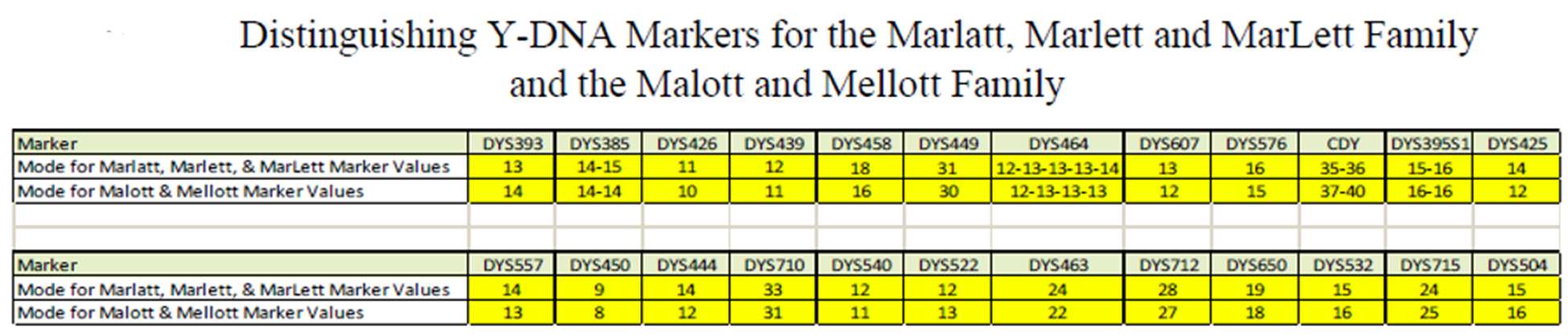
Comparison of Y-DNA STR Marker Values for Test Takers Closely Related to D. Kipp Melat with Modal Values for the Marlatt, Marlett, and MarLett Families and the Malott and Mellott Families
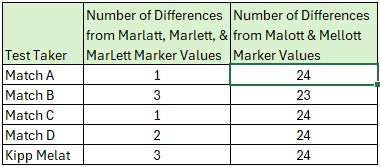
Supporting Note 80
C. W. Dolfortorie, Central Bureau voor Genealogie, The Hague, Netherlands, letter (subject: “Merlet”) to Lois Hall, 9 July 1974, reporting research conducted in the Municipal Archives of Leiden concerning the family of Gedeon Merlette; retyped by Jerry McMindes and forwarded to William P. Marlatt in a mailing postmarked 10 July 1986; privately held by William P. Marlatt.
[Analysis: This letter reports that the archives at The Hague described Gedeon Merlette as a “carpenter, young man from Roussy” in December 1643. The term translated as “young man” indicates that Gedeon had not previously married but does not establish his age (Supporting Note 176). His identification as a carpenter suggests that he had already acquired sufficient training to be identified with the carpentry trade. Considered together with his marriage in 1644 and the baptism of his son Josias in 1645, this evidence suggests that Gedeon was probably born no later than about 1624. A later birth is possible, but would place him at an increasingly young age to have acquired sufficient training to be identified as a carpenter and to have married and begun a family by 1645.
The letter further reports that Gedeon’s bride, Margaret, was described as a “spinster from Limbourg.” In this context, “spinster” indicates that she had not previously married but does not provide information about her age (Supporting Note 177). The record therefore supports Limbourg as Margaret’s place of origin but, by itself, does not establish her approximate year of birth.
The letter also refers to Paul Merlette, who is believed to have been a brother of Gedeon Merlette. A copy of Paul's marriage record, enclosed in a package sent by E. R. Cordtz to William P. Marlatt, postmarked 30 June 1986, documents his marriage to Elizabeth Moreau on 20 February 1655 in the French church at Mannheim. The record identifies Paul's parents as Josias Marles and Jeanne Robb, who had resided in Roussy, Champagne, during their lifetimes. Gedeon's independent identification as being “from Roussy,” together with the apparent relationship between Gedeon and Paul, is consistent with the hypothesis that Josias Marles and Jeanne Robb were also Gedeon's parents. The evidence is suggestive, however, and does not by itself establish that parent-child relationship.]
Supporting Note 81
Marriage record of Gedeon Merleth, carpenter from de Rousy, and Margriet Martin of Limborch, married 21 August 1644, Walloon Church, Leiden, Holland; reported in A. J. Versprille, Archivist, Gemeente-Archief van Leiden, Leiden, Holland, letter to Mrs. Josef Finck, St. Paul, Minnesota, 14 August 1965; copy forwarded by Dorothy Leach to William P. Marlatt in correspondence postmarked 18 December 1986; privately held by William P. Marlatt.
[Analysis: According to the information supplied by the Archivist of Leiden, Gedeon Merleth, identified as a carpenter from de Rousy, married Margriet Martin of Limborch in the Walloon Church at Leiden on 21 August 1644. This record establishes the earliest known documented marriage of Gedeon Merleth and identifies his occupation and stated place of origin, as well as Margriet Martin’s stated place of origin. The identification of Gedeon as being from de Rousy is consistent with other evidence connecting the Merlet family with Roussy, in present-day France. Because the information is derived from an archivist’s correspondence reporting the contents of the archival record rather than from examination of the original Walloon Church marriage register or a digital image of it, the reported details should be verified against the original record when possible.]
Supporting Note 82
Mary Everhart Malott, Peter Malott of Maryland and His Descendants (1996), p. 12a, reproducing a letter from Miss A. J. Verspeille [Versprille], Archivist, Gemeente-Archief van Leiden, Boisotkade 2A, Leiden, Holland, to Mrs. Josef Finck, St. Paul, Minnesota, 14 August 1965.
[Commentary: Malott states, "They [Gedeon Merleth and Margariet Martijn] were married in the Walloon Church in Leyden on August 21, 1644.” Malott reproduced the 14 August 1965 letter from the Leiden archivist reporting the marriage record, providing an additional surviving copy of the correspondence cited in Supporting Note 81.]
Supporting Note 83
A. J. Versprille, Archivist, Gemeente-Archief van Leiden, Leiden, Holland, letter to Mrs. Josef Finck, St. Paul, Minnesota, 14 August 1965, reporting a Walloon Church marriage record for Gedeon Merleth and Margriet Martin, Leiden, 21 August 1644; copy forwarded by Dorothy Leach to William P. Marlatt in correspondence postmarked 18 December 1986; privately held by William P. Marlatt.
[Analysis: According to the archivist’s letter, the Walloon Church marriage record identifies Gedeon Merleth as a carpenter from “de Rousy” and Margriet Martin as being from “Limborch”; they married at Leiden, Holland, on 21 August 1644. The archivist’s report supports the identification of Margriet Martin as Gedeon’s wife, his occupation as a carpenter, his origin in Roussy, and the date and place of their marriage. The description of Gedeon as a carpenter indicates that he had entered or completed training in a skilled trade by 1644. His identification as being “from de Rousy” provides important contemporary evidence connecting him with Roussy, in present-day France.]
Supporting Note 84
Mrs. William (“Ruth”) Heidgerd, Secretary, Huguenot Historical Society, New Paltz, New York, extracts from Mannheim church records reporting the birth and baptism of Abraham, son of Gedeon Marlette and Marguerite Martin, born 26 January 1656 and baptized 3 February 1656; sent to Sara Katherine (“Sally”) Fox Smit, who forwarded the extracts to Eva G. Malott (letter dated 1 December 1972); Eva G. Malott forwarded the extracts to William P. Marlatt in correspondence dated 27 October 1986; privately held by William P. Marlatt.
[Analysis: These extracts report the birth and baptism of Abraham, identifying his parents as Gedeon Marlette and Marguerite Martin. When correlated with their documented marriage at Leiden on 21 August 1644, the record provides strong evidence that Marguerite Martin was Gedeon’s wife and the mother of Abraham. Although the baptismal record of Josias, baptized 17 September 1645, names Gedeon as his father but does not identify his mother, no evidence has been found that Gedeon was married to anyone other than Marguerite Martin during the period between their marriage in August 1644 and Abraham’s birth in January 1656. Moreover, Josias was baptized approximately thirteen months after Gedeon and Marguerite’s marriage. Taken together, the chronology and absence of evidence of another marriage strongly support the conclusion that Marguerite Martin was also the mother of Josias.]
Supporting Note 85
AncestryDNA, DNA results for D. Kipp Melat, Ancestry.com (https://www.ancestry.com : accessed on the date specified in the analysis), DNA matches, shared DNA amounts, shared matches, ThruLines, and linked family trees; private database accessible through the test taker’s authorized account.
Supporting Note 86
Blaine T. Bettinger, “The Shared cM Project 4.0 tool v4,” interactive version by Jonny Perl, DNA Painter, last updated 26 March 2020, (https://dnapainter.com/tools/sharedcmv4 : accessed 30 August 2026).
[Summary: The Shared cM Project is a crowdsourced database developed by Blaine Bettinger that reports the amounts of autosomal DNA, measured in centimorgans (cM), shared by people with known genealogical relationships. Version 4 incorporates data from nearly 60,000 known relationships and provides observed ranges and averages for different relationships. The Shared cM tool at DNA Painter allows a user to enter the amount of DNA shared with a match and identify the possible relationships consistent with that amount, together with probability estimates for those relationships.]
Supporting Note 87
AncestryDNA, “What is genetic inheritance?,” AncestryDNA Help, (https://www.ancestry.com/cs/dna-help/matches/inheritance : accessed 16 September 2026); AncestryDNA, “How do we estimate relationships?,” AncestryDNA Help, (https://www.ancestry.com/cs/dna-help/matches/estimates : accessed 16 September 2026); AncestryDNA, “What are Shared Matches?,” AncestryDNA Help, (https://www.ancestry.com/cs/dna-help/matches/shared-matches : accessed 16 September 2026); AncestryDNA, “Parents’ DNA & Substitutes,” AncestryDNA Learning Hub, (https://www.ancestry.com/c/dna-learning-hub/telling-parents-matches-apart : accessed 16 September 2026).
[Summary: AncestryDNA explains that autosomal DNA is inherited from both parents and recombined from generation to generation, so relatives inherit different portions of ancestral DNA. More distant relatives generally share less DNA, and some distant relatives may share no detectable DNA. Shared Matches identifies people who match both the test taker and another selected match and can help identify the family line through which the relationship occurs. Ancestry also explains that when a parent is unavailable, other biological relatives can serve as substitutes or surrogate test takers for investigating particular family branches.]
Supporting Note 88
Pennsylvania Department of Health, Certificate of Death, Susan Brandon, died 2 March 1919, Venango County, Pennsylvania, file no. 37656; “Pennsylvania, U.S., Death Certificates, 1906–1972,” database with images, Ancestry.com (https://www.ancestry.com/…; Full URL : accessed 28 October 2026); citing Pennsylvania Department of Health, death certificates, Series 11.90, Record Group 11, Pennsylvania Historical and Museum Commission, Harrisburg, Pennsylvania.
[Summary: Susan Brandon, a widow, died 2 March 1919 in Oil City, Venango County, Pennsylvania, at the reported age of 82 years, 9 months, and 2 days. Her date of birth was recorded as 2 May 1836, and her birthplace as Cranberry Township, Pennsylvania. Her father was identified as Robert Melat, born in Venango County, Pennsylvania, and her mother as Mary Collingwood, born in Pennsylvania. The informant was J. W. Brandon of Oil City, Pennsylvania. The cause of death was chronic endocarditis.]
[Analysis: This death certificate identifies Susan Brandon as a daughter of Robert Melat and provides additional evidence concerning her identity and parentage. However, the identification of her mother as Mary Collingwood conflicts with the Robert Melat family Bible and other evidence identifying Elizabeth Kifer as the mother of Susanna Melat, born in 1834, and Charlotte Collingwood as Robert’s subsequent wife (Supporting Notes 18, 28, and 29). The reported birth date of 2 May 1836 also differs from the Bible entry of 21 May 1834. Because the certificate was completed many years after Susan’s birth, and the informant’s firsthand knowledge of her birth and parentage has not been established, these discrepancies require correlation with the earlier family records. The certificate independently supports the identification of Susan Brandon as Robert Melat’s daughter but does not, by itself, resolve the conflicting information concerning her birth date or mother.]
Supporting Note 89
“Robert Melat,” obituary, Venango Spectator (Franklin, Pennsylvania), reportedly 15 September 1887; microfilm, Pennsylvania Room, Franklin Library, Franklin, Pennsylvania, personally examined by D. Kipp Melat in the late 1980s; digital image subsequently obtained from the Franklin Library by D. Kipp Melat in October 2026, bearing the handwritten annotation “Melat, Robert. VS - Sept. 15 - 1887”; image transmitted by D. Kipp Melat to William P. Marlatt, 30 October 2026; privately held by William P. Marlatt.
[Extract: “Robert Melat died at the residence of his son, John Melat, in Rockland township, last Sunday night, aged ninety-one years. He was one of the old settlers of the county, and until lately was remarkably vigorous, considering his years.”]
[Analysis: The obituary provides contemporary evidence identifying John Melat as a son of Robert Melat and reporting that Robert died at John's residence in Rockland Township. The handwritten annotation identifies the newspaper as “VS” and suggests a publication date of 15 September 1887. In correspondence with William P. Marlatt, D. Kipp Melat stated that he first located an abstract of Robert's obituary in the Franklin Library's obituary card file in the late 1980s and subsequently examined the obituary on microfilm, verifying its publication date at that time. Kipp identified “VS” as a standard abbreviation for the Venango Spectator. Although the original dated newspaper image has not been independently reexamined for this study, Kipp's firsthand account provides substantial support for the identification of the newspaper and its publication date.
According to the Speaking of Family website (Supporting Note 29), Robert Melat, b. 23 March 1799, died on 11 September 1887 in Rockland Township, Venango County, Pennsylvania, at age 88. The website cites the following source: “Obituary of Robert Melat, Venango Spectator, Franklin, PA, 15 Sep. 1887, Pennsylvania Room, Franklin Library, Franklin, Venango County, Pennsylvania.”
If the obituary was published on Thursday, 15 September 1887, the preceding Sunday was 11 September 1887, consistent with the death date reported by the Speaking of Family website. However, the obituary reports Robert's age as ninety-one years, whereas his birth date of 23 March 1799, recorded in the Robert Melat family Bible (Supporting Note 18), would make him eighty-eight years old in September 1887.
The 1887 death date conflicts with the death year 1883 inscribed on Robert Melat's gravestone and reported in the Find a Grave memorial (Supporting Note 32). In correspondence with William P. Marlatt, D. Kipp Melat stated that Robert's gravestone was replaced in the 1950s by Jesse M. Melat and Boyd E. Melat. Kipp reported that this information had been passed down to him by his aunt Helen Melat Steffee, daughter of Jesse M. Melat. If accurate, the later replacement of the gravestone provides a possible explanation for the conflicting death year, since an error may have occurred when the replacement marker was made.
The obituary's wording, the handwritten annotation, and Kipp's firsthand account of examining the newspaper on microfilm strongly support 11 September 1887 as Robert Melat's probable death date. Although the original newspaper's publication date has not been independently reverified for this study, the evidence favors 1887 over the 1883 death year inscribed on the gravestone. The discrepancy with the gravestone remains unresolved, but the reported replacement of the marker provides a plausible explanation for the conflicting inscription.]
Supporting Note 90
1850 U.S. census, Venango County, Pennsylvania, Rockland Township, p. 58A, dwelling 16, family 16, Robert Molat household; National Archives microfilm publication M432, roll 832, Record Group 29; database with images, Ancestry.com, “1850 United States Federal Census” (https://www.ancestry.com/…; Full URL : accessed 28 October 2026).
[Summary: Robert Molat, age 50 (b. ca. 1800), farmer, born Pennsylvania, was enumerated in Rockland Township, Venango County, Pennsylvania, with real estate valued at $180. His household included Elizabeth Molat, age 40 (b. ca. 1810); Jackson Molat, age 9 (b. ca. 1841); and Hanson Molat, age 11 (b. ca. 1839).]
[Analysis: Robert Molat is believed to have been Robert Melat, b. 23 March 1799, whose first wife, Elizabeth Kifer, died in 1842 (Supporting Notes 18 and 36). Consequently, the woman identified as Elizabeth Molat, age forty, in the 1850 census could not have been Robert's deceased first wife. Susan Brandon's 1884 deposition identifies Charlotte Collingwood as Robert's second wife (Supporting Note 28), making Charlotte a plausible candidate for the woman enumerated in this household, notwithstanding the discrepancy in her recorded given name.
The name of the eleven-year-old boy, transcribed as Hanson Molat, is difficult to decipher in the original census image and may instead read Harrison. D. Kipp Melat has identified Harrison Waite, later known as Harris McKane, as a son of Charlotte Collingwood from her earlier marriage to Ezra Waite. Harris McKane's 1926 death certificate reportedly identifies his mother as Lottie Collingwood, providing additional evidence consistent with this proposed identification. However, the reported birth date of Harris McKane, 20 January 1838, is not entirely consistent with the age of eleven recorded in the 1850 census.
Jackson Molat, age nine, may have been Jackson H. Melat, whose birth was recorded as 21 March 1839 in the Robert Melat family Bible (Supporting Note 18), although his reported census age is approximately two years younger than expected.
Taken together, the evidence suggests that the woman enumerated as Elizabeth may have been Charlotte Collingwood and that the boy whose name has been transcribed as Hanson may have been her son Harrison Waite. These identifications remain inferential rather than established facts. The census does not specify relationships among household members, and the discrepancies in names and ages require consideration when evaluating the proposed family reconstruction.]
Supporting Note 91
Michael R. Haines, “Long Term Marriage Patterns in the United States from Colonial Times to the Present,” National Bureau of Economic Research, Historical Paper No. 80 (March 1996), pp. 6, 7, and 24–25; digital publication, (https://www.nber.org/system/files/working_papers/h0080/h0080.pdf : accessed 21 October 2026).
[Summary: Haines examines historical marriage patterns in the United States, including evidence from colonial populations. The study discusses differences in marriage ages by sex, historical period, and population. Historical evidence indicates that men in several colonial populations commonly first married in their mid-twenties. These demographic patterns provide a reasonable basis for evaluating an estimated marriage age but do not establish when a particular individual married.]
Supporting Note 92
Washington County, Pennsylvania, Recorder of Deeds, Deed Book 1-K, p. 47, Daniel Malett to Charity Reed, deed dated and acknowledged 18 September 1792, recorded 24 June 1794; digital image, FamilySearch, “Washington, Pennsylvania, United States records” (https://www.familysearch.org/…; Full URL : accessed 24 August 2026), image 31 of 615, Image Group Number 008036006.
[Summary: By deed dated 18 September 1792, Daniel Malett of Washington County, Pennsylvania, for £30 paid by Charity Reed, conveyed to her a tract of land in Washington County containing 132 acres. The property adjoined lands of David Patton, Thomas Hutchison, William Huston, William Carnage, and Robert Craighead. Daniel signed the instrument by mark. The deed was witnessed by John Ritchie, M. Ritchie, and Thos. Bay; Daniel acknowledged the deed on 18 September 1792 before M. Ritchie, one of the judges of the Court of Common Pleas of Washington County; and the deed was recorded on 24 June 1794.]
[Analysis: This deed documents Daniel Malett residing in Washington County, Pennsylvania, by 18 September 1792 and owning a 132-acre tract there. The deed is potentially significant to the identification of Daniel Marlatt, b. 9 January 1772, because he would have been twenty years old on the date of the conveyance. The record does not, by itself, establish that this Daniel Malett was the same man as Daniel Marlatt, b. 1772. Further correlation with land, tax, census, and other records is necessary before making that identification.]
Supporting Note 93
Nelson Wiley Evans and Emmons Buchanan Stivers, A History of Adams County, Ohio, from Its Earliest Settlement to the Present Time, Including Character Sketches of the Prominent Persons Identified with the First Century of the County’s Growth (West Union, Ohio: E. B. Stivers, 1900), p. 434, “Liberty Township”; digital image, Internet Archive (https://archive.org/…; Full URL : accessed 24 August 2026).
[Extract: Under “Early Settlers,” the authors state: “James January came as early as 1796 and one year later opened a tavern on the Trace at the foot of the hill west of West Union on the Swearengen farm. About this date also came Needham Perry, Alexander Meharry, Richard Askren, John Mahaffey, Rev. Thomas Odell, David Robe, George Dillinger, Bezebel Gordon, Col. John Lodwick, Daniel Marlatt, James Wade and Joseph Wade. And later, James McGovney, John Stivers, Conrad Foster, and Lewis Coryell.”]
[Analysis: This county history identifies Daniel Marlatt as one of the early settlers of the area that later became Liberty Township, Adams County, Ohio. The phrase “About this date also came,” following the statement that James January arrived as early as 1796 and opened a tavern one year later, suggests that Daniel Marlatt arrived in the area at approximately the same period, about 1796–1797. Because the work was published in 1900, more than a century after the reported settlement, it constitutes secondary evidence for Daniel Marlatt’s arrival and should be correlated with contemporary records.]
Supporting Note 94
1800 U.S. census, Beaver County, Pennsylvania, Hanover Township, p. 189, Joseph Melatt (indexed under Joseph Holatt) household; NARA microfilm publication M32, roll 36; digital image, Ancestry.com, “1800 United States Federal Census” (https://www.ancestry.com/…; Full URL : accessed 24 August 2026), image 29; citing Family History Library microfilm 363339.
[Summary: The 1800 federal census enumerates Joseph Melatt in Hanover Township, Beaver County, Pennsylvania. His household consisted of eight persons: one male aged 10–15, two males aged 16–25, one male aged 45 or older, two females under age 10, one female aged 10–15, and one female aged 16–25. If Joseph was the male aged forty-five or older, he was born no later than 1755. The enumeration places the household of Samuel Gerard immediately after Joseph Melatt, followed by Samuel Kerrethers and Thomas Gerard.]
[Analysis: The age of the oldest male in Joseph Melatt’s household is consistent with Joseph Marlatt, b. ca. 1752, son of John and Lydia Marlatt. The close enumeration proximity of Joseph Melatt to Samuel and Thomas Gerard is potentially significant because Samuel and Thomas may have been sons of Andrew Jarrard/Jarrett, who witnessed the 10 August 1780 will of John Marlatt in Sussex County, New Jersey (Supporting Note 51). If the relationship of Samuel and Thomas Gerard to Andrew Jarrard/Jarrett can be established, their proximity to Joseph Melatt would provide FAN-club evidence supporting the hypothesis that the Joseph Melatt enumerated in Hanover Township in 1800 was associated with the family of John and Lydia Marlatt. The census evidence alone, however, does not establish Joseph Melatt’s identity or his relationship to the Gerard/Jarrard family.]
Supporting Note 95
Halton-Peel Branch, Ontario Genealogical Society, “Marlatt Family Farm,” Ontario Ancestors, citing “An Early Family Graveyard,” by Philip Shaw, updated; https://haltonpeel.ogs.on.ca/marlatt-family-farm/ : accessed 24 August 2026.
[Summary: The history states that Joseph Marlatt acquired 200 acres through a land petition dated 8 July 1806 and that the Marlatt family had first settled in Barton, Lincoln County, where they remained for approximately four years before the land petition was granted.]
[Analysis: If the reported four-year period is accurate, Joseph Marlatt and his family were living in Upper Canada by approximately 1802, providing evidence of a Marlatt family's presence in Canada by the beginning of the nineteenth century.]
Supporting Note 96
Pennsylvania, General Assembly, House of Representatives, “A Return of Taxable Inhabitants within Part of Hanover Township being that Part of Washington County (which is included within the bounds of Beaver County) now Annexed to Allegheny County,” 1800, entry 97, Joseph Mellat; Septennial Census Returns, 1779–1863, box 1026, Records of the House of Representatives, Records of the General Assembly, Record Group 7, Pennsylvania Historical and Museum Commission, Harrisburg; digital image, Ancestry.com, “Pennsylvania, U.S., Septennial Census, 1779–1863” (https://www.ancestry.com/…; Full URL : accessed 24 August 2026).
[Extract: The return is headed: “A Return of Taxable Inhabitants within Part of Hanover Township being that Part of Washington County (which is Included within the Bounds of Beaver County) now Annexed to Allegheny County &c 1800.” Joseph Mellat appears as entry 97. John Mellat appears separately as entry 82 on the same return.]
[Analysis: The original return provides substantially more precise geographic information than the Ancestry.com database designation “Hanover, Allegheny, Pennsylvania.” It identifies Joseph Mellat as a taxable inhabitant in 1800 of the portion of Hanover Township formerly belonging to Washington County, described as being within the bounds of Beaver County and “now Annexed to Allegheny County.” The appearance of John Mellat on the same return provides evidence that both men were living within the same relatively specific geographic area in 1800. This association may be significant in evaluating whether Joseph and John Mellat were related and whether either or both were descendants of John Marlatt, b. ca. 1714; however, the return itself does not establish their relationship or parentage.]
Supporting Note 97
Daughters of the American Revolution, Washington County (Pa.) Chapter, Tax Lists of Washington County, Penna., 1784–85, 1793 (Washington, Pennsylvania: Washington County Chapter, Daughters of the American Revolution, 1955), pp. 34–35, entry for John Mallett, Nottingham Township, 1793; digital images, Internet Archive (https://archive.org/details/taxlistsofwashin00daug : accessed 15 October 2026).
[Summary: John Mallett was listed as a freeman in Nottingham Township, Washington County, Pennsylvania, in the 1793 tax list.]
[Analysis: John Mallett was identified as a freeman in Nottingham Township, Washington County, Pennsylvania, in the 1793 tax list. This designation suggests that he was an unmarried taxable male, but his precise age cannot be established from the entry alone. If he was at least 21 years old in 1793, he would have been born no later than 1772.
John Mallett's residence in Nottingham Township in 1793, George Melatt's appearance in the township's 1798 tax records (Supporting Note 31), and the similarity of their surnames suggest a possible family relationship. John Mallett could have been another son of George Marlatt, b. ca. 1749, although no documentary evidence has been identified establishing that relationship. The repeated use of the given name John among the sons and grandsons of John Marlatt, b. ca. 1714, is consistent with this possibility but does not independently establish John's parentage.]
Supporting Note 98
Find a Grave, database and images, memorial 147133035, “Joseph Nathaniel Marlatt (1752– 1813),” citing Marlatt Family Farm Cemetery, Mississauga, Peel Regional Municipality, Ontario, Canada; maintained by Patricia Jackson (contributor 47297496); digital images, Find a Grave, (https://www.findagrave.com/…; Full URL : accessed 24 August 2026).
[Extract: “Joseph was the son of John Marlatt 1721 – 1780 Mansfield, Warren, New Jersey, USA and Lydia Jarrad 1725 – 1765 Mansfield, Warren, New Jersey, USA. According to his fathers Will dated 1780 (Supporting Note 51) there were 9 living children at the time of his death. His brother George Marlatt is also buried here.
On July 8 1806 Joseph Marlatt bought the land on which the cemetery sits through a land petition. The lad was located at the Junction of the Dundas Highway and the county line. It consisted of 200 acres which was originally Crown land as was much of the land in this area.
In 1973 several digs were done where the graves were located. However, neither the graves nor gravestones were found. As a result all traces of the cemetery and gravestones have disappeared.”]
[Analysis: The memorial identifies Joseph Nathaniel Marlatt as born in 1752 in Warren County, New Jersey, and died in 1813 in Trafalgar, Ontario, and identifies his parents as John Marlatt and Lydia Jarrad. It also states that Joseph acquired 200 acres in 1806 containing the site of the Marlatt Family Farm Cemetery and that his brother George Marlatt was buried there. However, the memorial states that neither the graves nor gravestones were found during investigations conducted in 1973. Consequently, the memorial does not provide photographic or inscriptional evidence for Joseph’s birth, death, burial, parentage, or middle name. These statements constitute derivative information supplied on the memorial and should be independently supported by contemporary or otherwise reliable records.]
Supporting Note 99
Find a Grave, database with images, memorial 285302510, “Nathan Marlatt (2 February 1753–13 February 1797),” reporting birth at Mansfield Township, [Sussex County], New Jersey, and death at St. Thomas, Elgin County, Ontario, Canada; maintained by K Braddock; Find a Grave (https://www.findagrave.com/…; Full URL : accessed 25 August 2026).
[Summary: The memorial identifies Nathan Marlatt as born 2 February 1753 in Mansfield Township, [Sussex County], New Jersey, and as having died 13 February 1797 at St. Thomas, Elgin County, Ontario, Canada. The burial location is unknown.]
Supporting Note 100
Carl J. York, “Surry Co., NC Taxables 1774 and 1775,” North Carolina Genealogical Society Journal 26, no. 2 (May 2000): 177–185, specifically p. 178; citing North Carolina State Archives, Surry County Taxables, “No Date 1,” file C.R.092.701.11.
[Summary: John Marlatt was recorded with “one Taxabel” on the 1775 Surry County taxables list. Recorded nearby were John Forbis, Samuel Critchfield, Nathaniel Critchfield, John McCarty, and Arthur Critchfield.]
[Analysis: This is the earliest identified record placing a man named John Marlatt in North Carolina. The tax record establishes his presence in Surry County by 1775, but does not establish when he arrived. He is believed to have been John Marlatt, b. ca. 1751, son of John Marlatt, b. ca. 1714, of Mansfield Township, Sussex County, New Jersey. This identification is consistent with the Surry County estate proceedings for John Marlatt, whose widow Rebecca administered his estate beginning in January 1783 (Supporting Note 101). However, the tax record does not identify John's parents, wife, or children, and therefore does not independently establish his parentage or that the two records concern the same man. If the identification is correct, the 1775 tax record establishes that a member of the Mansfield Township Marlatt family had migrated to North Carolina by 1775.]
Supporting Note 101
Margaret Free, “John Marlatt and Rebecca Ferree,” Marlatt, Melott, Mallott Past and Present Newsletter 1, no. 2, p. 3; citing Surry County, North Carolina, court records, pp. 103–105.
[Extract: “Return of sales of the goods and chattels of John Marlatt made by Rebecca Marlatt widow Administratrix, 20 January 1783.”]
[Analysis: The estate record establishes that John Marlatt had died by 20 January 1783 and that his widow, Rebecca Marlatt, was administering his estate in Surry County, North Carolina. When correlated with John's appearance on the 1775 Surry County taxables list, the records establish his continuing association with Surry County from at least 1775 until his death before 20 January 1783.]
Supporting Note 102
Joseph H. Bausman, History of Beaver County Pennsylvania and Its Centennial Celebration, vol. 1 (New York: Knickerbocker Press, 1904), pp. 1215–1216, Appendix No. V, “List of Early Taxables of Beaver County,” Hanover Township, 1802, entries for Joseph Morlatt and Joseph Marlatt; digital images, Ancestry.com, “Beaver County, Pennsylvania History” (https://www.ancestry.com/…; Full URL : accessed 24 August 2026).
[Extract: The 1802 list of taxable inhabitants of Hanover Township includes “Morlatt, Joseph” among the regular taxables on p. 1215. On the following page, under the separate heading “Single Freemen,” the list includes “Marlatt, Joseph.” The same Hanover Township list also includes “Jarrard, Samuel.”]
[Analysis: The 1802 Hanover Township tax list identifies two men whose names were recorded as Joseph Morlatt and Joseph Marlatt. The latter was specifically classified as a “Single Freeman.” These entries may represent Joseph Marlatt, b. ca. 1752, and his son Joseph, b. ca. 1780. The younger Joseph would have been about twenty-two years old in 1802, consistent with his classification as a single freeman. This interpretation is also consistent with the 1800 federal census household of Joseph Melatt, which included two males aged sixteen through twenty-five. The records do not, however, expressly identify the two Josephs as father and son, and their identities require correlation with additional evidence.]
Supporting Note 103
Ancestry.com, “New Jersey, U.S., Abstract of Wills, 1670–1817,” database with images (https://www.ancestry.com/…; Full URL : accessed 27 August 2026), image 112 of 581, p. 113, entry for Ephraim Drake Sr., 21 April 1797; citing Elmer T. Hutchinson, ed., Calendar of New Jersey Wills, Administrations, Etc., vol. 9, 1796–1800, Documents Relating to the Colonial, Revolutionary and Post-Revolutionary History of the State of New Jersey, First Series, vol. 38 (Newark, New Jersey: New Jersey Law Journal, 1944), p. 113; abstract citing Lib. 37, p. 280, File 732S.
[Extract: “1797, April 21. Drake, Ephraim, Sr., of Sussex Co. Int. Adm’rs—Joshua Drake and Ephraim Drake, Jr. Fellowbondsmen—Peter Drake and Benjamin Drake; all of said Co. Lib. 37, p. 280; File 732S.”]
[Commentary: The FamilySearch Family Tree profile for Jacob Drake, 25 August 1755–18 December 1826, GT7V-LT7 (https://www.familysearch.org/en/tree/person/details/GT7V-LT7), states that Jacob Drake was born on 25 August 1755 in Sussex, New Jersey, British Colonial America, to Ephraim Hiram Drake, 1732–1797, L811-B3P, and Anne Asher, 1733– 1831, L6LS-181. Reportedly, Ephraim Drake and Anne Asher were married on 30 September 1757 in Sandyston Township, Sussex County, New Jersey. No source citations were provided for this information. However, the aforementioned Abstract of Wills contains an entry for Ephraim Drake Sr. of Sussex County. Thus, both the FamilySearch Family Tree and the Abstract of Wills associate Ephraim Drake with Sussex County, New Jersey. This provides some support for the allegation that his purported son Jacob Drake was born in Sussex County, although it does not independently establish Jacob’s parentage, exact date of birth, or place of birth.]
Supporting Note 104
Ancestry.com, “Pennsylvania, U.S., Wills and Probate Records, 1683–1993,” database with images (https://www.ancestry.com/…; Full URL : accessed 25 August 2026), entry for Jacob Drake, probate 18 December 1826; citing Washington County (Pennsylvania), Register of Wills, Index to Wills, A–L, 1781–1935, vol. 4, p. 255; original data: Pennsylvania County, District and Probate Courts.
[Summary: The Washington County will index identifies Jacob Drake and records a probate date of 18 December 1826, with the associated probate record located in vol. 4, p. 255.]
Supporting Note 105
Find a Grave, database and images, memorial 142361989, “Daniel Marlatt (9 January 1772–31 July 1848),” citing Cherry Fork Cemetery, Cherry Fork, Adams County, Ohio; maintained by Turtlerunner (contributor 46987801); digital images, Find a Grave (https://www.findagrave.com/…; Full URL : accessed 24 August 2026).
[Extract: Photograph of gravestone inscribed: “Daniel Marlatt Born Jan 9 1772 Died July 31 1848 AE 76 Yrs”]
[Analysis: The gravestone identifies Daniel Marlatt’s date of birth as 9 January 1772 and his date of death as 31 July 1848, at age seventy-six. Because the memorial photograph provides an image of the gravestone itself, the birth and death information is supported by the inscription rather than solely by information entered by the Find a Grave memorial contributor.]
Supporting Note 106
1861 census of Canada, Canada West, Peel County, Toronto Township, district 01, p. 1, John Marlatt household; Library and Archives Canada, Ottawa, Census Returns for 1861, microfilm C-1063; digital image, Ancestry.com, “1861 Census of Canada” (https://www.ancestry.com/…; Full URL : accessed 24 August 2026).
[Summary: John Marlatt was enumerated as head of household in Toronto Township, Peel County, Canada West. He was recorded as male, married, age 84, born in the United States, and affiliated with the Episcopal Methodist religion. His reported age corresponds to an estimated birth year of about 1777.]
[Analysis: The 1861 census documents John Marlatt, born about 1777 in the United States, residing in Toronto Township, Peel County, Canada West. His age and birthplace are consistent with further investigation of whether he was a member of the Marlatt family that migrated from the United States to Upper Canada. The census entry itself does not identify his parents or establish his relationship to other Marlatt family members.]
Supporting Note 107
Scott Smith-Bannister, Names and Naming Patterns in England, 1538–1700 (Oxford: Clarendon Press, 1997), chap. 3, “Naming and the Family,” pp. 55–77; publisher's chapter abstract, Oxford Academic, (https://doi.org/10.1093/acprof:oso/9780198206637.003.0003 : accessed 21 October 2026).
[Summary: Smith-Bannister examined naming practices in sixteen English parishes between 1538 and 1700, using historical family records to investigate how frequently children were named after their parents and other relatives. The study found a progressive increase in children being named after a parent, with sons substantially more likely to share their father's given name than daughters were to share their mother's. This trend occurred regardless of birth order, indicating that naming sons after their fathers was not restricted to firstborn sons.]
[Analysis: The recurrence of the given name George is consistent with the possibility that George Marlatt, b. ca. 1775–1776, was named after his proposed father, George Marlatt, b. ca. 1749. Although Smith-Bannister's research concerns England during 1538–1700 rather than New Jersey during the eighteenth century, it establishes that father–son naming was an increasingly common historical practice. The shared given name therefore provides circumstantial support for the proposed father–son relationship but does not independently establish parentage.]
Supporting Note 108
Ancestry.com, Pennsylvania and New Jersey, U.S., Church and Town Records, 1669– 2013, database with images (Ancestry.com, https://www.ancestry.com/search/collections/2451/records/865506 : accessed 26 August 2026), image 16 of 559, entry for Ann Marlatt, residence, 12 February 1821, Washington, Washington County, Pennsylvania, First United Methodist Church, “Time of Approbation: 1821, Feb. 12th”; citing Historical Society of Pennsylvania, Philadelphia, Historic Pennsylvania Church and Town Records, reel 427; original records also identified as Methodist Church Records, Eastern Pennsylvania United Methodist Church Commission on Archives and History, Valley Forge, Pennsylvania.
[Commentary: Entries for Joseph Marlatt and Ephraim Marlatt were recorded earlier in this same book (image 4 of 555). Joseph Marlatt, b. ca. 1800, is thought to have been a son of George Marlatt, b. ca. 1775–1776, and his wife Mary (Supporting Note 47). The name Ephraim may be a family name originating with Mary’s grandfather, Ephraim Drake. The name Ann may also be a family name, since an aunt of George Marlatt, b. ca. 1775–1776, was named Ann (Supporting Note 51). Considering these points, it seems likely that the Ann Marlatt named in this church record was a daughter of George Marlatt, b. ca. 1775–1776, and his wife Mary.]
Supporting Note 109
Ancestry.com, “Pennsylvania, U.S., Wills and Probate Records, 1683–1993,” database with images (https://www.ancestry.com/…; Full URL : accessed 26 August 2026), entry for Jacob D. Marlatt, probate 19 November 1884, Butler County, Pennsylvania, case no. 338; citing Butler County (Pennsylvania), Register of Wills, Probate Files, 1803–1918, M313– M438, 1883–1895.
[Commentary: This record is thought to pertain to Jacob D. Marlatt, son of George Marlatt, b. ca. 1775–1776, and his wife Mary (Drake) Marlatt. The middle initial “D” in Jacob’s name may have originated from his mother’s maiden name, Drake; however, no records have been found supporting this allegation. Nonetheless, numerous family researchers have recorded Jacob’s middle name as Drake.]
Supporting Note 110
Find a Grave, database with images, “Joseph Marlatt,” memorial no. 117871267, Allegheny Cemetery, Pittsburgh, Allegheny County, Pennsylvania; maintained by Rob and Debi Felten, contributor no. 46883097, (https://www.findagrave.com/…; Full URL : accessed 20 September 2026).
[Summary: The Find a Grave memorial for Joseph Marlatt reports that he was born in 1800, died 12 January 1846 at age 45–46, and was buried in Section 11 of Allegheny Cemetery in Pittsburgh, Allegheny County, Pennsylvania. The memorial links Jane Marlatt (1810–1875) as his spouse and William Wallace Marlett (1827–1897), Eliza H. Marlatt Miner (1835– 1899), and Albert Marlatt (1837–1923) as his children. The memorial does not identify the original sources for these family relationships.]
Supporting Note 111
Allegheny County, Pennsylvania, Will Books, vol. 19, pp. 229–231, no. 133, last will and testament of Jane Marlatt, widow of Joseph Marlatt, dated 15 November 1873, admitted to probate 21 November 1876; digital images, Ancestry.com, Pennsylvania, U.S., Wills and Probate Records, 1683–1993, (https://www.ancestry.com/…; Full URL : accessed 20 September 2026); citing Allegheny County Register of Wills, Will Books, 1789–1917.
[Summary: Jane Marlatt, widow of Joseph Marlatt and resident of the Twentieth Ward of Pittsburgh, Pennsylvania, executed her will on 15 November 1873. She named as her children Amelia Drew, wife of James Drew; Annie Marlatt; William Wallace Marlatt; Amanda Scott, wife of David Scott of Oakland, California; Albert Marlatt; Matilda Anjer, wife of Jerome B. Anjer; Emeline Bryan, wife of Hamlin Bryan of Jacksonville, California; Eliza Miner, wife of a Mr. Miner of Oakland, California; and Mary Munson, wife of David Munson of Binghamton, California. Jane made specific monetary bequests to several of these children and directed that the residue of her estate be divided equally among the children she named for that purpose. She also granted Annie Marlatt the privilege of remaining in Jane's house until it was sold, provided Annie paid the taxes during her occupancy. Jane appointed O. Howard Evans executor. Testimony presented in 1876 established that Jane had executed the will and that the original had subsequently been accidentally destroyed. The surviving copy was admitted to probate on 21 November 1876.]
Supporting Note 112
1870 U.S. census, Columbiana County, Ohio, population schedule, East Fairfield, p. 20 (stamped p. 85B), dwelling 181, William Marlett household; National Archives and Records Administration (NARA) microfilm publication M593, roll 1183; digital image, Ancestry.com, “1870 United States Federal Census,” (https://www.ancestry.com/search/collections/7163/records/38944367 : accessed 15 October 2026).
[Summary: William Marlett, age 62 (b. ca. 1808), was enumerated in East Fairfield, Columbiana County, Ohio, in 1870. He was a farmer, born in Ohio, reportedly with a father born outside the United States. His real estate was valued at $10,275 and his personal estate at $1,000. The household included Louisa Marlett, age 36; D. Cora Marlett, age 14; Oliver Marlett, age 13; C. Ella Marlett, age 10; S. Ira Marlett, age 8; A. Bertha Marlett, age 6; Alvan Marlett, age 2; and William Marlett, age one month. The census does not identify the relationships among household members.]
[Analysis: William Marlett was reportedly born in Ohio about 1808. The surname Marlett is consistent with a known variation of Marlatt. William Marlett, b. ca. 1808, is believed to have been a son of George Marlatt, b. ca. 1775–1776, who was probably born in New Jersey. If this relationship is correct, the census report that William's father was foreign-born presents conflicting evidence. George may have died while William was young, in which case William might not have known his father's birthplace. Alternatively, the census information may have been supplied by another household member who was unfamiliar with his paternal ancestry. The identity of the informant is unknown, and the reported foreign birth is inconsistent with the proposed identification of George Marlatt, b. ca. 1775–1776, as William's father. This conflict remains unresolved.]
Supporting Note 113
Find a Grave, database and images, memorial 81164367, William Marlatt (1808–19 May 1878), East Fairfield Cemetery, East Fairfield, Columbiana County, Ohio, Section A, Row 17; maintained by Anne Rupert; (https://www.findagrave.com/memorial/81164367/william-marlatt : accessed 15 October 2026).
[Summary: The memorial identifies William Marlatt as born in 1808 in Pennsylvania and deceased on 19 May 1878 in East Fairfield, Columbiana County, Ohio, where he was buried in East Fairfield Cemetery, Section A, Row 17. His spouse is identified as Louisa R. Mansker Marlatt, b. 1834, and his children are listed as Julia W. Marlatt Gleckler, b. 1839; Zara Costen Marlatt, b. 1843; Cora D. Marlatt Sampsell, b. 1856; Oliver Marlatt, b. 1857; Ella Cornelia Marlatt Gunnell, b. 1860; Ira Marlatt, b. 1862; Bertha A. Marlatt, b. 1868; Alvin Marlatt, b. 1868; William Edward Marlatt, b. 1870; Mary M. Marlatt Krohn, b. 1873; and Lawrence James Marlatt, b. 1876.]
[Analysis: The memorial's identification of William Marlatt, b. 1808, and his family is consistent with the William Marlett household enumerated in East Fairfield in the 1870 U.S. census. However, the memorial reports William's birthplace as Pennsylvania, whereas the 1870 census reports Ohio. This discrepancy remains unresolved. The memorial also identifies Bertha as born in 1868, whereas the 1870 census reports her age as six, suggesting a birth about 1864. The memorial's family relationships are contributor-supplied information and require corroboration from independent records. Neither the memorial nor the 1870 census establishes William's parentage or his connection to the earlier Marlatt–Merlet lineage.]
Supporting Note 114
Western Pennsylvania Conference, United Methodist Church, Archives & History Ministry Team, Marriages, 1834–1855, Gleaned from The Pittsburgh Christian Advocate (2000), compiled by Helen Clear, p. 171, entry for William Marlatt and Barbara E. Wallace, married 8 October 1835, reported in the 15 October 1835 issue; digital PDF, Western Pennsylvania Conference, United Methodist Church (https://www.wpaumc.org/…; Full URL : accessed 14 November 2026).
[Extract: “MARLATT, WILLIAM to BARBARA E. WALLACE on 8 October 1835 by Rev. Z. H. Coston, all of Pittsburgh. [15 October 1835]”]
[Analysis: This entry establishes that a marriage between William Marlatt and Barbara E. Wallace was reported as having taken place on 8 October 1835 in Pittsburgh, Pennsylvania. The wording “all of Pittsburgh” indicates that the bride, groom, and officiating minister were associated with Pittsburgh at the time of the marriage. The record does not identify William's parents or provide his age or birthplace.
William Marlatt, b. ca. 1808, who was enumerated in East Fairfield, Columbiana County, Ohio, in 1870, is a possible candidate for the groom. If they were the same man, William would have been approximately 27 years old at the time of the marriage. The marriage to Barbara E. Wallace could also explain the presence of children born before William's later marriage to Louisa R. Mansker.]
Supporting Note 115
Pennsylvania Department of Health, death certificate no. 18243 (1950), William E. Marlatt, died 18 March 1950, Allegheny County; Pennsylvania Department of Health death certificates, 1906–1972, series 11.90, Record Group 11, Pennsylvania Historical and Museum Commission, Harrisburg; digital image, Ancestry.com, Pennsylvania, U.S., Death Certificates, 1906–1972 (https://www.ancestry.com/…; Full URL : accessed 15 October 2026).
[Summary: William E. Marlatt died on 18 March 1950 at Suburban General Hospital in Bellevue, Allegheny County, Pennsylvania. He was a married, retired carpenter, born on 2 July 1870 in Columbiana County, Ohio, and was identified as the son of William Marlatt and Louisa Mansger. His usual residence was 4 Mineola Avenue, West View, Pennsylvania. The certificate identifies his age as 79 years, 8 months, and 16 days. The informant was Clarence Marlatt of Brecksville, Ohio. William was buried on 21 March 1950 in Mt. Royal Cemetery, Shaler Township, Allegheny County, Pennsylvania.]
[Analysis: The identification of William E. Marlatt's parents as William Marlatt and Louisa Mansger supports his placement in the family of William Marlatt, b. ca. 1808, who was enumerated in East Fairfield, Columbiana County, Ohio, in the 1870 U.S. census. That census included a William Marlett, age one month, consistent with the death certificate's reported birth in July 1870, although the precise dates should be reconciled with the census enumeration date. The mother's surname, recorded as Mansger, is similar to Mansker, the surname associated with Louisa R. Marlatt in her Find a Grave memorial. The death certificate provides evidence of William E. Marlatt's parentage but does not establish the ancestry of his father, William Marlatt, b. ca. 1808.]
Supporting Note 116
1850 U.S. census, Allegheny County, Pennsylvania, population schedule, Pittsburgh, Third Ward, p. 109B, dwelling 133, family 151, Eli Marlatt household; digital image, Ancestry.com, “1850 United States Federal Census,” (https://www.ancestry.com/…; Full URL : accessed 20 September 2026); citing NARA microfilm publication M432, roll 745.
[Summary: The 1850 census enumerated Eli Marlatt, age 40, a moulder born in Ohio, in Pittsburgh’s Third Ward, Allegheny County, Pennsylvania. The household also included Charlotte Marlatt, age 35; George W. Marlatt, age 17; William A. Marlatt, age 15; Thomas Marlatt, age 13; Frances Marlatt, age 11; Amanda Marlatt, age 9; Henry Marlatt, age 7; Anna Marlatt, age 5; and Martha Marlatt, age 1. The census reported that Eli could not read or write. The census did not state the relationships among the household members.]
Supporting Note 117
1870 U.S. census, Allegheny County, Pennsylvania, population schedule, Stowe Township, p. 18 (stamped p. 544B), dwelling 117, Eli Marlatt household; National Archives and Records Administration (NARA) microfilm publication M593, roll 1299; digital image, Ancestry.com, “1870 United States Federal Census,” (https://www.ancestry.com/search/collections/7163/records/9436263 : accessed 16 October 2026).
[Summary: Eli Marlatt, age 60 (b. ca. 1810), was enumerated in Stowe Township, Allegheny County, Pennsylvania, in 1870. He was born in Ohio and employed as a laborer. His household included Charlotte Marlatt, age 57, and Julia Marlatt, age 11. The post office was Temperanceville.]
[Analysis: Eli Marlatt's age, birthplace, and association with Charlotte are consistent with the Eli Marlatt, age 40, enumerated with Charlotte in Pittsburgh, Allegheny County, Pennsylvania, in 1850. The 1870 census establishes that Eli was living when enumerated and therefore died sometime after that date. The census does not identify his parents or establish his connection to the earlier Marlatt–Merlet lineage.]
Supporting Note 118
1850 U.S. census, Butler County, Pennsylvania, population schedule, Cranberry Township, p. 144B, dwelling 195, family 195, Jacob Marlott household; digital image, Ancestry.com, “1850 United States Federal Census,” (https://www.ancestry.com/…; Full URL : accessed 20 September 2026); citing NARA microfilm publication M432, roll 760. [Summary: The 1850 census enumerated Jacob Marlott, age 34, a farmer born in Pennsylvania, in Cranberry Township, Butler County, Pennsylvania. He reported real property valued at $744. The household also included Jane Marlott, age 29; Joseph H. B. Marlott, age 2; and Mary Jane Marlott, an infant under age 1. The census did not state the relationships among the household members.]
Supporting Note 119
Butler County, Pennsylvania, Register of Wills, probate file M-338, Jacob D. Marlatt, 1884, administration papers, inventory and related estate papers; digital images, Ancestry.com, “Pennsylvania, U.S., Wills and Probate Records, 1683–1993,” “M313–M438, 1883–1895,” image 798 of 3,113 et seq., (https://www.ancestry.com/…; Full URL : accessed 20 September 2026).
[Summary: The probate file for Jacob D. Marlatt of Cranberry Township, Butler County, Pennsylvania, documents the administration of his estate following his death on 17 October 1884 at about 2:00 A.M. John Rowan of Cranberry Township was granted letters of administration and requested the appraisal of Jacob’s personal property. A caveat opposing the granting of letters of administration had been filed by Mrs. Lambert, who was identified as Jacob’s eldest daughter and heir; the caveat was subsequently dismissed or withdrawn. The estate inventory was prepared by William Garvin and R. C. Graham. The surviving file contains administration and related estate papers but no will.]
Supporting Note 120
Pennsylvania Department of Health, death certificate for Walter Marlatt, died 19 March 1908, Allegheny County, Pennsylvania; Pennsylvania death certificates, 1906–1972, series 11.90, Record Group 11, Pennsylvania Historical and Museum Commission, Harrisburg; digital image, Ancestry.com, “Pennsylvania, U.S., Death Certificates, 1906–1972,” (https://www.ancestry.com/…; Full URL : accessed 15 October 2026).
[Summary: Walter Marlatt, a widowed mill worker, died on 19 March 1908 at St. Barnabas House in Allegheny County, Pennsylvania, of pulmonary tuberculosis. His death certificate identifies his birth date as 25 September 1871, his age as 36 years, 5 months, and 24 days, and his birthplace as Butler County, Pennsylvania. His father was identified as Jacob Marlatt, born in Pennsylvania, and his mother as Sarah Emerick, born in Beaver County, Pennsylvania. A. T. Bailey was the informant. Walter was buried on 22 March 1908, with the funeral arrangements handled by Thomas B. Moreland.]
[Analysis: The death certificate identifies Jacob Marlatt and Sarah Emerick as the parents of Walter Marlatt, b. 1871, providing evidence of this parent–child relationship. The reported birthplaces of Walter and his parents place the family in western Pennsylvania during the nineteenth century.]
Supporting Note 121
1820 U.S. census, Washington County, Pennsylvania, population schedule, Canton Township, p. 179, Mary Marlett household; digital image, Ancestry.com, “1820 United States Federal Census,” (https://www.ancestry.com/…; Full URL : accessed 20 September 2026); citing NARA microfilm publication M33, roll 113.
[Summary: The 1820 federal census enumerated Mary Marlett in Canton Township, Washington County, Pennsylvania. Her household contained thirteen free white persons: two males under age ten, two males age 10–15, one male age 16–25, six males age 26–44, one female age 16–25, and one female age 26–44. The census did not identify any household member other than Mary Marlett by name or state their relationships to her.]
[Analysis: This Mary Marlett may have been Mary (Drake) Marlatt, wife or widow of George Marlatt, b. ca. 1775–1776, who had previously lived in Washington County, Pennsylvania. George Marlatt was documented in Washington County in 1797–1800 (Supporting Notes 42, 31, and 38) before he and his wife Mary were living in Warren, Trumbull County, Ohio, by 1806. The 1820 census therefore places a woman of the appropriate name in the same Pennsylvania county where George and Mary had previously resided. The census does not, however, identify Mary Marlett as Mary (Drake) Marlatt or establish the relationships of the other persons in her household. Accordingly, the record provides geographic and chronological evidence consistent with the possibility that Mary Marlett was Mary (Drake) Marlatt, but it does not establish that identification.
Robert Melat, b. 23 March 1799, and Joseph Marlatt, b. ca. 1800, both proposed sons of George and Mary (Drake) Marlatt, would have fallen within the 16–25 age category in 1820. However, Robert married Elizabeth Kifer on 26 January 1819 (Supporting Note 33), and the 1820 census includes a possible separate household for Robert in Slippery Rock Township, Butler County, Pennsylvania (Supporting Note 35). Therefore, Joseph Marlatt is the more likely candidate for the single male age 16–25 enumerated in Mary Marlett’s household, although his identity cannot be established from the census alone.]
Supporting Note 122
Pennsylvania, petition of citizens of Butler County to Surveyor General Garret Wall concerning the appointment of a deputy surveyor, November 1823, subscriber Robert Melat; digital image, FamilySearch, Pennsylvania, United States records, image 260 of 970, Image Group Number 008713007, (https://www.familysearch.org/…; Full URL : accessed 20 September 2026).
[Summary: In November 1823, citizens of Butler County, Pennsylvania, petitioned Surveyor General Garret Wall concerning the appointment of a deputy surveyor for the county. Robert Melat appears among the subscribers to the petition, with his surname recorded as “Melat.” This is the earliest record identified in this study in which Robert's surname appears in the spelling Melat.]
[Commentary: Butler County, Pennsylvania where Robert Melat lived in 1823 was adjacent to Allegheny County, Pennsylvania where Mary Marlatt resided in 1820.]
Supporting Note 123
1840 U.S. census, Allegheny County, Pennsylvania, population schedule, Pittsburgh North Ward, p. 325, Jos Marlett household; digital image, Ancestry.com, “1840 United States Federal Census,” (https://www.ancestry.com/…; Full URL : accessed 20 September 2026); citing NARA microfilm publication M704, roll 441.
[Summary: The 1840 census enumerated the household of Jos Marlett in Pittsburgh North Ward, Allegheny County, Pennsylvania. The household contained ten free white persons: one male under age 5, one male age 10–14, one male age 30–39, one female under age 5, two females age 5–9, three females age 10–14, and one female age 20–29. One member of the household was employed in commerce. The census did not identify household members other than Jos Marlett by name or state their relationships to him.]
Supporting Note 124
1840 U.S. census, Allegheny County, Pennsylvania, population schedule, Pittsburgh West Ward, p. 349, Wm Marlatt household; digital image, Ancestry.com, “1840 United States Federal Census,” (https://www.ancestry.com/…; Full URL : accessed 20 September 2026); citing NARA microfilm publication M704, roll 441.
[Summary: The 1840 census enumerated the household of Wm Marlatt in Pittsburgh West Ward, Allegheny County, Pennsylvania. The household contained six free white persons: two males age 20–29, two females under age 5, one female age 20–29, and one female age 40– 49. One member of the household was employed in manufacture and trade. The census did not identify household members other than Wm Marlatt by name or state their relationships to him.]
Supporting Note 125
1850 U.S. census, Allegheny County, Pennsylvania, population schedule, Pittsburgh, Fourth Ward, p. 220B, dwelling 178, family 191, W. Wallace Marlatt household; digital image, Ancestry.com, “1850 United States Federal Census,” (https://www.ancestry.com/…; Full URL : accessed 20 September 2026); citing NARA microfilm publication M432, roll 745.
[Summary: The 1850 census enumerated W. Wallace Marlatt, age 24, a plough maker born in Pennsylvania, in Pittsburgh's Fourth Ward, Allegheny County, Pennsylvania. The household also included Jane Marlatt, age 46, born in England, who reported real property valued at $10,000; Emeline Marlatt, age 20; Eliza Marlatt, age 18; Mary Marlatt, age 15; Albert Marlatt, age 13; Anne Marlatt, age 11; Amelia Marlatt, age 9; and Amanda Liggett, age 23, all born in Pennsylvania. The census did not state the relationships among these household members.]
[Analysis: The composition of the 1850 Marlatt household corresponds generally with the age and sex categories reported for the household of Jos Marlett in Pittsburgh in 1840 (Supporting Note 123). The will of Jane Marlatt, widow of Joseph Marlatt, identifies William Wallace Marlatt, Amanda Scott, Matilda Anjer, Emeline Bryan, Eliza Miner, Mary Munson, Albert Marlatt, Amelia Drew, and Annie Marlatt as her children (Supporting Note 111). This evidence confirms that several of the individuals enumerated with Jane in 1850 were her children and strengthens the correlation between the 1840 and 1850 households.
The 1840 household included one male and three females age 10–14. William Wallace Marlatt, age 24 in 1850, would have been approximately age 14 in 1840 and could correspond to the one male age 10–14. Amanda, age 23 in 1850, would have been approximately age 13 and could correspond to one of the three females age 10–14. Matilda, age 22 in 1850, would have been approximately age 12 and could correspond to another female in that category.
Jane Marlatt was reported as age 46 in 1850, placing her at approximately age 36 in 1840. This conflicts with the age 20–29 category reported for the single adult female in Jos Marlett’s 1840 household (Supporting Note 123). However, the 1840 household included four children age 10–14. If the oldest of these children was about age 14 and the adult female was their mother, an age of only 20–29 raises a chronological question. For example, a woman who was age 20 when a child born about 1826 was born would have been approximately age 34 in 1840 and should have been enumerated in the 30–39 category. Jane’s reported age in 1850 is therefore more consistent with being the mother of children who were already age 10–14 in 1840 than is the age category reported for the adult female in 1840.
Taken together, the correspondence in names, ages, sexes, and documented family relationships supports the conclusion that Jane Marlatt was probably the adult female enumerated in the household of Jos Marlett in 1840 and that William Wallace and several of Jane’s other children were probably among the unnamed children in that household. The discrepancy in Jane’s reported age remains unresolved, but it does not outweigh the overall correspondence between the records.]
Supporting Note 126
James S. Norton, New Jersey in 1793: An Abstract and Index to the 1793 Militia Census of the State of New Jersey (Salt Lake City: Family History Library, 1973), entry for Robt. Malet, image 339; digital images, FamilySearch (https://www.familysearch.org/…; Full URL : accessed 22 September 2026).
[Extracts: The abstract of the 1793 New Jersey militia census includes entries such as “Abm. Malat”, “David Malatt”, “Gedian Malat”, “James Malat”, “John Melat”, “John Merlate”, “Jos. Malatt”, “Nath. Malatt”, “Peter Malat”, “Robt. Malet”, and “Wm. Melat”.]
[Analysis: Under the militia laws in effect in 1793, eligible men were generally required to be at least 18 years old and under 45 years old. Accordingly, the men identified in these militia census entries were likely born between approximately 1748 and 1775. This estimated birth-year range may help distinguish these individuals from other men with similar names. Refer to Supporting Note 178 for plausible identities of some of these men.]
Supporting Note 127
1850 U.S. census, Allegheny County, Pennsylvania, population schedule, Pittsburgh, Ward 3, p. 218 (stamped p. 109B), dwelling 133, family 151, Eli Marlatt household; National Archives and Records Administration (NARA) microfilm publication M432, roll 745; digital image, Ancestry.com, “1850 United States Federal Census,” (https://www.ancestry.com/search/collections/8054/records/934986 : accessed 15 October 2026).
[Summary: Eli Marlatt, age 40 (b. ca. 1810), was enumerated in Pittsburgh, Allegheny County, Pennsylvania, in 1850. He was a moulder, born in Ohio, and was recorded as unable to read or write. His household included Charlotte Marlatt, age 35; George W. Marlatt, age 17; William A. Marlatt, age 15; Thomas Marlatt, age 13; Frances Marlatt, age 11; Amanda Marlatt, age 9; Henry Marlatt, age 7; Anna Marlatt, age 5; and Martha Marlatt, age 1.]
[Analysis: The household composition is consistent with Charlotte being Eli's wife and the younger household members being their children, although the 1850 census does not explicitly identify family relationships. Eli's reported birth in Ohio about 1810 places him among the early nineteenth-century Marlatt families who may have migrated westward from Pennsylvania or New Jersey. However, this census does not identify Eli's parents or establish his connection to the earlier Marlatt–Merlet lineage.]
Supporting Note 128
1860 U.S. census, Butler County, Pennsylvania, population schedule, Cranberry Township, p. 60 (stamped p. 352), dwelling 435, family 424, Jacob Marlatt household; National Archives and Records Administration (NARA) microfilm publication M653, roll 1086; digital image, Ancestry.com, “1860 United States Federal Census,” (https://www.ancestry.com/search/collections/7667/records/3353426 : accessed 15 October 2026).
[Summary: Jacob Marlatt, age 44 (b. ca. 1816), was enumerated in Cranberry Township, Butler County, Pennsylvania, in 1860. He was a farmer, born in Pennsylvania, with real estate valued at $1,200 and personal estate valued at $600. His household included Sarah Marlatt, age 35; Joseph Marlatt, age 13; Mary Marlatt, age 11; Sevilla Marlatt, age 7; George Marlatt, age 5; Ann Marlatt, age 4; Melzena Marlatt, age 2; and Catherine M. Marlatt, age 1.
Analysis: The household composition is consistent with Jacob and Sarah Marlatt being the parents of the younger household members, although the 1860 census does not explicitly identify family relationships. Walter Marlatt's 1908 Pennsylvania death certificate identifies his parents as Jacob Marlatt and Sarah Emerick, providing additional evidence concerning this family's identity. The 1860 census places Jacob and Sarah in Butler County approximately eleven years before Walter's reported birth there in 1871.]
Supporting Note 129
Find a Grave, database and images, memorial 52785743, George Marlatt (12 October 1806–15 October 1886), Wyoming Cemetery, Wyoming, Stark County, Illinois; maintained by Find a Grave; (https://www.findagrave.com/memorial/52785743/george-marlatt : accessed 15 October 2026).
[Summary: The memorial identifies George Marlatt as born on 12 October 1806 and deceased on 15 October 1886. He was buried in Wyoming Cemetery, Wyoming, Stark County, Illinois. His gravestone inscription reads “Aged 80 Yrs, 3 Ds.” The memorial identifies his parents as Joseph Marlatt and Sarah Frew and states that he married Malinda Clara Porter, b. 1817, on 20 August 1835 in Spencer County, Indiana. Their listed children include Drusilla Jane Marlatt Colgan, b. 1837; Robert B. Marlatt, b. 1838; James L. Marlatt, b. 1838; Joseph M. Marlatt, b. 1841; Homer Jerome Marlatt, b. 1852; Albert Mervin Marlatt, b. 1854; and Miron P. Marlatt, b. 1860.]
[Analysis: The gravestone inscription is consistent with the reported birth and death dates of George Marlatt. The identification of Joseph Marlatt and Sarah Frew as his parents provides a possible connection to the broader Marlatt–Merlet lineage. However, the memorial does not identify Joseph's parents or establish his relationship to the earlier Marlatt families of New Jersey and Pennsylvania. The reported parentage, marriage, and children should be corroborated with independent documentary evidence.]
Supporting Note 130
Jane (Marlett) Taft, Gideon Marlett (Gedeon Merlet), A Huguenot of Staten Island, N.Y., with Some Account of His Descendants in the United States and Canada, 1668–1907 (Burlington, Vermont, 1907), p. 244; digital image, Internet Archive (https://archive.org/details/gideonmarlettged00taft/page/n493/mode/2up : accessed 15 October 2026).
[Summary: Taft identifies Joseph Marlatt of Mercer County, Pennsylvania, as a millwright and a soldier in the War of 1812 who moved to Adams County, Ohio, in 1817. The account lists sixteen children: James, b. 14 June 1804; John, b. 27 July 1805, d. April 1808; George, b. 12 October 1806; Robbins, b. 16 March 1808; Joseph, b. 19 April 1810; Nathan, b. 29 August 1811; Hannah, b. 7 February 1813; Mary, b. 26 June 1814; Sarah, b. 4 April 1817; Lydia, b. 27 December 1818; Daniel, b. 8 September 1821; Martha, b. 14 January 1823; Matilda, b. 23 January 1825; Jesse, b. 21 January 1826; and Hiram and Cyrus, both b. 19 August 1831. Taft also states that James, b. 1804, was living in Pittsburgh, Pennsylvania, in 1843.]
[Analysis: The account identifies George Marlatt, b. 12 October 1806, as a son of Joseph Marlatt and places the family in Mercer County, Pennsylvania, before its reported move to Adams County, Ohio, in 1817. George's birth date agrees with that reported on his Find a Grave memorial (https://www.findagrave.com/memorial/52785743/george-marlatt). However, Taft does not identify Joseph's parents on this page, and the reported relationships and dates require corroboration from independent records.]
Supporting Note 131
Washington County, Pennsylvania, probate file of John Young, receipt or promissory note dated 16 September 1802, signed by John Young and George Marlatt, witnessed by Joseph Marlatt; “Probate Files, 1787–1849, W–Z,” image 2051 of 2595; digital image, FamilySearch, Pennsylvania, Probate Records, 1683–1994 (https://www.familysearch.org/…; Full URL : accessed 16 October 2026).
[Extract: “We or either of us Doe promise to pay or cause to be paid unto Daniel McGregor or Frederick Cooper the Just and full sum of three Pounds fifteen Shillings and one penny of good and Lawfull money of the State of Pennsylvania to be paid at or before the fifteenth Day of September next 1803 Value Received as witness our hands and Seals this 16th day of September 1802.” The document bears the signatures of John Young and George Marlatt and identifies Joseph Marlatt and George McKibey as witnesses.]
[Analysis: This document places George Marlatt and Joseph Marlatt together in a transaction dated 16 September 1802, preserved in the Washington County, Pennsylvania, probate records. The date and location are consistent with the possibility that George was George Marlatt, b. ca. 1775–1778, and Joseph was his proposed brother, b. ca. 1777. Their appearance together provides evidence of an association between the two men, but the document does not identify their parents or establish that they were brothers. The proposed identifications and relationship require correlation with additional records.]
Supporting Note 132
Missouri State Board of Health, death certificate no. 24218 (1910), William Clinton Marlatt, died 15 August 1910, Johnson County, Missouri; digital image, Ancestry.com, “Missouri, U.S., Death Certificates, 1910–1971,” (https://www.ancestry.com/…; Full URL : accessed 16 October 2026).
[Summary: The death certificate identifies William Clinton Marlatt, b. 28 March 1841, Cherry Fork, Ohio, who died on 15 August 1910 in Warrensburg, Johnson County, Missouri, at age 69 years, 4 months, and 18 days. He was a retired, married man whose cause of death was septicemia. His father was identified as Silas Marlatt, born in Cherry Fork, Ohio, and his mother as Jane Kane, also born in Cherry Fork, Ohio. The informant was Herbert R. Marlatt of St. Louis, Missouri. William was buried in City Cemetery, Warrensburg, on 17 August 1910.]
[Analysis: The death certificate directly identifies Silas Marlatt and Jane Kane as the parents of William Clinton Marlatt, b. 1841. This provides evidence of the parent–child relationship, although the information was supplied by an informant rather than recorded at William's birth. The certificate does not identify the parents of Silas Marlatt or establish his connection to the earlier Marlatt–Merlet lineage.]
Supporting Note 133
Find a Grave, database and images, memorial 142361782, Silas Marlatt (3 December 1808–14 January 1884), Cherry Fork Cemetery, Cherry Fork, Adams County, Ohio, Section 2; maintained by Turtlerunner; (https://www.findagrave.com/memorial/142361782/silas-marlatt : accessed 16 October 2026).
[Summary: The memorial identifies Silas Marlatt as born on 3 December 1808 and deceased on 14 January 1884, aged 75 years. He was buried in Section 2 of Cherry Fork Cemetery, Cherry Fork, Adams County, Ohio. The memorial identifies his parents as Daniel Marlatt, b. 1772, and Catharine Marlatt, b. 1767; his wife as Jane Kane Marlatt, b. 1813; and three children: Mary C. Marlatt Scroggs, b. 1838; Sarah Ann Marlatt McIntire, b. 1839; and Hannah F. Marlatt Wallace, b. 1843.]
[Analysis: The identification of Daniel Marlatt, b. 1772, and Catharine Marlatt, b. 1767, as Silas's parents provides a possible connection to the earlier Marlatt families. The identification of Jane Kane as his wife is consistent with the 1910 Missouri death certificate of William Clinton Marlatt, b. 1841, which identifies his parents as Silas Marlatt and Jane Kane. Although William Clinton Marlatt is not included among the children listed on this memorial, the death certificate provides independent evidence of that parent–child relationship. The relationships reported on Find a Grave require corroboration from original records, particularly the identification of Daniel and Catharine as Silas's parents.]
Supporting Note 134
1870 U.S. census, Stark County, Illinois, population schedule, Valley Township, p. 24 (stamped p. 467B), dwelling 186, George Marlatt household; National Archives and Records Administration (NARA) microfilm publication M593, roll 278; digital image, Ancestry.com, “1870 United States Federal Census,” (https://www.ancestry.com/search/collections/7163/records/15153289 : accessed 16 October 2026).
[Summary: George Marlatt, age 66 (b. ca. 1804), was enumerated in Valley Township, Stark County, Illinois, in 1870. His household included Malinda Marlatt, age 51; James Marlatt, age 30; W. William Marlatt, age 19 (b. ca. 1851), born in Illinois and employed as a farm laborer; Homer Marlatt, age 17; Emeline Marlatt, age not provided in the Ancestry.com transcription; Mervin Marlatt, age 15; and Miron Marlatt, age 11. The post office was Wyoming.]
[Analysis: The household composition is consistent with Malinda being George's wife and the younger household members being their children, although the 1870 census does not explicitly identify family relationships. George's reported age suggests a birth about 1804, reasonably consistent with the birth date of 12 October 1806 reported in Jane (Marlett) Taft's genealogy (p. 244) and on his Find a Grave memorial. The presence of Malinda, James, Homer, Mervin, and Miron further supports the identification of this household with the family of George Marlatt, b. 1806, and Malinda Porter. The census does not identify George's parents, although Taft identifies him as a son of Joseph Marlatt of Mercer County, Pennsylvania.]
Supporting Note 135
1870 U.S. census, Buchanan County, Missouri, population schedule, Rush Township, p. 36 (stamped p. 403B), dwelling 261, Cyrus Marlatt household; National Archives and Records Administration (NARA) microfilm publication M593, roll 761; digital image, Ancestry.com, “1870 United States Federal Census,” (https://www.ancestry.com/search/collections/7163/records/329467 : accessed 16 October 2026).
[Summary: Cyrus Marlatt, age 40 (b. ca. 1830), was enumerated in Rush Township, Buchanan County, Missouri, in 1870. His household included Hannar A. Marlatt, age 34; Graham Marlatt, age 16; Altey F. Marlatt, age 14; Lisa L. Marlatt, age 11; William E. Marlatt, age 9 (b. ca. 1861), born in Ohio; Cyrus F. Marlatt, age 6; and Charls F. Marlatt, age 4. The post office was Winthrop.]
[Analysis: The household composition is consistent with Hannar A. Marlatt being Cyrus's wife and the younger household members being their children, although the 1870 census does not explicitly identify family relationships. Cyrus's age is consistent with the birth date of 19 August 1831 reported for Cyrus Marlatt, son of Joseph Marlatt of Mercer County, Pennsylvania, in Jane (Marlett) Taft's genealogy (p. 244). This suggests that the two records may refer to the same individual, but the identification requires corroboration. The census does not identify Cyrus's parents or independently establish his connection to the earlier Marlatt–Merlet lineage.]
Supporting Note 136
Find a Grave, database and images, memorial 133200435, William Curtis Marlatt (17 November 1874–5 October 1945), Winchester Cemetery, Winchester, Adams County, Ohio; maintained by Life's a garden. Dig it!; (https://www.findagrave.com/memorial/133200435/william_curtis-marlatt : accessed 16 October 2026).
[Summary: The memorial identifies William Curtis Marlatt as born on 17 November 1874 in Ohio and deceased on 5 October 1945 in Ohio. He was buried in Winchester Cemetery, Winchester, Adams County, Ohio. The memorial includes information attributed to a 1945 Ohio death record identifying him as William Curtis Marlott, born on 17 November 1873, and naming his parents as Hiram Marlott and Elizabeth Palmer and his wife as Vernie Marlott. The memorial identifies his parents as Hiram Marlatt, b. 1830, and Elizabeth Bird Palmer Marlatt, b. 1835; his wife as Laverna “Vernie” Vaughn Marlatt, b. 1873; and his children as George H. Marlatt, b. 1907; Fuji Vaughn Marlatt, b. 1910; and Nellie Genora Marlatt, b. 1915. It also identifies Homer Ellsworth Marlatt, b. 1886, as his brother.]
[Analysis: The identification of Hiram Marlatt as William Curtis Marlatt's father provides a possible connection to the Hiram Marlatt, b. 19 August 1831, identified as a son of Joseph Marlatt of Mercer County, Pennsylvania, in Jane (Marlett) Taft's genealogy (p. 244). However, the identification of these two men named Hiram Marlatt requires corroboration. The memorial also contains conflicting birth dates for William Curtis Marlatt: 17 November 1874 in the memorial's biographical information and 17 November 1873 in the transcribed Ohio death record. The original death certificate should be examined to verify the birth date and reported parentage. The family relationships listed on Find a Grave should be corroborated with independent documentary evidence.]
Supporting Note 137
FamilyTreeDNA, “What is Y-chromosome DNA (Y-DNA)?,” FamilyTreeDNA Help Center, (https://help.familytreedna.com/hc/en-us/articles/4414463886351-What-is-Y-chromosome-DNA-Y-DNA : accessed 16 September 2026); FamilyTreeDNA, “Y-STR Testing,” FamilyTreeDNA Help Center, (https://help.familytreedna.com/hc/en-us/articles/4414488182799-Y-STR-Testing : accessed 16 September 2026); FamilyTreeDNA, “Introduction to the Big Y-700 Test,” FamilyTreeDNA Help Center, (https://help.familytreedna.com/hc/en-us/articles/4414479800463-Introduction-to-the-Big-Y-700-Test : accessed 16 September 2026); FamilyTreeDNA, “DNA Test Options,” FamilyTreeDNA Help Center, (https://help.familytreedna.com/hc/en-us/articles/5540798323343-DNA-Test-Options : accessed 14 November 2026).
[Summary: FamilyTreeDNA explains that the Y chromosome is passed from father to son and therefore traces the direct paternal line. Y-STR markers can mutate, and mutations transmitted to descendants can create Y-STR signatures associated with paternal lineages. FamilyTreeDNA currently describes Y-37 and Y-111 as STR tests that provide predicted haplogroups, while the Big Y-700 combines extensive STR testing with SNP analysis and provides a confirmed Y-DNA haplogroup. The Big Y-700 includes the 111 STR markers used in Y-111 plus at least 589 additional STR markers and examines a SNP-rich region of the Y chromosome.]
Supporting Note 138
FamilyTreeDNA, “Understanding Y-DNA SNPs,” FamilyTreeDNA Help Center, (https://help.familytreedna.com/hc/en-us/articles/13915129578895-Understanding-Y-DNA-SNPs : accessed 16 September 2026); FamilyTreeDNA, “Y-STR Results Frequently Asked Questions,” FamilyTreeDNA Help Center, (https://help.familytreedna.com/hc/en-us/articles/4408071453711-Y-STR-Results-Frequently-Asked-Questions : accessed 16 September 2026).
[Summary: FamilyTreeDNA explains that SNPs are relatively rare Y-DNA changes that, once they occur, are unlikely to change back in later generations. SNPs can therefore be used to identify branches of the paternal haplotree. STRs mutate more frequently and can sometimes mutate back to an earlier value. A set of STR values forms a Y-DNA signature, or haplotype, that can be compared with other test takers.]
Supporting Note 139
FamilyTreeDNA, “Marlatt-Merlet Family DNA Project,” project administrator database, FamilyTreeDNA (https://www.familytreedna.com : accessed on the date specified in the analysis), Member Information, family trees, Family Finder results and matches, Chromosome Browser, Y-DNA STR results and matches, Big Y-700 results, Block Tree, SNPs, and haplogroups; private database accessible to authorized project administrators only.
Supporting Note 140
FamilyTreeDNA, “Marlatt-Merlet Family DNA Project - Y-DNA Results Overview,” Marlatt-Merlet Family DNA Project, (https://www.familytreedna.com/…; Full URL : accessed 16 September 2026).
[Summary: The public project results page displays Y-STR results, test type, reported paternal ancestor, and haplogroup for project members who have taken a Y-DNA test. It anonymously lists D. Kipp Melat as kit 237191 with reported paternal ancestor Robert Melat, b. 1799, terminal Haplogroup G-FT64375, Big Y-700 testing, DYS456 = 16, and DYS570 = 17. The page also displays results for other members of the project, such as men belonging to haplogroups G-FT64375, G-FT64131, G-FT247721, G-FT64201, and G-FTB81217.]
Supporting Note 141
United States Supreme Court, Irvine v. Irvine, 76 U.S. (9 Wall.) 617 (1869), opinion text, Legal Information Institute, Cornell Law School, (https://www.law.cornell.edu/supremecourt/text/76/617 : accessed 16 September 2026); Pennsylvania Supreme Court, Wheeler v. Kidder, 105 Pa. 270 (1884), case text, (https://calculators.law/caselaw/decisions/X6ORVJJ05RPM/wheeler-v-kidder : accessed 16 September 2026).
[Summary: Nineteenth-century decisions applying common-law principles recognize that an infant could hold title to real property and that a deed executed during minority was generally voidable rather than automatically void. Wheeler v. Kidder specifically involved real estate held in the name of an infant daughter.]
Supporting Note 142
Supreme Court of Pennsylvania, Burk’s Appeal, 75 Pa. 141, 146 (1874), case text, OpenJurist, (https://openjurist.org/75/pa/141/burk-s-appeal-6365872 : accessed 16 September 2026).
[Summary: Burk’s Appeal discusses the wife’s dower interest when a married man contracts to sell his land and explains that a purchaser from the husband assumes the risk that the wife may refuse to join in a conveyance releasing that interest.]
[Commentary: The case illustrates why a wife’s joinder was material when her husband conveyed his land. It does not indicate that a wife was ordinarily required to join a deed merely conveying property to her husband as purchaser. Accordingly, the absence of a wife from George Millatt’s 1797 purchase deed should not be treated as evidence that he was unmarried. Because this decision postdates the 1797 transaction, it is best used as explanatory legal context rather than as proof of the precise Pennsylvania rule in force in 1797.]
Supporting Note 143
Douglas Harper, “Polly,” Online Etymology Dictionary, (https://www.etymonline.com/word/Polly : accessed 16 September 2026).
[Summary: The Online Etymology Dictionary identifies Polly as a rhyming form of Molly and a pet form of Mary.]
[Analysis: Jacob Drake’s 1824 will names “Polly Malatt” among his children (Supporting Note 48). Because Polly was used as a pet form of Mary, the name is consistent with the identification of Polly Malatt as Mary (Drake) Marlatt. The nickname evidence alone does not establish the identification but provides additional support when correlated with the other documentary evidence concerning George and Mary (Drake) Marlatt.]
Supporting Note 144
Ancestry.com, “1850 United States Federal Census,” database with images (Ancestry.com, https://www.ancestry.com/search/collections/8054/records/13113444 : accessed 27 August 2026), entry for Joseph Marlatt, age 73, Winchester Township, Adams County, Ohio, dwelling 1806, family 1806, p. 171B, line 33; citing National Archives and Records Administration, Records of the Bureau of the Census, Record Group 29, 1850 U.S. census, population schedule, NARA microfilm publication M432, roll 657; images reproduced by FamilySearch.
[Commentary: This record shows that Joseph Marlatt, b. ca. 1777, was born in New Jersey.]
Supporting Note 145
Pennsylvania Historical and Museum Commission, Records of the Office of the Comptroller General, RG-4, Tax & Exoneration Lists, 1762–1794, microfilm roll 332, Northumberland County, Muncy Township, 1786, entry for Mary Melat; digital image, Ancestry.com, “Pennsylvania, U.S., Tax and Exoneration, 1768–1801,” image 27 of 44 (https://www.ancestry.com/search/collections/2497/records/1146270 : accessed 1 September 2026).
[Extract: Mary Melat is listed with two horses and two cows.]
[Commentary: Both this entry for Mary Melat and the entry for Mary Mallet (Supporting Note 53) list two horses and two cows. It is not known whether these entries refer to the same woman, but this possibility cannot be excluded. Muncy is now in Lycoming County, Pennsylvania, but before Lycoming County was created in 1795, the Muncy area was part of Northumberland County (Supporting Note 179). Muncy is approximately 210–230 miles from Nottingham Township, Washington County, Pennsylvania, by modern roads and lies roughly one-third of the way from Sussex County, New Jersey, to Nottingham Township.]
Supporting Note 146
William P. Marlatt, email to David P. Marlatt, 22 April 2023, concerning the proposed family of George Marlatt, b. ca. 1749; privately held by William P. Marlatt, Moorpark, California.
[Summary: This email proposed that Joseph Marlatt, b. ca. 1777, may have been a brother of Daniel Marlatt, b. 1772; and George Marlatt, b. ca. 1775–1776 and that these men may have been sons of George Marlatt, b. ca. 1749, of Mansfield Township, Sussex County, New Jersey, and grandsons of John Marlatt, b. ca. 1714–1721, and Lydia.]
Supporting Note 147
Jane (Marlett) Taft, Gideon Marlett (Gedeon Merlet), A Huguenot of Staten Island, N.Y., with Some Account of His Descendants in the United States and Canada, 1668–1907 (Burlington, Vermont, 1907), pp. 218–225; manuscript, Library of Congress, Washington, D.C., call no. CS71.M348; digital images, Internet Archive, (https://archive.org/details/gideonmarlettged00taft/page/n493/mode/2up : accessed 17 October 2026).
[Extracts: p. 218, “Nathan Marlatt born Feb. 2, 1753 in “New Jersey, near Brooklyn, N.Y.” ”; “Oct. 21, 1797, He sold his “plantation” in township of “Mansfield Wood House,” Sussex Co., N. Jersey …” “He removed to Niagara, Canada”. p. 224, “Joseph Marlatt from Pennsylvania, U.S. to Canada.” “He with the rest of his family went from Pennsylvania to Canada shortly following his son John, who settled there about 1800, locating at Dundas near Hamilton, Ont.”]
Supporting Note 148
“New Jersey, U.S., Compiled Census and Census Substitutes Index, 1643–1890,” Ancestry.com, database, (https://www.ancestry.com/…; Full URL : accessed 17 October 2026), Nathaniel Malatt, Mansfield Township, Sussex County, New Jersey, June 1793 tax list; citing Ronald V. Jackson, Accelerated Indexing Systems, compiler, New Jersey Census, 1643–1890, NJ Tax Lists Index, 1772–1822.
[Commentary: Nathaniel Malatt of Mansfield Township, Sussex County, New Jersey, listed in this 1793 tax list index, was probably Nathan Marlatt b. 1753, son of John Marlatt b. ca. 1714.]
Supporting Note 149
Joseph H. Bausman, History of Beaver County, Pennsylvania, and Its Centennial Celebration, vol. 1 (New York: Knickerbocker Press, 1904), pp. 95–96, “List of Taxables,” Hanover Township, 1802; digital images, Library of Congress, (https://tile.loc.gov/…; Full URL : accessed 17 October 2026).
[Summary: The 1802 taxables list for Hanover Township, Beaver County, Pennsylvania, includes Joseph Morlatt among the general taxpayers on p. 95 and Joseph Marlatt under the separate heading “Single Freemen” on p. 96. Samuel Jarrard also appears among the general taxpayers on p. 95. The history explains that these lists were collected to identify early county residents and that the lists for the southern portion of Beaver County date from 1802.]
[Analysis: The separate entries for Joseph Morlatt and Joseph Marlatt suggest that two men with variations of the Marlatt surname were taxable in Hanover Township in 1802. The designation “Single Freemen” distinguishes the second Joseph from those included in the general taxables list and is consistent with an unmarried adult male subject to taxation. However, the published list does not establish whether these entries represent two different individuals or a duplicate assessment. One possibility is that Joseph Morlatt was Joseph Marlatt, b. ca. 1752, and that Joseph Marlatt, listed as a single freeman, was his son Joseph, b. ca. 1780. The younger Joseph would have been approximately 22 years old in 1802 and therefore old enough to qualify as a single freeman, provided he was unmarried. The tax list does not independently establish either man's identity or their proposed father–son relationship. The presence of Samuel Jarrard in the same township is potentially relevant to the proposed Marlatt–Jarrard family connection, but the tax list does not establish a relationship between them.]
Supporting Note 150
History of Mercer County, Pennsylvania: Its Past and Present (Chicago: Brown, Runk & Co., 1888), p. 179; digital text, Internet Archive, (https://archive.org/…; Full URL : accessed 17 October 2026).
[Summary: The history lists Joseph Marlatt of Springfield Township, Mercer County, Pennsylvania, among those permitted to operate taverns and sell alcoholic beverages in both 1807 and 1808.]
[Commentary: This Joseph Marlatt is thought to have been the brother of George Marlatt b. ca. 1775–1776, Joseph Marlatt b. ca. 1777, who married Sarah Frew around 1803.]
Supporting Note 151
Email from Sally Nield to William P. Marlatt dated 2 November 2021 entitled Re: Identities of the Malets and Melatts of Sussex County, New Jersey.
[Extract: “Daniel Marlatt (1772–1848) sold property in Washington co., PA in 1794.”]
[Commentary: Sally Nield brought this deed to the author's attention in November 2021. The original deed, dated 18 September 1792 and recorded 24 June 1794, is documented in Supporting Note 92.]
Supporting Note 152
Nelson W. Evans and Emmons B. Stivers, History of Adams County, Ohio, from Its Earliest Settlement to the Present Time (West Union, Ohio: E. B. Stivers, 1900), p. 434, “Liberty Township,” “Early Settlers”; digital transcription, Ohio Genealogy Express, (https://ohiogenealogyexpress.com/…; Full URL : accessed 17 October 2026).
[Summary: The history identifies Daniel Marlatt among the early settlers of the area that became Liberty Township, Adams County, Ohio. It states that James January arrived as early as 1796 and that Daniel Marlatt was among several settlers who arrived “about this date.” The account therefore suggests that Daniel Marlatt settled in the area around 1796 but does not establish his exact year of arrival.]
Supporting Note 153
FamilyTreeDNA, “Marlatt-Merlet Family DNA Project - Y-DNA Results Overview,” database, Marlatt-Merlet Family DNA Project, FamilyTreeDNA (https://www.familytreedna.com/…; Full URL : accessed 3 September 2026).
[Commentary: This Web page displays Y-Chromosome DNA (Y-DNA) STR results for members of the Marlatt-Merlet Family DNA Project. The columns display each project member’s kit number, paternal ancestry information according to project settings, paternal tree branch (haplogroup), and Y-STR results. In the haplogroup column, haplogroups shown in green are confirmed by SNP testing; haplogroups shown in red are predicted.
The page lists D. Kipp Melat’s kit number 237191, reported paternal ancestor Robert Melat, b. 1799, terminal haplogroup G-FT64375, Big Y-700 test results, DYS456 = 16, and DYS570 = 17. The page also displays results for other members of the project, including men in Haplogroups G-FT64375, G-FT64131, G-FT247721, G-FT64201, and G-FTB81217.
The goals of this project are to: 1) identify the common ancestors of Marlatt family members, and 2) identify the descendants of Gedeon Merlet, b. ca. 1624. Surnames of interest include Marlatt, Marlett, Marlette, Marlot, Marlott, Merlat, Morlatt, Murlatt, Malott, Mollet, Mellott, and similar spelling variants.
Gedeon Merlet, b. ca. 1624, from Roussy, France, is thought to have been the progenitor of most of the Marlatts living in the United States and Canada today. He married Margariet Martin in Leiden, Holland, on 21 August 1644 (Supporting Notes 81, 82, and 83). In 1662, Gedeon, his wife, and four sons traveled from Leiden, Holland, to Staten Island, New Amsterdam [now New York]. The sons who came to Staten Island were Josias, chr. 17 September 1645, Leiden, Holland (Supporting Note 76); Paulus, chr. 14 September 1653, Mannheim, Germany (Supporting Note 180); Abraham, chr. 3 February 1656, Mannheim, Germany (Supporting Note 84); and Jean Pierrat, b. 18 April 1658, Mannheim, Germany (Supporting Note 180).
Numerous family members have traced their ancestries back to Gedeon Merlet. Many of the Marlatt family members from New Jersey and Ontario, Canada are descendants of Josias, bapt. 1645. Early descendants of Abraham bearing the Marlatt and Marlett surnames lived in New York, New Jersey, and Virginia. Documentary evidence suggests that the Malott and Mellott families descended from John Peterson Mollets/Mallet [b. 1658] (Supporting Notes 181 and 182); however, haplogroup analysis of patrilineal descendants raises questions about this proposed ancestry as discussed below. Individuals in the proposed Malott and Mellott lines lived in Maryland, Pennsylvania, Kentucky, and Ontario, Canada. No living patrilineal descendants of Paulus, chr. 1653, have been identified through the Marlatt-Merlet DNA Project.]
[Analysis: The test takers in the Marlatt-Merlet DNA Project carry haplogroups G, R, I, and E (Supporting Notes 139 and 175). Big Y-700 DNA test results for D. Kipp Melat indicate that he is in terminal Haplogroup G-FT64375 and his most recent ancestral haplogroup is G-FT64201 (Supporting Note 139). His Y-DNA results indicate that he is not closely related to the men who tested positive for Haplogroups R, I, and E. Kipp shares haplogroup G-FT64201 with nine other men, either as their terminal haplogroup or as an ancestral haplogroup (Supporting Note 62). These men, in general, have surnames Marlatt or Marlett, and are thought to all descend from Gedeon Merlet b. ca. 1624.
Kipp does not match closely with the men carrying terminal Haplogroup G-FTB81217, even though they do share distant Haplogroups such as G-S2808, G-CTS4803, and G-M201 (Supporting Note 139). This suggests that the most recent common patrilineal ancestor of Kipp and these men lived before Gedeon Merlet, b. ca. 1624, and raises questions about the proposed descent of the Malott and Mellott families from Gedeon’s son Jean Pierrat, chr. 1658.
Based on Big Y-700 testing and Y-DNA STR marker testing (Supporting Note 79), D. Kipp Melat is most closely related to his Marlatt and Marlett matches and is much more distantly related to the Malott and Mellott lines.]
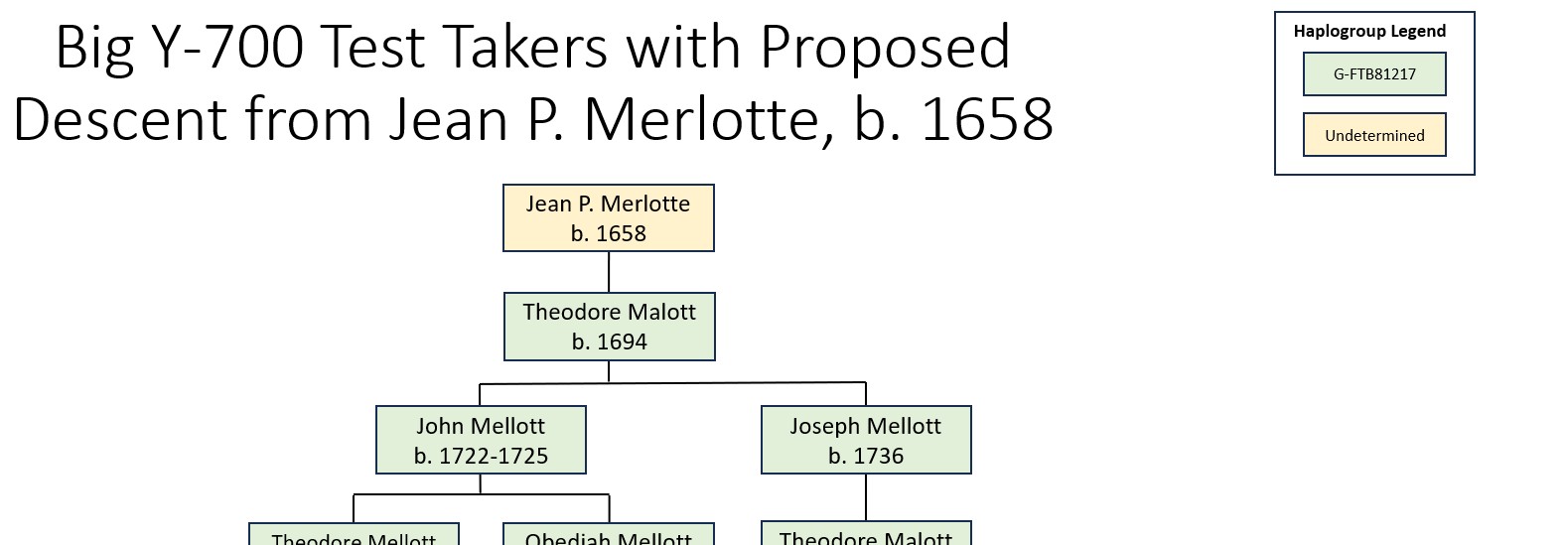
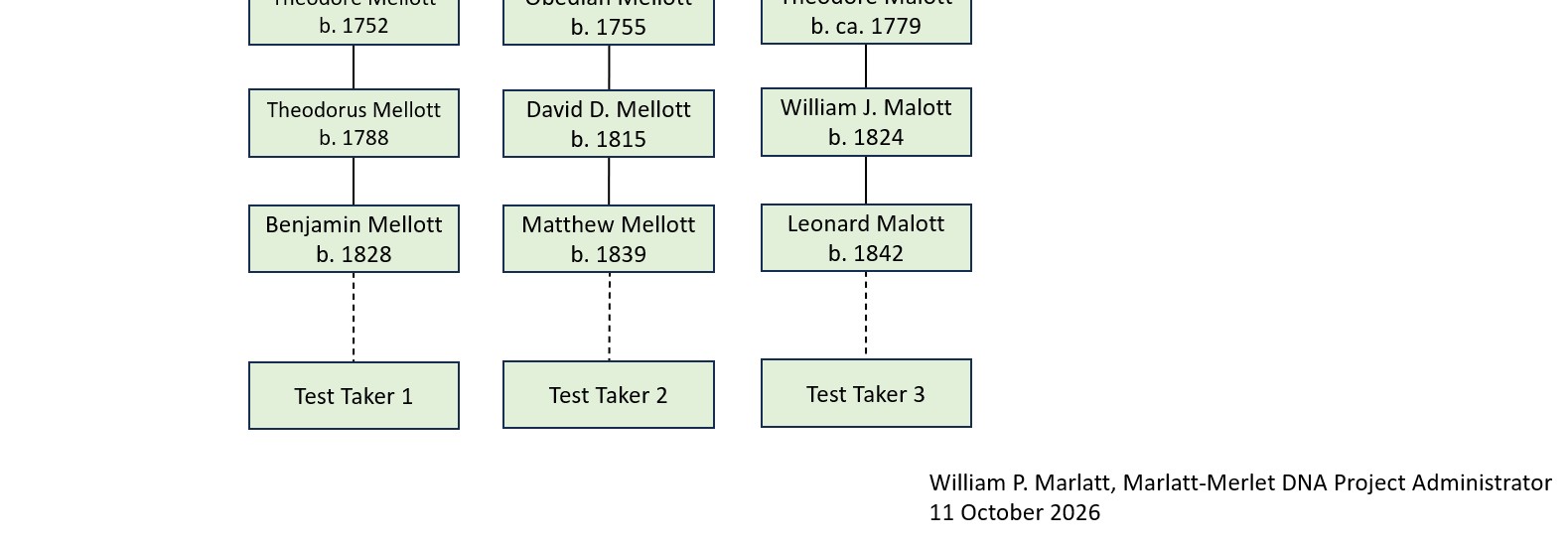
Supporting Note 154
Find a Grave, database and images, memorial 273240268, John Marlatt (1721–10 August 1780), burial details unknown; maintained by K Braddock, contributor 49140591, (https://www.findagrave.com/memorial/273240268/john-marlatt : accessed 4 September 2026).
[Summary: The Find a Grave memorial identifies John Marlatt as born in 1721 in Mansfield Township, Burlington County, New Jersey, and as having died on 10 August 1780 in Mansfield Township. The memorial identifies Lydia Ann Jarrard Marlatt (1725–1783) as his spouse and lists three children: Hannah Marlatt (1747–1780), George Marlatt (1749–1814), and Nathan Marlatt (1753–1797).]
[Image: The Find a Grave memorial lists George Marlatt (1749–1814) as a child of John Marlatt (1721–1780).]
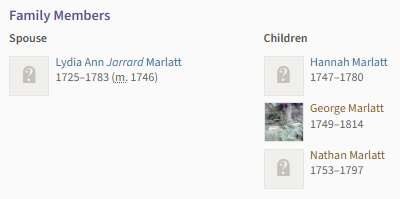
[Commentary: This memorial is pertinent to the potential conflict concerning the death of George Marlatt, b. ca. 1749, because it identifies John Marlatt's son George as having lived from 1749 to 1814. This conflicts with evidence developed in this study suggesting that George Marlatt, b. ca. 1749, died by 1786. The identity and 1814 death year assigned to George in this derivative source are evaluated in conjunction with other Find a Grave, cemetery, probate, and military records in Supporting Note 54.]
Supporting Note 155
Find a Grave, database and images, memorial 147133035, Joseph Nathaniel Marlatt (1752–1813), citing Marlatt Family Farm Cemetery, Mississauga, Peel Regional Municipality, Ontario, Canada; maintained by Patricia Jackson, contributor 47297496, (https://www.findagrave.com/memorial/147133035/joseph_nathaniel-marlatt : accessed 4 September 2026).
[Extract: “Joseph was the son of John Marlatt 1721 – 1780 Mansfield, Warren, New Jersey, USA and Lydia Jarrad 1725 – 1765 Mansfield, Warren, New Jersey, USA. According to his fathers Will dated 1780 there were 9 living children at the time of his death. His brother George Marlatt is also buried here.”]
[Summary: The memorial identifies Joseph Nathaniel Marlatt (1752–1813) as a son of John Marlatt and states that Joseph's brother George Marlatt was also buried at the Marlatt Family Farm Cemetery. The memorial's Family Members section separately identifies Sgt. George Marlatt (1781–1814) as a son of Joseph.]
[Image: The Family Members section of the memorial identifies five children of Joseph Nathaniel Marlatt: John Marlatt (1777–1868), Sgt. George Marlatt (1781–1814), Rachel Marlatt Ryckman (1785–1868), Eliza Marlatt Snider (1791–1851), and Samuel Marlatt (1796–1875).]
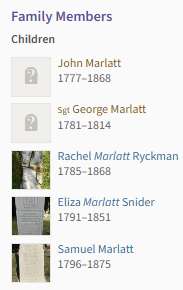
[Commentary: This memorial is pertinent to the potential conflict concerning the identity of the George Marlatt associated with the Marlatt Family Farm Cemetery. The memorial states that Joseph's brother George Marlatt was also buried there, while separately identifying Sgt. George Marlatt (1781–1814) as Joseph's son. When correlated with the Find a Grave memorial for John Marlatt, which identifies John's son George as George Marlatt (1749– 1814) (Supporting Note 154), these assertions associate the 1814 death year with both Joseph's brother George, b. ca. 1749, and Joseph's son George, b. 1781. The identity of the George Marlatt who died in Ontario in 1814 is evaluated through cemetery, probate, and military evidence in Supporting Note 54.]
Supporting Note 156
Find a Grave, database and images, memorial 147133100, George Marlatt (1749–28 December 1814), citing Marlatt Family Farm Cemetery, Mississauga, Peel Regional Municipality, Ontario, Canada; maintained by Patricia Jackson, contributor 47297496, (https://www.findagrave.com/memorial/147133100/george-marlatt : accessed 4 September 2026).
[Extract: “George was the son of John Marlatt 1721 – 1780 Mansfield, Warren, New Jersey, USA and Lydia Jarrad 1725 – 1765 Mansfield, Warren, New Jersey, USA. According to his fathers Will dated 1780 there were 9 living children at the time of his death. His brother Joseph Marlatt is also buried here.”]
[Summary: The memorial identifies George Marlatt as born in 1749 in Mansfield Township, Warren County, New Jersey; as a son of John Marlatt (1721–1780) and Lydia Jarrad (1725– 1765); as having died on 28 December 1814 in Trafalgar, Ontario; and as having been buried at the Marlatt Family Farm Cemetery in Mississauga, Ontario. It also identifies Joseph Marlatt as George's brother and states that Joseph was buried at the same cemetery.]
[Image: The Find a Grave memorial identifies George Marlatt (1749–1814) as a son of John Marlatt and Lydia Ann Jarrard Marlatt and gives his death as 28 December 1814 at Trafalgar, Ontario, and his burial as the Marlatt Family Farm Cemetery.]
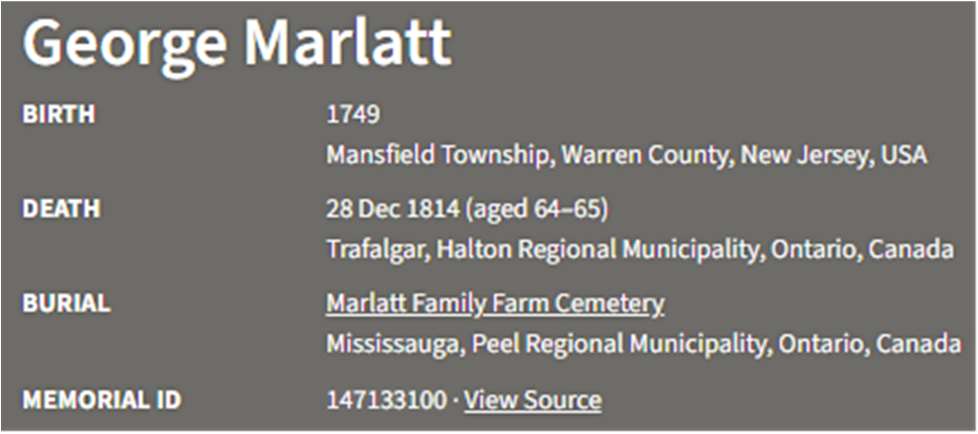
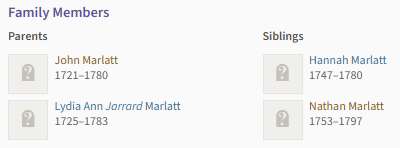
[Commentary: This memorial directly presents the identification that creates the conflict examined in Supporting Note 54. It identifies the George Marlatt born in 1749, son of John Marlatt and brother of Joseph Marlatt, as the man who died at Trafalgar on 28 December 1814 and was buried at the Marlatt Family Farm Cemetery. Evidence from the cemetery, probate, and military records is evaluated in Supporting Note 54 to determine whether the George who died at Trafalgar in 1814 was George Marlatt, b. ca. 1749, or the younger Sgt. George Marlatt, b. 1781.]
Supporting Note 157
Find a Grave, database and images, memorial 147141990, Sgt. George Marlatt (15 June 1781–28 December 1814), burial details unknown; maintained by Patricia Jackson, contributor 47297496, (https://www.findagrave.com/memorial/147141990/george-marlatt : accessed 4 September 2026).
[Summary: The memorial identifies Sgt. George Marlatt as born 15 June 1781 in Monmouth County, New Jersey, and as having died on 28 December 1814 in Ontario. It identifies Joseph Nathaniel Marlatt (1752–1813) as his father and lists John Marlatt (1777–1868), Rachel Marlatt Ryckman (1785–1868), Eliza Marlatt Snider (1791–1851), and Samuel Marlatt (1796–1875) as his siblings. The memorial states that George served with the 2nd York Battalion during the War of 1812 and died of disease. It also identifies Margrethra (Rebecka) Shain as his wife.]
[Extract: “Sgt. Marlatt served with the 2nd York Battalion during the War of 1812. He died of disease, which was very common during this war.”]
[Extract: “His will:” The memorial reproduces a transcription of the will of George Marlatt of Trafalgar Township dated 26 December 1814. The transcription identifies Rebechah as George's wife and describes his landed property as part of Lot 1 in the First Concession of Trafalgar Township, north of Dundas Street. The memorial states that the will information was “gathered from One World Tree.”]
[Image: The Family Members section identifies Joseph Nathaniel Marlatt (1752–1813) as the father of Sgt. George Marlatt (1781–1814) and identifies John Marlatt (1777–1868), Rachel Marlatt Ryckman (1785–1868), Eliza Marlatt Snider (1791–1851), and Samuel Marlatt (1796–1875) as his siblings.]
[Commentary: This memorial is particularly pertinent to the conflict examined in Supporting Note 54 because it identifies a younger Sgt. George Marlatt, b. 1781, as a son of Joseph Nathaniel Marlatt and gives his death as 28 December 1814—the same date Find a Grave assigns to the separate memorial for Joseph's brother George Marlatt, b. 1749 (Supporting Note 156). The memorial further associates the younger George with service in the 2nd York Battalion and reproduces the 26 December 1814 will of George Marlatt of Trafalgar Township. Because the will transcription on the memorial is attributed to OneWorldTree, a discontinued, user-contributed genealogical database whose information was not independently verified, the original probate record (Supporting Note 158) is used elsewhere in this study to evaluate this identification.]
Supporting Note 158
“York, Toronto, Ontario, Canada records,” images, FamilySearch (https://www.familysearch.org/ark:/61903/3:1:3Q9M-CSTB-S3VQ-H?view=explore : accessed 3 September 2026), “York. Court Records 1811–1864,” image 1093 of 1212, will of George Marlatt, dated 26 December 1814; image group no. 008345354.
[Summary: In his will dated 26 December 1814, George Marlatt of Trafalgar Township, York County and Home District, a yeoman, identified Rebeckah as his wife and gave her certain cattle, household furniture, and other property she had brought to him, together with the use of one-third of his landed property during her widowhood. His land was described as Lot 1 in the First Concession of Trafalgar Township, north of Dundas Street. When Rebeckah was no longer his widow, the land was to pass equally to Samuel Marlatt and Nathan Marlatt. George also made bequests to George Hunter, Joseph Marlatt, Samuel Marlatt, and Nathan Marlatt, and left the remainder of his estate, after payment of his lawful debts, to his wife Rebeckah. He appointed Samuel Pikeman, John Marlatt, and David Snider as executors. The will was witnessed by William Tisdale, Peter Shook, and James Hunter.]
[Commentary: The description of George Marlatt's land as Lot 1 in the First Concession of Trafalgar Township, north of Dundas Street, corresponds to the location of the Marlatt Family Farm Cemetery on Lot 1, Concession 1 NDS, north of Dundas Street (Supporting Note 161). This geographic correlation provides evidence connecting the George Marlatt who made the will on 26 December 1814 with the George Marlatt associated with the Marlatt Family Farm Cemetery.]
Supporting Note 159
“York, Toronto, Ontario, Canada records,” images, FamilySearch (https://www.familysearch.org/ark:/61903/3:1:3Q9M-CSTB-S3VQ-H?view=explore : accessed 3 September 2026), “York. Court Records 1811–1864,” images 1097–1098 of 1212, affidavit of James Hunter, 22 February 1815, concerning the will of George Marlatt; image group no. 008345354.
[Summary: On 22 February 1815, James Hunter, one of the subscribing witnesses to the will of George Marlatt, appeared before Robert Baldwin, Surrogate for the Home District of Upper Canada. Hunter swore that he was present and saw George Marlatt sign the will and that the name and signature of George Marlatt on the will were in George's own handwriting. Hunter further swore that the names and signatures of witnesses William Tisdale, Peter Shook, and James Hunter were in their own handwriting and that the witnesses signed in the presence of the testator and of each other. Hunter stated that he believed George Marlatt was of sound mind, memory, and understanding when he signed the will.]
[Commentary: James Hunter's sworn testimony supports the authenticity of the will of George Marlatt dated 26 December 1814 (Supporting Note 158) by establishing that Hunter personally witnessed George sign it and that the signatures of George and the three witnesses were genuine. The affidavit therefore strengthens the reliability of the will as evidence identifying George Marlatt of Trafalgar Township and his property on Lot 1 in the First Concession north of Dundas Street.]
Supporting Note 160
“York, Toronto, Ontario, Canada records,” images, FamilySearch (https://www.familysearch.org/ark:/61903/3:1:3Q9M-CSTB-S3VQ-H?view=explore : accessed 3 September 2026), “York. Court Records 1811–1864,” image 1100 of 1212, affidavit of Samuel Pikeman and David Snyder, 22 February 1815, concerning the estate of George Marlatt; image group no. 008345354.
[Transcription: Before me Robert Baldwin Esquire Surrogate for the Home District of the Province of Upper Canada— Personally came and appeared Samuel Pikeman and David Snyder of Townships of Barton & Trafalgar who being sworn maketh Oath and sayeth that George Marlatt of the Township Trafalgar departed this life on, or about the twenty eighth of December last past possessed of some personal and real Estate within the Home District of said Province— Sworn before me at York this 22nd day of Feby 1815.
Robt Baldwin Samuel Pikeman David Snider]
[Summary: On 22 February 1815, Samuel Pikeman and David Snyder appeared before Robert Baldwin, Surrogate for the Home District of Upper Canada, and swore that George Marlatt of Trafalgar Township had died “on, or about the twenty eighth of December last past,” while possessing personal and real estate within the Home District. Because the affidavit was sworn on 22 February 1815, “December last past” refers to December 1814, establishing that George Marlatt died on or about 28 December 1814.]
[Commentary: This affidavit provides direct contemporary evidence that the George Marlatt of Trafalgar Township whose estate was being administered in 1815 died on or about 28 December 1814. Samuel Pikeman was also one of the executors named in George Marlatt's will dated 26 December 1814 (Supporting Note 158), further connecting the deceased George identified in this affidavit with the testator of that will. The death date also corresponds with the reported 1814 death year for the George Marlatt associated with the Marlatt Family Farm Cemetery (Supporting Note 161).]
Supporting Note 161
Halton-Peel Branch, Ontario Genealogical Society, “Marlatt Family Farm,” Halton-Peel Branch, Ontario Genealogical Society, (https://haltonpeel.ogs.on.ca/marlatt-family-farm/ : accessed 3 September 2026).
[Summary: This account identifies the Marlatt Family Farm Cemetery as being located on Lot 1, Concession 1 NDS, north of Dundas Street, in Trafalgar Township. It reports that two ancient cedar trees marked the resting places of Joseph and George Marlatt and that their monuments indicated deaths in 1813 and 1814, respectively.]
[Commentary: The cemetery location is significant because Lot 1, Concession 1 NDS, north of Dundas Street, corresponds to the land identified in the 1814 will of George Marlatt as Lot 1 in the First Concession of Trafalgar Township, north of Dundas Street (Supporting Note 158). The reported 1814 death year for the George Marlatt buried at this location is also consistent with the probate evidence establishing that George Marlatt of Trafalgar Township died in December 1814 (Supporting Note 160). This correlation provides evidence that the George Marlatt whose estate was probated in 1815 was the George associated with the Marlatt Family Farm Cemetery.]
Supporting Note 162
Heritage Mississauga, “Call to Arms,” Heritage News, Winter 2012, (https://heritagemississauga.com/…; Full URL : accessed 3 September 2026).
[Summary: This account describes members of the Marlatt family who served during the War of 1812. It identifies John, Joseph Jr., and George as members of the family who served and reports that only John returned home, while Joseph Jr. and George died of disease in 1813 and 1814, respectively.]
[Commentary: This account provides evidence for the existence of a George Marlatt associated with Joseph Marlatt's Ontario family who died in 1814. The reported 1814 death year is consistent with the original probate affidavit establishing that George Marlatt of Trafalgar Township died on or about 28 December 1814 (Supporting Note 160). This evidence is pertinent to distinguishing the younger George from Joseph's brother George Marlatt, b. ca. 1749, whose death is estimated in this study as by 1786 (Supporting Note 44).]
Supporting Note 163
“Transcripts of Documents of the 2nd Regiment of York Militia,” OurOntario.ca, (https://images.ourontario.ca/Partners/TTHS/TTHS0033272901T.PDF : accessed 3 September 2026).
[Extract: “Qr Mstr. Sgt. George Marlatt”]
[Summary: The transcribed records of the 2nd Regiment of York Militia identify George Marlatt as a quartermaster sergeant in the regiment during the War of 1812 period.]
[Commentary: This record documents a George Marlatt serving as quartermaster sergeant in the 2nd Regiment of York Militia. When correlated with the account identifying a George Marlatt of the Ontario Marlatt family who served during the War of 1812 and died in 1814 (Supporting Note 162), it provides evidence connecting that George with the military designation “Sgt. George Marlatt” appearing in the Find a Grave memorial for Joseph Nathaniel Marlatt (Supporting Note 155). The identification is further evaluated in Supporting Note 54.]
Supporting Note 164
Fred Blair, “December 1814 Stories,” War of 1812 Canadian Stories, (https://warof1812cdnstories.blogspot.com/p/december-1814-stories.html : accessed 3 September 2026).
[Extract: “Sergeant George Marlatt, 2nd York, disease, December 28, 1814.”]
[Summary: This compilation identifies Sergeant George Marlatt of the 2nd York as having died of disease on 28 December 1814.]
[Commentary: The reported death date of 28 December 1814 closely agrees with the original York County Surrogate Court affidavit stating that George Marlatt of Trafalgar Township died “on, or about the twenty eighth of December” 1814 (Supporting Note 160). The identification of the deceased as Sergeant George Marlatt of the 2nd York also corresponds with the record identifying “Qr Mstr. Sgt. George Marlatt” in the 2nd Regiment of York Militia (Supporting Note 163). This correlation provides evidence that the George Marlatt of Trafalgar Township who died on or about 28 December 1814 was the George Marlatt who served in the 2nd York during the War of 1812.]
Supporting Note 165
Monmouth County, New Jersey, Ancient Court Minutes, 1730–1734, 23 October 1730, item 13, jury entry naming George Merlat and Paul Merlat; digital image, FamilySearch, “Miscellaneous records” (https://www.familysearch.org/…; Full URL : accessed 25 August 2026), image 1,349 of 1,553, FHL microfilm 2,456,484, item 13, DGS 009068922.
[Extract: On 23 October 1730, the Monmouth County court minutes record a jury being sworn that included George Merlat and Paul Merlat.]
[Analysis: Paul Merlat's service as a juror on 23 October 1730 provides evidence that he had attained the qualifications then applicable to jury service. New Jersey's 1713/14 law governing jury qualifications required jurors to meet specified qualifications, including being freeholders of the county (Supporting Note 171). English law concerning jury service excluded persons under age twenty-one, and English common law and applicable English statute law were practiced in colonial New Jersey (Supporting Note 172). The actual text of the 1713/14 New Jersey act has not yet been examined to determine whether it expressly required jurors to have attained age twenty-one. Accordingly, age twenty-one provides a reasonable historical benchmark rather than a conclusively established New Jersey legal minimum. If Paul was at least twenty-one when he served as a juror in 1730, he would have been born no later than about 1709. Correlated with the other evidence concerning Paul, his jury service supports an estimated birth of ca. 1709.]
Supporting Note 166
Francesco Cinnirella, Marc Klemp, and Jacob Weisdorf, “Malthus in the Bedroom: Birth Spacing as Birth Control in Pre-Transition England,” Demography 54 (2017): 413–436, especially table 1; (https://pmc.ncbi.nlm.nih.gov/articles/PMC5477677/ : accessed 19 September 2026).
[Summary: A demographic study based on family reconstitution data from 26 English parishes examined 15,845 families and 62,223 births occurring between 1540 and 1850. The researchers found that the average interval between successive births was approximately 924 days, or about 2.5 years, although individual birth intervals varied considerably (standard deviation about 1.2 years). The study demonstrates that an interval of approximately two to three years between successive births was common in the population studied. This evidence provides a reasonable historical benchmark for evaluating possible birth intervals among the children of Josias Merlet, but it does not establish the actual spacing or birth order of his children.]
Supporting Note 167
Genealogical Society of New Jersey, Genealogical Magazine of New Jersey (Newark), vol. 33 (January/April 1958): 1–4, Kenn Stryker-Rodda, “The Janeway Account Books, 1735–1746”; digital images, FamilySearch (https://www.familysearch.org/…; Full URL : accessed 9 July 2023), from FHL microfilm 008621375.
[Extracts: “One of the most valuable sets of account books, from a genealogical standpoint, is that kept by Jacob Janeway from 1735 to 1746 for a store in East New Jersey. When John Bodine Thompson examined these books in 1896 he was so impressed by their ‘value for future genealogists and historians’ that he persuaded their owner, Mr. Henry L. Janeway, to place them in the Rutgers University Library.” “Concerning the location of the store there has been some conjecture. Henry L. Janeway supposed it to have been at Middlebrook; and John Bodine Thompson, largely because of some of the names he recognized and because the Janeway family had originally come from Burnt Mills, Hertfordshire, had “no doubt that the locality was the Burnt Mills on the North Branch of the Raritan, still known by that name, which has never been known to tradition as destroyed by fire.” However, a newspaper advertisement of 1747, reprinted in NJA 12:339, described it as “adjoining to Rariton road, which leads from Well’s Ferry to Rariton landing, seven miles from said landing, and nine miles from New-Brunswick,” and the store as “having been kept there upwards of twenty years.” It would seem, therefore, that the store was located in what was later the town of Bridgewater and is today Bound Brook—a favorable spot, as even the early maps show there a major crossroads, making it readily accessible to practically all of the localities mentioned in the records.”]
Supporting Note 168
“1706 Census of Staten Island,” entry for Joseph Marlett, age 24, p. 3, no. 2, identified as “Man”; transcription, Richmond County, New York GenWeb, RootsWeb, (https://sites.rootsweb.com/~nyrichmo/1706.txt : accessed 19 September 2026).
[Summary: The 1706 Staten Island census identifies Joseph Marlett as age twenty-four, indicating a birth of about 1682.]
[Analysis: This Joseph Marlett is probably the same Joseph Marlett who later appeared in Monmouth County, New Jersey, and whose estate was administered there in 1715, although the records do not directly establish that identification. If so, Joseph's reported age provides collateral chronological evidence for evaluating the estimated birth of George Merlet. An average interval of approximately two and a half years between successive births was common in the historical population examined in Supporting Note 166, although individual birth intervals varied considerably. This evidence should be used only as a general chronological benchmark and does not establish either the birth order or the actual interval between Joseph and George. Nevertheless, a Joseph born about 1682 and a George born in the mid-1680s present a plausible sibling chronology. Correlated with George's documented appearance as a witness to Andrew Bowne's will in 1707 (Supporting Note 64), this evidence is consistent with the estimated birth of George Merlet at ca. 1686.]
Supporting Note 169
Reginald L. Poole, English Regnal Years and Titles: Hand-Lists, Easter Dates, Etc. (Oxford: Clarendon Press, 1910), p. 41; digital image, Wikimedia Commons, (https://upload.wikimedia.org/…; Full URL : accessed 16 September 2026).
[Summary: Poole’s table explains that Charles II reckoned his regnal years from 30 January 1648/9, although he did not actually reign in England until the Restoration. Under that reckoning, his thirty-sixth regnal year began on 30 January 1684 and ended on 29 January 1685.]
Supporting Note 170
Frederick Skene, State Engineer and Surveyor, Map of Staten Island, Richmond Co., N.Y., Showing the Colonial Land Patents from 1668 to 1712, C. D. Burrus, draftsman (1907), scale 1 inch = 1,500 feet; manuscript notation, “This Map is not Official”; privately held by William P. Marlatt, Moorpark, California.
[Analysis: The map depicts the locations and boundaries of colonial land patents on Staten Island and places an 80-acre tract identified as “Abm Marlett,” dated 26 July 1694, immediately northwest of Great Kills. East and northeast of Great Kills, the map places lands of Samuel Curtis, Lewis Lakeman, J. Watson, and R. Doddiman, names also associated with the property description in the 1699 deed from Josiah Marlet and wife Jane to Christopher Garnetson. Nathaniel Brittaine is shown holding a 100-acre tract dated 25 June 1696 immediately north of this eastern group. The geographic concentration of these landholders provides useful independent context for locating the Marlet family’s property interests on the south side of Staten Island and for interpreting the neighboring landowners named in contemporary Marlet deeds. The map does not establish that the 80-acre tract identified with Abraham Marlett was the same property conveyed by Josiah Marlet in 1699.]
Supporting Note 171
New Jersey, Acts of the General Assembly of the Province of New-Jersey: From the Surrender of the Government to Queen Anne, on the 17th Day of April, in the Year of Our Lord 1702, to the 14th Day of January 1776, Samuel Allinson, comp. (Burlington, New Jersey: Isaac Collins, Printer to the King, for the Province of New-Jersey, 1776), p. 24, “An Act for Ascertaining the Qualifications of Jurors within this Province,” passed 11 March 1713/14; digital image, New Jersey State Library, (https://hdl.handle.net/10929/147906 : accessed 18 September 2026).
[Summary: The act established qualifications for jurors in the Province of New Jersey. Jurors were required to be of good fame and freeholders of the county in which they served; grand jurors were subject to a specified real-property qualification and petit jurors to a specified real- or personal-property qualification. The act does not expressly state a minimum age of twenty-one.]
Supporting Note 172
William Blackstone, Commentaries on the Laws of England, book 3, chap. 23, “Of the Trial by Jury” (Oxford: Clarendon Press, 1768), p. 362; digital transcription, The Avalon Project, Yale Law School, (https://avalon.law.yale.edu/…; Full URL : accessed 18 September 2026); citing 7 & 8 William III, chap. 32. See also New Jersey Constitution of 1776, arts. XXI–XXII; transcription and images, New Jersey State Archives, (https://www.nj.gov/…; Full URL : accessed 18 September 2026).
[Summary: Blackstone's discussion of English jury law identifies persons under age twenty-one among those excluded or exempted from jury service under 7 & 8 William III, chapter 32. The New Jersey Constitution of 1776 expressly continued in force the common law of England and so much of English statute law as had previously been practiced in the colony, unless subsequently altered. These authorities support using age twenty-one as a historical benchmark when evaluating Paul Merlat's documented jury service in colonial New Jersey in 1730. However, because the actual text of New Jersey's 1713/14 act governing jury qualifications has not yet been examined for an express age requirement, these authorities do not by themselves establish that age twenty-one was the legally required minimum for Paul's jury service.]
Supporting Note 173
New Jersey State Archives, “Early Land Records, 1650–1900s,” Searchable Databases and Records Request Forms, database (New Jersey Department of State, https://wwwdnet-dos.nj.gov/…; Full URL : accessed 27 August 2026), search for Thomas Cherry, entry for Thomas Cherry, grantor, to George Merlett, grantee, conveyance of land on the east side of the Machiponix River, Middlesex County, 24 May 1718; reference D-3 (EJ), folio 106, SSTSE023.
Supporting Note 174
New Jersey State Archives, “Early Land Records, 1650–1900s,” Searchable Databases and Records Request Forms, database (New Jersey Department of State, https://wwwdnet-dos.nj.gov/…; Full URL : accessed 27 August 2026), search for Thomas Cherry, entry for Thomas Cherry, grantor, to George Merlatt, conveyance in Middlesex County, 7 March 1719; locations: East Jersey, Middlesex; reference D-3 (EJ), folio 97, SSTSE023.
Supporting Note 175
William P. Marlatt, Marlatt-Merlet DNA Project Summary Report Including Lineage Proofs of Selected Project Members (Moorpark, California: privately published by the author, 19 March 2021).
[Summary: This report presents lineage proofs for selected descendants of Gedeon Merlet, b. ca. 1624, the immigrant ancestor of numerous Marlatt-Merlet families in the United States and Canada. Developed in conjunction with members of the Marlatt-Merlet DNA Project representing different family branches, the lineage proofs document descent to the earliest known Marlatt-Merlet ancestors using evidence of births, marriages, and family relationships and are intended to assist in developing and proving other family lineages. The report also explains the Genealogical Proof Standard, examines Y-DNA and paternal haplogroups and their use in distinguishing family branches, describes the history, goals, activities, and accomplishments of the Marlatt-Merlet DNA Project, and summarizes key findings and planned activities. Supporting appendices provide the lineage proofs and instructions for participating in the DNA project and Y-DNA testing, while a glossary explains genetic-genealogy terminology. The report encourages researchers to use the findings in their own research, report errors or additional evidence, participate in the DNA project, and share the report with other Marlatt-Merlet family researchers.]
Supporting Note 176
Drents Archief, “Begin onderzoek,” section “De huwelijksakte” and “Bronnen voor huwelijksdata vóór 1811,” (https://www.drentsarchief.nl/…; Full URL : accessed 16 September 2026); Yvette Hoitink, “Dutch term – J.M. and J.D.,” Dutch Genealogy, (https://www.dutchgenealogy.nl/…; Full URL : accessed 16 September 2026).
[Summary: Dutch genealogical guidance explains that the historical marriage-record terms jongeman and jongedochter indicate that the person had not previously married. It does not give an indication of the person’s age.]
[Extract: “Het echtpaar wordt in de akte ‘jongeman’ en ‘jongedochter’ genoemd. Dit heeft niets te maken met hun leeftijd, maar deze benamingen geven aan dat zij niet eerder gehuwd zijn geweest.”]
[Translation: The couple are described in the record as “young man” (jongeman) and “young woman” (jongedochter). These terms have nothing to do with their ages; rather, they indicate that neither had been married previously.].
Supporting Note 177
Amy Louise Erickson, “When did spinsters spin?,” Cambridge Group for the History of Population and Social Structure, University of Cambridge, (https://www.campop.geog.cam.ac.uk/blog/2025/06/12/spinsters/ : accessed 16 September 2026).
[Summary: Erickson explains that “spinster” developed a marital-status meaning and, by the seventeenth century, was commonly used to identify a never-married woman, although the word could also retain an occupational meaning in some contexts.]
Supporting Note 178
Ancestry.com, “New Jersey, U.S., Compiled Census and Census Substitutes Index, 1643– 1890,” database, Ancestry.com (https://www.ancestry.com/search/collections/3562 : accessed 19 October 2026), database identified as “NJ Tax Lists Index 1772–1822,” search results for surname wildcard M*l*t* and year 1793; citing Ronald V. Jackson and Accelerated Indexing Systems, comp., New Jersey Census, 1643–1890 (Provo, Utah: Ancestry.com Operations Inc., 1999).
[Extracts: The following selected entries appeared in the search results for 1793:
- John Merlate — Middlesex County, Piscataway
- Gideon Malat — Monmouth County, Freehold
- James Malat — Monmouth County, Freehold
- John Melat — Monmouth County, Freehold
- Abraham Molat — Monmouth County, Upper Freehold
- David Malatt — Morris County, Hanover
- John Millert — Morris County, Hanover
- William Melat — Sussex County, Knolton
- Abraham Malat — Sussex County, Mansfield
- Joseph Malatt — Sussex County, Mansfield
- Nathaniel Malatt — Sussex County, Mansfield
- Peter Malat — Sussex County, Vernon
- Robert Malet — Sussex County, Vernon.]
[Commentary: Assuming the men in this list were at least 21 at the time the census was taken in 1793, they would have been born no later than 1772. Plausible identities for some of these men are:
- William Melat b. 1770, son of John Marlatt b. ca. 1738–1743
- Abraham Malat b. 1762–1764, son of John Marlatt b. ca. 1738–1743
- Joseph Malatt b. ca. 1752, son of John Marlatt b. ca. 1714
- Nathaniel Malatt b. 1753, son of John Marlatt b. ca. 1714
- Robert Malat b. by 1772, close relative of Robert Melat b. 1799
Refer to Supporting Note 126 for related information.]
Supporting Note 179
Thomas W. Lloyd, History of Lycoming County, Pennsylvania (Topeka and Indianapolis: Historical Publishing Co., 1929), pp. 187–189, chapter “Muncy Township”; transcription, Lycoming County PAGenWeb, (https://www.lycoming.pagenweb.org/Individual_Townships/Muncy.html : accessed 16 September 2026).
[Summary: Lloyd states that Muncy Township was created as part of Northumberland County on 9 April 1772 and became part of Lycoming County when Lycoming County was organized on 17 April 1795.]
Supporting Note 180
Eva G. Malott, Fort Wayne, Indiana, correspondence and enclosed summary of Mannheim church records prepared by Mrs. William Heidgerd, Secretary, Huguenot Historical Society, New Paltz, New York; package to William P. Marlatt, postmarked 28 October 1986; privately held by William P. Marlatt.
[Extract: “#12 GEDEON MARLET and MARGUERITE MARTIN have had baptized their son PAUL who has had for godfather PAUL MARLET and for godmother JEANNE TONDEUR and has been born the 14th of September (1653)”]
[Extract: “#242 GEDEON MERLET and MARGUERITE MARTIN, his wife, have had Baptized their son named JEAN PIERRAT, born the 18th April and has been Baptized the 2nd of May, (1658) who has for Godfather JEAN PIERRAT and for Godmother MARIE le NOIR.”]
Supporting Note 181
“Piscataway Ear Marks,” The Genealogical Magazine of New Jersey, p. 15; published transcription of an ear-mark registration dated 18 July 1710, recorded by Isaac Smalley, clerk; Genealogical Society of New Jersey, New Brunswick, New Jersey.
[Extract: “the marke of theoder molat Is a hole in the right Eare the marke that was formerly his honured Father John peterson mollets deseased. Entred the 18 day of July anodom: 1710. Isaac Smalley Clerk.”]
[Analysis: This entry records the transfer or continuation of a livestock ear mark previously associated with the deceased John Peterson Mollet to Theoder Molat, explicitly identified as his son. The entry establishes that John Peterson Mollet had died by 18 July 1710 and provides direct evidence of the father–son relationship. The surname spellings Molat and Mollet suggest a possible connection with other early New Jersey families using similar surname variants, but the entry alone does not establish a relationship to the Marlatt–Merlet lineage.]
Supporting Note 182
John Peterson Mallet, will dated 30 January 1702/3, Piscataway, Middlesex County, East Jersey; transcription supplied by Matthew Ferricks to William Marlatt, email, 30 January 2026, 10:25 a.m.; attributed to Record of Wills in New Jersey, 1705–1804, vol. 1, New Jersey State Archives, FamilySearch Film No. 522714, Image Group No. 7600435; FamilySearch catalog, (https://www.familysearch.org/en/search/catalog/koha:140248 : accessed 21 October 2026). Original record location and page not independently verified.
[Summary: John Peterson Mallet, a blacksmith of Piscataway, Middlesex County, East Jersey, executed his will on 30 January 1702/3. He named his wife Mary Mallet as sole executrix and appointed John Royse and Gabriel Rayloo as overseers. He bequeathed his lands in the West Indies to his son Peter Mellat and his plantation in Piscataway to his wife during her widowhood, with the property passing to his sons John and Theodore Mallet upon her remarriage. He also named his daughters Hannah Mallet and Mariam Hooper and his wife's daughter Lydia Jebou. Additional bequests included money, silverware, gold rings, and two enslaved individuals, Bombo and Fortune, whose ownership was to pass from his wife to his sons John and Theodore under the conditions specified in the will. The will also mentioned debts owed to him in New York and the West Indies. Witnesses were John Langstaff, John Manning, and Isaiah Smalley.]
[Analysis: This will provides explicit evidence identifying Peter, John, and Theodore as sons of John Peterson Mallet, and Hannah and Mariam as his daughters. Lydia Jebou is identified as his wife's daughter, but the will does not establish that she was John Peterson Mallet's biological daughter. The bequest of the Piscataway plantation to John and Theodore establishes their anticipated inheritance of the family property. The will also provides evidence that John Peterson Mallet was living on 30 January 1702/3. The Piscataway ear-mark entry dated 18 July 1710 identifies Theoder Molat as the son of the deceased John Peterson Mollet, consistent with the father–son relationship documented in this will. Together, these records support the identification of Theodore Mallet and Theoder Molat as the same individual and establish that John Peterson Mallet had died by 18 July 1710. However, neither record independently establishes a relationship between this Piscataway family and the descendants of Gedeon Merlet, b. ca. 1624.]
Supporting Note 183
FamilyTreeDNA, “Marlatt-Merlet - News,” Marlatt-Merlet Family DNA Project, FamilyTreeDNA, (https://www.familytreedna.com/groups/marlatt-merlet/about/news : accessed 16 September 2026).
[Summary: The Marlatt-Merlet Family DNA Project page states that the project officially began on 31 October 2011. It identifies the project goals as determining common ancestors of Marlatt family members and identifying descendants of Gedeon Merlet, b. ca. 1624. The page lists Marlatt, Marlett, Marlette, Marlot, Marlott, Merlat, Morlatt, Murlatt, Malat, Malott, Mollet, Mellott, and similar spellings as surnames of interest. It also explains that Y-DNA is transmitted through the direct paternal line and that mutations can help distinguish branches and common paternal ancestors.]
Supporting Note 184
Board for Certification of Genealogists, “Ethics and Standards,” Board for Certification of Genealogists, (https://www.bcgcertification.org/ethics-standards : accessed 16 September 2026); Board for Certification of Genealogists, “About BCG,” (https://bcgcertification.org/about : accessed 16 September 2026).
[Summary: The Board for Certification of Genealogists identifies five interdependent components of the Genealogical Proof Standard: reasonably exhaustive research; complete and accurate source citations; thorough analysis and correlation; resolution of conflicting evidence; and a soundly reasoned written conclusion based on the strongest available evidence. BCG further states that documentation should identify the source of each information item that is not common knowledge.]
Supporting Note 185
Blaine T. Bettinger, The Family Tree Guide to DNA Testing and Genetic Genealogy, 2nd ed. (Cincinnati, Ohio: Family Tree Books, 2019); publisher's description, (https://www.penguinrandomhouse.com/…; Full URL : accessed 20 October 2026).
[Summary: This book explains the principal types of DNA testing used in genealogical research, including autosomal DNA, Y-DNA, mitochondrial DNA, and X-DNA. It discusses genetic inheritance, DNA matches, haplogroups, and methods for interpreting test results. The book also addresses the use of genetic evidence to investigate ancestral relationships and resolve genealogical research questions.]
Supporting Note 186
J. David Vance, The Genealogist's Guide to Y-DNA Testing for Genetic Genealogy, 2nd ed. (independently published, 2024); bibliographic description, (https://www.amazon.com/…; Full URL : accessed 14 November 2026).
[Summary: This book explains the use of Y-DNA testing to investigate direct paternal ancestry. It introduces Y-DNA testing, explains the interpretation of test results, and discusses the genetic principles underlying Y-DNA analysis. The second edition expands its treatment of consumer Y-DNA test reports, testing strategies, Y-DNA projects, and the use of genetic evidence to investigate paternal family relationships.]
Supporting Note 187
1830 U.S. census, Allegheny County, Pennsylvania, population schedule, Allegheny, p. 83, Mary Marlatt household; digital image, Ancestry.com, “1830 United States Federal Census” (https://www.ancestry.com/…; Full URL; accessed 16 November 2026); citing National Archives and Records Administration, Fifth Census of the United States, 1830, microfilm publication M19, roll 144, Record Group 29; Family History Library microfilm 0020618; images reproduced by FamilySearch.
[Summary: Mary Marlatt was enumerated as head of a household in Allegheny, Allegheny County, Pennsylvania, in 1830. The household contained one white female aged 50–59, one white male aged 15–19, and one white male aged 10–14, for a total of three persons.]
[Analysis: The 1830 census establishes that a woman identified as Mary Marlatt was living in Allegheny County, Pennsylvania. Her reported age of 50–59 suggests a birth between approximately 1770 and 1780, overlapping the estimated birth period of Mary (Drake) Marlatt, b. ca. 1775–1781, wife of George Marlatt, b. ca. 1775–1776.
The household included two males, one aged 15–19 and the other aged 10–14. These age ranges are consistent with two proposed sons of George and Mary (Drake) Marlatt. Eli Marlatt, b. ca. 1810 (Supporting Note 116), could have been the older male, depending on his actual birth date. Jacob D. Marlatt, b. ca. 1816 (Supporting Note 118), fits the younger age category.
The correspondence between the household members' ages and those of Mary and her proposed sons provides additional circumstantial support for identifying this household as that of Mary (Drake) Marlatt. However, the census does not identify the two males by name, establish their relationships to Mary, or establish that the woman enumerated was George Marlatt's wife or widow. It also does not establish whether she was the Mary Marlett enumerated in Washington County, Pennsylvania, in 1820 (Supporting Note 121). These identifications remain unproved.]
[Commentary: The 1820 census of Mary Marlett in Canton Township, Washington County, Pennsylvania (Supporting Note 121), records a female aged 26–44 and two males under age 10. Ten years later, the 1830 census of Mary Marlatt in Allegheny County records a female aged 50–59 and two males aged 10–19. These age categories are chronologically compatible and could represent the same woman and two younger household members. Jacob D. Marlatt, b. ca. 1816 (Supporting Note 118), fits the younger male age category in both censuses, while Eli Marlatt, b. ca. 1810 (Supporting Note 116), is a less certain possibility for the older male. The 1820 household also contained several additional adults whose relationships to Mary are unknown. Although the comparison provides circumstantial support for the possibility that both records concern Mary (Drake) Marlatt, neither census establishes her identity or the relationships of the household members.]
Abbreviations and Acronyms
| Abbreviation / Acronym | Meaning |
|---|---|
| b. | born |
| bapt. | baptized |
| bur. | buried |
| ca. | circa; approximately |
| chr. | christened |
| cM | centimorgan(s) |
| Co. | County |
| Cont. | containing |
| D.C. | District of Columbia |
| d. | died |
| DGS | FamilySearch digital image group / Digital Genealogical Society number |
| DNA | deoxyribonucleic acid |
| Dr. | Doctor |
| ed. | editor; edited by |
| Esq. | Esquire |
| est. | estimated |
| etc. | et cetera |
| FAN | Friends, Associates, and Neighbors |
| FHL | Family History Library |
| ibid. | in the same source or place just cited (ibidem) |
| Inc. | Incorporated |
| Int. | intestate |
| Jr. | Junior |
| Lib. | Liber; book |
| m. | married |
| M.D. | Doctor of Medicine |
| NA / N/A | not applicable/not available |
| NARA | National Archives and Records Administration |
| N.C. / NC | North Carolina |
| N.J. / NJ | New Jersey |
| NPE | non-paternal event |
| N.Y. | New York |
| no. / No. | number |
| nos. / Nos. | numbers |
| Pa. | Pennsylvania |
| p. | page |
| poss. | possible; possibly |
| pp. | pages |
| prob. | probable; probably |
| R.D. | Rural Delivery |
| Rev. | Reverend |
| Robt. | Robert |
| SNP | Single Nucleotide Polymorphism |
| Sr. | Senior |
| STR | Short Tandem Repeat |
| TBD | to be determined |
| Thos. | Thomas |
| Twp. | Township |
| U.S. | United States |
| USA | United States of America |
| vol. / Vol. | volume |
| vols. / Vols. | volumes |
| Wm. | William |
| VS | Venango Spectator Newspaper |
| Y-DNA | Y-chromosome DNA |
Glossary
Administrator / Administratrix — A man (administrator) or woman (administratrix) appointed by a court to administer a deceased person's estate, generally when there is no executor authorized to act.
Ancestral Couple — A husband and wife from whom a person or group of people descends. In autosomal DNA analysis, either or both members of an ancestral couple may be the source of DNA shared by their descendants.
Ancestral Haplogroup — An earlier haplogroup through which a test taker’s paternal line descended. A man carries not only the mutation or mutations defining his terminal haplogroup but also those defining the ancestral haplogroups along his paternal line.
Ancestral Line — A sequence of ancestors connecting a person to an earlier ancestor. A paternal ancestral line follows the father, his father, his father, and so forth.
Autosomal DNA — DNA inherited from both parents through the 22 pairs of non-sex chromosomes. Because autosomal DNA is inherited through many ancestral lines and is randomly recombined in each generation, the amount inherited from a particular ancestor generally decreases and becomes less predictable with increasing genealogical distance.
Autosomal DNA Match — Two people who share enough autosomal DNA for a testing company to identify them as genetically related or potentially related.
Big Y-700 — A FamilyTreeDNA Y-chromosome test that examines a large portion of the Y chromosome, including hundreds of STR markers and large numbers of SNPs. It is used to identify paternal-line relationships and place test takers on detailed branches of the Y-DNA haplotree.
Bondsman — A person who provides a financial guarantee that another person will fulfill a legal obligation.
Centimorgan (cM) — A unit used to describe genetic linkage and the amount of autosomal DNA shared between individuals. In genetic genealogy, the total number of shared centimorgans helps evaluate possible genealogical relationships.
Collateral Line — A family line descending from a relative other than a person's direct ancestor. For example, descendants of an ancestor's brother or of another child of an ancestral couple constitute collateral lines.
Common Ancestor — An ancestor from whom two or more individuals descend.
Concession — In Canadian land records, a designated division of land within a township, typically subdivided into numbered lots. Concessions were used to identify the locations of properties.
Conflation — The mistaken combination of information about two or more different individuals into a single identity or genealogical account.
Derivative Source — A source created by copying, transcribing, abstracting, or summarizing information from another source.
DNA Match — A person whose DNA shares sufficient genetic similarity with another test taker to indicate a possible biological relationship.
DNA Test Proxy — A relative whose DNA test results are used in place of, or in addition to, another person's results to investigate an ancestral relationship. A proxy may be used when a person cannot take a particular type of DNA test, such as a woman using a male paternal-line relative for Y-DNA testing, or when a relative has inherited DNA that provides additional evidence of a relationship to a distant ancestor. In this study, a proxy was used when the primary test taker did not have suitable autosomal DNA matches extending to a particular distant ancestor.
Dower — A widow's legal right to a portion of her deceased husband's real property under historical law.
Downstream Haplogroup — A more recent haplogroup that developed from an earlier ancestral haplogroup after a new Y-DNA mutation occurred. It represents a more recent branch of the paternal family tree.
DYS Marker — A standardized name for a location on the Y chromosome used in Y-STR testing. Each marker, such as DYS456 or DYS570, has a numerical value representing the number of repeated DNA sequences at that location.
Executor / Executrix — A man (executor) or woman (executrix) named in a will and authorized to administer the deceased person's estate.
FAN Network — A person's Friends, Associates, and Neighbors. FAN research examines people associated with an ancestor to help identify relationships, distinguish individuals with similar names, establish migration patterns, and solve genealogical problems.
Freeman — In eighteenth-century Pennsylvania tax records, generally an unmarried man at least 21 years old who had been released from apprenticeship or servitude for at least six months. Freemen typically did not own land and were often listed separately under the heading “Single Freemen.”
Genealogical Proof Standard (GPS) — A professional framework for reaching reliable genealogical conclusions. It requires reasonably exhaustive research, complete and accurate source citations, analysis and correlation of the collected evidence, resolution of conflicting evidence, and a soundly reasoned written conclusion.
Genetic Genealogy — The use of DNA test results together with traditional genealogical records and research methods to investigate biological relationships and ancestry.
Genetic Signature — A distinctive combination of genetic characteristics associated with a particular paternal or family branch. In Y-DNA research, this may include particular STR values, SNPs, or haplogroups.
Grantee — A person who receives ownership or an interest in property from another person.
Grantor — A person who transfers ownership or an interest in property to another person.
Half-Sibling — A person who shares one biological parent, but not both, with another person. Half-siblings typically share less autosomal DNA than full siblings.
Haplogroup — A genetically defined branch of the human family tree whose members share a common ancestor and particular inherited mutations. In this study, Y-DNA haplogroups identify branches of the direct paternal Marlatt-Merlet family.
Haplotree — A branching diagram showing the evolutionary relationships among Y-DNA haplogroups. Each branch is defined by specific genetic mutations (SNPs) inherited from a common paternal ancestor. The haplotree illustrates how paternal lineages have divided over generations and shows the relationship between ancestral and descendant haplogroups.
Haplotype — A set of genetic markers or marker values inherited together. In Y-DNA genealogy, a haplotype typically refers to a man's combination of short tandem repeat (STR) values, such as those reported in a Y-37, Y-67, or Y-111 test. Comparing haplotypes helps identify men who may share a common paternal ancestor.
Indenture — A formal written agreement, commonly used to document a transfer of land or other legal obligation.
Independently Documented Lineage — A line of descent established through genealogical records and research independently of the DNA match being evaluated. Independent documentation reduces the danger of using an assumed family relationship to prove itself.
Indirect Evidence — Evidence that must be combined with other information or interpreted to answer a genealogical research question.
Joinder — The act of joining two or more parties or claims together in a single legal proceeding.
Land Patent — A legal instrument by which a government or other authorized authority grants title to land.
Marker Value — The numerical result reported for a particular genetic marker. For a Y-STR marker, the marker value represents the number of times a short DNA sequence is repeated at that location on the Y chromosome. Comparing marker values among test takers can help identify paternal relationships and distinguish branches of a paternal lineage.
Marlatt-Merlet DNA Project — A genetic genealogy research project that uses Y-DNA, autosomal DNA, documentary research, and traditional genealogical methods to investigate the paternal ancestry and relationships of individuals associated with the Marlatt, Marlett, Marlette, Melat, Merlet, and related surnames. The project includes comparison of Y-DNA test results and documented or proposed paternal lineages to identify relationships among branches of the broader Marlatt-Merlet family.
Mode — The value that occurs most frequently within a set of data. In FamilyTreeDNA Y-STR results tables, the mode represents the STR marker value that occurs most frequently among the test takers in a particular group. Comparing individual marker values with the mode can help identify genetic differences and distinguish paternal family branches.
Mutation — A change in DNA that can be inherited by subsequent generations. Y-DNA mutations are particularly useful in genetic genealogy because they can distinguish different paternal branches.
Non-Paternal Event (NPE) — A situation in which the biological paternal line differs from the paternal line indicated by the recorded surname or documented genealogy. Possible causes include adoption, an undocumented biological father, surname changes, or other circumstances. The term describes a genetic-genealogical discrepancy and does not identify its cause.
Paternal Line — A person's ancestry through the father's side of the family. The term may refer specifically to the direct male-to-male line or more broadly to ancestors on the father's side, including those who are not part of the direct paternal line.
Patriline / Patrilineal Line — An uninterrupted line of descent from father to son through successive generations. This is the line through which the Y chromosome is transmitted and is therefore the ancestral line investigated through Y-DNA testing.
Probate — The legal process of establishing the validity of a deceased person's will, when one exists, and administering the estate, including the distribution of property to heirs or beneficiaries.
Recombination — The process by which a parent’s two copies of a chromosome exchange segments during the formation of eggs or sperm. Together with the random selection of chromosomes passed to each child, recombination results in descendants inheriting different portions of their ancestors’ autosomal DNA, and distant relatives may inherit little or no detectable DNA from a particular ancestor.
Regnal Years — Years of a monarch’s reign, used to date historical events and documents.
Removed — A term describing a difference in generation between two cousins. Cousins in the same generation are not removed. Once removed indicates a difference of one generation; twice removed indicates a difference of two generations; and so forth. For example, a person's fourth cousin's child is that person's fourth cousin once removed.
Shared cM Project — A research project developed by Blaine T. Bettinger that compiles observed amounts of autosomal DNA shared by people with known genealogical relationships. The project's relationship ranges and averages are used in this study to evaluate whether the amount of DNA shared between two test takers is consistent with their proposed genealogical relationship. The interactive version of the Shared cM Project is provided through DNA Painter, an online genetic genealogy analysis platform (https://dnapainter.com/tools/sharedcmv4).
Shared DNA — DNA inherited in common by two individuals. The amount of shared autosomal DNA is generally expressed in centimorgans (cM).
Shared Match — A DNA test taker who appears as a genetic match to two other test takers. Groups of shared matches can help identify the ancestral family responsible for a DNA relationship.
Short Tandem Repeat (STR) — A location in DNA where a short sequence is repeated multiple times. In Y-DNA testing, the number of repeats at particular STR markers is compared among men to evaluate paternal relationships. STR values occasionally mutate between generations.
Single Nucleotide Polymorphism (SNP) — A change at a single position in the DNA sequence. On the Y chromosome, SNPs can be inherited through the paternal line and are used to define branches, or haplogroups, of the Y-DNA family tree.
Supporting Note — A numbered entry in this study that presents the source citation and, when appropriate, related material used to document, explain, or evaluate the evidence supporting the lineage proof. Supporting Notes may include bracketed Summary, Extract, Analysis, Commentary, Image, Photo, or Affidavit entries, depending upon the nature and purpose of the evidence presented.
Terminal Haplogroup — The most recent or most specific haplogroup currently assigned to a DNA test taker. It represents the test taker's most recently identified branch of the Y-DNA haplotree.
Testator / Testatrix — A man (testator) or woman (testatrix) who makes a will.
ThruLines — An AncestryDNA feature that uses DNA matches and linked family trees to suggest possible common ancestors and lines of descent. These suggestions require independent verification because they may rely on inaccurate family trees.
Y Chromosome — One of the human sex chromosomes. It is normally transmitted from father to son, making it particularly useful for tracing direct paternal ancestry.
Y-DNA — DNA from the Y chromosome used to investigate direct paternal ancestry. Because the Y chromosome passes from father to son with relatively little change, men descending through uninterrupted paternal lines from a common male ancestor generally have similar Y-DNA.
Y-DNA Match — Two male DNA test takers whose Y-DNA results are sufficiently similar to indicate that they probably share a common ancestor somewhere along their direct paternal lines.
Yeoman — A historical term generally referring to a farmer or landholder, often someone of modest or moderate means.
Y-STR Marker — A specific Short Tandem Repeat location on the Y chromosome. Comparing the values of multiple Y-STR markers can help determine whether men share paternal ancestry and can sometimes distinguish different branches of the same paternal family.
Y-STR Marker Tests (12-, 25-, 37-, 67-, and 111-Marker Tests) — FamilyTreeDNA Y-DNA tests that compare specified numbers of Short Tandem Repeat (STR) markers on the Y chromosome. The number identifies how many Y-STR markers are compared: 12, 25, 37, 67, or 111. Tests using more markers provide greater resolution for evaluating whether two men may share a paternal ancestor and for distinguishing paternal family branches. Results from the different test levels can be compared using the markers included in both tests.
[Commentary: William P. Melat’s will provides direct evidence identifying Caroline M. Melat as his wife and Homer B. Melat, Abba A. Smith, B. Franklin Melat, Caroline L. Melat, Jesse M. Melat, and Bessie M. Melat as his children. Because William himself expressly identified these individuals as “my children,” the will provides particularly strong evidence of these parent-child relationships. The four named grandchildren—Edna M. Carner, Grace M. Carner, Andrews E. Carner, and Alida T. Carner—were treated collectively as a separate family group and were to receive one of the seven equal shares of the estate remaining after Caroline’s death. This distribution suggests that the four grandchildren may have represented the family of another, possibly deceased, child of William, but the will does not identify their parent and therefore does not establish that relationship. The will was executed on 16 April 1898 and admitted to probate on 29 July 1898. Ancestry.com’s index incorrectly identifies 16 April 1898 as the probate date; the original record establishes that this was the date the will was executed.]