17th-century immigrants
The Company’s Offer: Gideon Merlet and the Dutch West India Company
It is often said that Gideon Merlet “signed on” with the Dutch West India Company. No contract survives, and none may ever have existed. What does survive is better: the Company’s own ledger of the passage money he owed, and a petition in which Gideon and his fellow passengers told the colony’s government what had brought them to New Netherland.
A colony run by a company
New Netherland was not governed by the Dutch state but by a trading company. The Dutch West India Company (in Dutch, the West-Indische Compagnie, or WIC) was chartered in 1621 to trade and make war in the Atlantic, from West Africa to Brazil and the Caribbean. Its Amsterdam Chamber ran New Netherland as one of its businesses. In Gideon’s time the colony’s Director General was Peter Stuyvesant, who governed with a small council at Fort Amsterdam on Manhattan.
It is easily confused with the Dutch East India Company (the VOC), a separate and much richer company that traded in Asia. Gideon’s story belongs entirely to the West India Company.
For most of its history the Company struggled to fill New Netherland. The fur trade needed few hands, and Dutch farmers had little reason to leave a prosperous republic. By the 1650s, with English colonies growing fast on both sides, the Company and its partner, the City of Amsterdam, were working hard to attract families who would farm the land. Many who answered were not Dutch at all: Walloons, Huguenots, Germans and Scandinavians, often religious refugees already living in the Netherlands, like the Merles in Leiden.
“The printed New Netherlands conditions”
The recruiting was done with printed pamphlets called conditions (conditiën), setting out what a colonist would be given and what he would owe. Gideon’s own petition of March 1663 says that he and his companions were moved to come by “the printed New Netherlands conditions.” It is the only direct link between Gideon and the Company’s recruiting that survives.
The petition doesn’t say which printing they had read, and several were in circulation. The best preserved is the set of conditions drawn up by the City of Amsterdam in 1656 for settlers in its own colony on the Delaware River. It gives a good idea of what such an offer looked like:
- Passage on credit. The city advanced the passage money, to be repaid later out of the colonist’s produce.
- A start in life. Clothing and all sorts of seed grain for the first year, and a store where tools and supplies could be bought at Amsterdam prices.
- Land. As much plowland, pasture and meadow as a family could work, “be it 20 or 30 or more morgens” (about 40 to 60 acres or more), in free and permanent ownership, provided it was under cultivation within two years.
- Low taxes. No land taxes for ten years and no tithe for twenty.
- A community. A schoolmaster who would also read the Scriptures and lead the psalms, and a smith, a wheelwright and a carpenter.
The Merles did not go to the Delaware, so those exact terms were not theirs. But what Gideon asked for in 1663 (land, seed grain and six months’ provisions, to be repaid later) matches this kind of offer closely.
Passage on credit: the Company’s ledger
The passenger list that names “Gideon Merlitt, wife and four children, 15, 8, 6 and 4 years old” is not really a passenger list at all. It comes from a West India Company account book that recorded what emigrants to New Netherland owed for their voyage, from 1654 to 1664. Each family has an account. The left-hand page is the debit side, charging them for vracht en costgelt, “freight and board money,” meaning passage and food on the voyage. The facing right-hand page is the credit side, recording anything later paid or settled.
The book survives at the New York State Archives in Albany, and Gideon’s own account is on folio 64, among the passengers of the Purmerland Church:
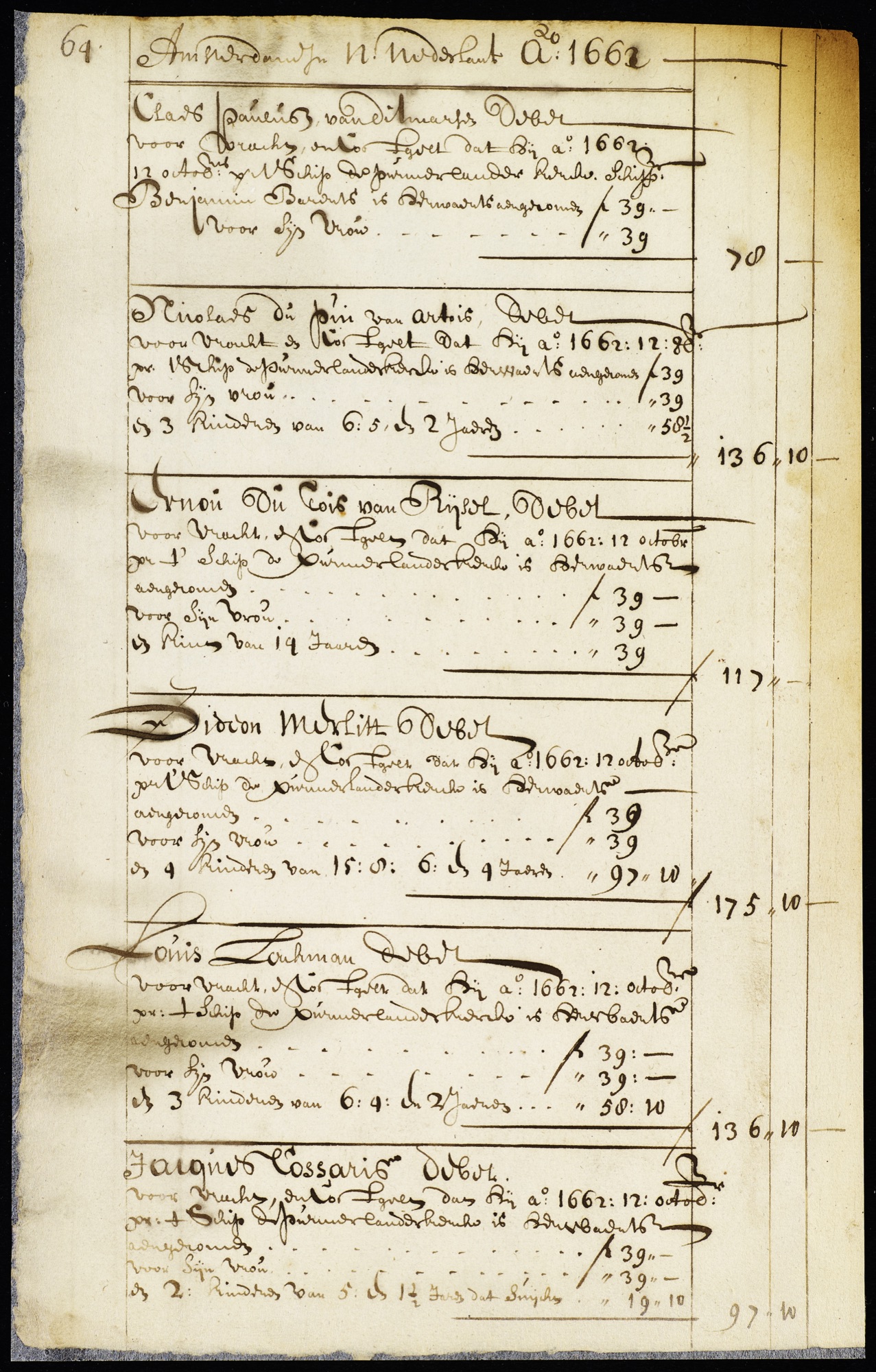
| The ledger (Dutch) | In English |
|---|---|
| Gideon Merlitt debet | Gideon Merlitt owes |
| voor vracht en costgelt dat hij ao 1662: 12 octob: per ’t schip de Purmerlanderkercke is derwaerts overgecomen | for freight and board money, for coming over there on 12 October 1662 in the ship the Purmerland Church |
| … f 39 | (for himself) 39 guilders |
| voor sijn vrouw … 39 | for his wife: 39 guilders |
| en 4 kinderen van 15: 8: 6: en 4 jaren … 97:10 | and 4 children of 15, 8, 6 and 4 years: 97 guilders 10 stuivers |
| 175:10 | Total: 175 guilders 10 stuivers |
The clerk’s handwriting is a 17th-century Dutch script and some words are abbreviated; the reading above is ours, and the figures are certain. A guilder was 20 stuivers, so the total is 175½ guilders.
The arithmetic shows how fares were charged in 1662. A full fare was 39 guilders (entries from the 1650s show 36). Josias, at 15, paid the full fare, and the three younger boys paid half fare, 19½ guilders each: 39 + 19½ × 3 = 97½. The other accounts on the same ship fit the same rule. Ernou Du Tois’s 14-year-old paid the full fare, children from about 2 to 13 paid half, and the youngest babies seem to have gone free.
So the family did not pay for the crossing before sailing. They sailed on credit and arrived in New Amsterdam owing the Company 175½ guilders, just as the printed conditions allowed.
What was a guilder worth?
There is no reliable way to turn a 17th-century guilder into modern dollars; prices and ways of life were too different. It is easier to measure it against what people earned and bought at the time:
- Wages. In mid-17th-century Holland a master carpenter earned about 1 guilder a day, and an unskilled laborer about 300 guilders a year. In New Netherland wages ran higher: as early as 1637 a carpenter there was paid 2 guilders a day.
- Food. A loaf of wheat bread cost 2 to 3 stuivers (about a tenth of a guilder), a pound of butter 6 to 8 stuivers, and a mug of beer a stuiver or so.
- Rent and property. A craftsman’s house in a Dutch town rented for 60 to 120 guilders a year, and a small town house sold for 800 to 1,500.
- In the colony. A beaver pelt, New Netherland’s main currency after wampum, traded at about 7 guilders in New Amsterdam in 1660.
Measured that way, the Merles’ 175½ guilders was about 175 days’ pay, or some seven months’ work, for a carpenter in Holland, which the records say Gideon was, or about 25 beaver pelts in New Amsterdam. That was a large debt for a refugee family to start a new life with, and it helps explain why, a month after landing, Gideon and his companions were asking the colony for seed grain and six months’ food. One rough modern estimate puts 100 guilders of the 1600s at about $6,000 today, which would make the family’s bill something like $10,000, but that figure should be taken as a loose guide only.
Money and debt followed the family in the new country. In December 1681, a Staten Island court ordered Gideon to pay a debt of 150 guilders to Peter Nowe; see the timeline.
Was it ever paid?
The facing credit page for folio 64 is blank. Nothing is written against Gideon’s account, or those of the other five families on that page. The credit side was used elsewhere in the book: on the next page of the Purmerland Church’s passengers, for instance, Ferdinandus de Mulder’s 39 guilders are marked as settled, written off to the account of the Company’s directors and referred to another of its books.
A blank credit side doesn’t prove the debt went unpaid. Repayments made in New Netherland would have been entered in the colony’s own books, most of which are lost, and the Company’s rule ended barely a year and a half after the family landed. But this ledger, at least, never records the Merles’ debt as settled.
The petition of 19 March 1663
A month after landing, Gideon and six of the men he had sailed with went before Stuyvesant and his council. The 1865 Calendar of Historical Manuscripts summarizes their petition as praying “for grants of land and seed grain, with provisions for six months.” The fuller extract in family research adds that they came because of the printed conditions and promised to repay what was advanced to them. The council gave its order on the petition the same day.
All seven petitioners can be matched to names on the Purmerland Church’s passenger list, one of them less certainly:
| In the petition | On the passenger list | Household |
|---|---|---|
| Nicolas Dupuy | Nicolaes Du Pui, from Artois | wife, 3 children |
| Gideon Merlet | Gideon Merlitt | wife, 4 children |
| Arnout du Toict | Ernou Du Tois, from Ryssel (Lille) | wife, 1 child |
| Jacques Cossart | Jacques Cossaris | wife, 2 children |
| Louis Lacquerman | Louis Lackman | wife, 3 children |
| Jacob (surname garbled in the printed calendar) | probably Jacob Colff, from Leiden | wife, 2 children |
| Jean le Canceleer | Jan de Conchilier | alone |
All seven have French or Walloon names, and six of them were fathers of young families. They seem to have traveled as a group, and they acted as one when they arrived. On 1 April 1663 Gideon joined the Dutch Reformed Church in New Amsterdam with about nineteen others, the Cossarts among them.
The petition is recorded among the council minutes in the New York Colonial Manuscripts, volume 10, part 2, page 49, with the council’s order on page 50.
Why Staten Island?
Staten Island was newly open to settlement. On 22 August 1661 the Company had allowed Pierre Billiou, a French-speaking Walloon, and his companions to settle there, founding the village later called Oude Dorp (“Old Town”), the island’s first lasting settlement. Its families were Dutch, French, Walloon and English. For French-speaking Protestants, it was a natural place to go. Pierre Billiou’s daughter, Christance Billeau, would marry Gideon’s son Abraham in 1678.
The Company kept courting French Protestants to the end. In January 1664 its Amsterdam Chamber resolved to let Huguenot families from La Rochelle and other parts of France sail to New Netherland and receive land there free of charge, and told Stuyvesant to give them every assistance. That summer, Stuyvesant and his council wrote back that seven or eight Frenchmen had already come over to look at the land, and that they were “most pleased with Staten Island.”
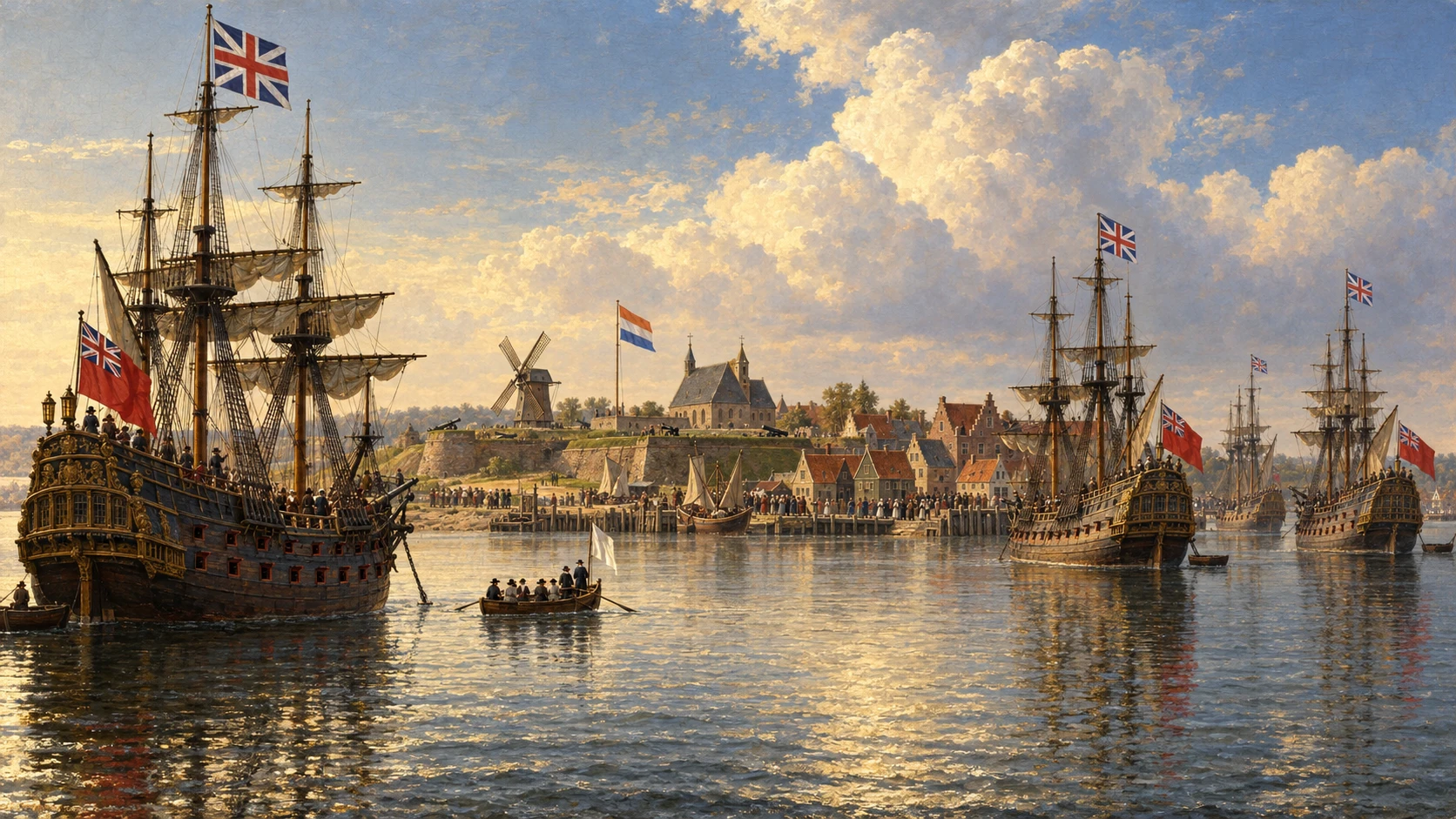
They were too late. Within weeks, in September 1664, English warships took New Netherland without a fight, and the Company’s rule was over. Gideon had arrived in the colony’s last year and a half.
What the Company did not do
It is easy to picture Gideon as a Company man, but the records point the other way. The Company had employees in New Netherland (soldiers, clerks, sailors, craftsmen on wages) and it had free colonists (vrijluiden) who came to farm for themselves. Gideon was a free colonist. He owed the Company money for his passage, but nothing suggests he worked for it.
Nor did the Company give him the land the family is remembered for. The surveys and patents for the Merlet land on the south side of Staten Island and at the mouth of Fresh Kill date from 1675–76, under the English. What land, if any, Gideon received after his petition of 1663 is not yet known.
Records still to find
- Repayment of the passage money in New Netherland’s own account books, if any survive. The Company’s ledger (above) shows the debt but no payment.
- The full petition and the council’s order (New York Colonial Manuscripts, vol. 10, part 2, pp. 49–50), for the exact wording and what was granted.
- The directors’ letter to Stuyvesant of 14 October 1662, which the archive’s catalog says concerns emigrants, among other matters. It was written the day the Purmerland Church is said to have cleared Amsterdam and may have sailed with her.
- Amsterdam notary records, now being indexed by the Amsterdam City Archives. Most of the Company’s own archive was sold as waste paper in 1821. See Records in Europe in the ship article.
The full story of the family’s journey is in Across the Atlantic in 1662, and the ship and everyone aboard her are in The Purmerland Church.