DNA research
The Marlatt-Merlet DNA Project: Summary Report
By William P. Marlatt, Marlatt-Merlet DNA Project Administrator, with assistance from Greg O. Marlatt, Co-Administrator. Report dated 5 January 2019.
Posted with permission. This report is shared on Malott.net with the permission of its author, William P. Marlatt. It is the work of many people who believe they descend from Gedeon Merlet, and who tested their DNA to find out. Additional research will be posted here as it comes in; see the September 2026 update below.
To protect living people, this web version leaves out the names of project members and DNA matches, and ends each lineage before the most recent generations. Most footnotes have been condensed into source notes, and a few illustrations from other publishers are not reproduced.
Update, September 2026: Big Y-700 results
Since this report was written, members of the project have taken FamilyTreeDNA’s Big Y-700 test, which reads a much larger part of the Y chromosome than the marker (STR) tests described below and can place a man in a far more recent branch, or haplogroup, of the family tree of mankind. In September 2026 the project administrator, William P. Marlatt, summarized the results:
- Gedeon’s line. Big Y results from descendants of Josias Merlet (b. 1645) and Abraham Marlatt (b. 1656), both thought to be sons of Gedeon, indicate that Gedeon most likely carried haplogroup G-FT64201.
- Theodore’s line. All three Big Y testers descended from Theodore Melot (b. 1694), son of Jean Pierre Melot, carry haplogroup G-FTB81217, so Theodore must have carried it too.
- The two do not connect. A man carries the defining mutations of every haplogroup above his own on his father’s line. Theodore’s descendants do not carry Gedeon’s G-FT64201, so they cannot be his direct male-line descendants.
This confirms, with stronger evidence, what the STR results in section D already suggested: the paternal line of Theodore, and of all the Malott and Mellott men descended from him, is genetically distinct from Gedeon Merlet’s. Yet the records are clear that Jean Pierre was baptized at Mannheim in 1658 as a son of Gedeon and Marguerite Martin, and that Theodore was baptized in New York in 1694 as a son of Jean Pierre Melot and Marie Melot. A “non-paternal event,” a birth where the biological father was not the man recorded, must have happened either between Gedeon and Jean Pierre or between Jean Pierre and Theodore. Which one is still unknown. Jean Pierre’s own haplogroup can’t be determined unless a male-line descendant of one of his other sons takes a Big Y test.
What this means for Malott and Mellott descendants
Everyone in the Malott and Mellott lines on this site traces back through Theodore to Jean Pierre and then to Gedeon. The DNA says that somewhere on the direct father-to-son line, at Theodore or above him, a biological father was not the man the records name. There are two possibilities:
- The break was between Gedeon and Jean Pierre. Jean Pierre’s biological father was then not Gedeon, but his mother was still Gedeon’s wife, Marie Martin. Theodore’s descendants would still descend from her, and from the Huguenot family that fled France, crossed on the Purmerland Church and settled Staten Island. Gedeon raised Jean Pierre as his son, and every record treats him that way.
- The break was between Jean Pierre and Theodore. Theodore’s descendants would then descend from his mother, Marie, and from an unknown father, and their male line would not go back to the Merlets by blood. Theodore might, for example, have been Marie’s son from an earlier relationship, raised under the Melot name.
Either way, the records still stand. The baptisms name Jean Pierre as Gedeon’s son and Theodore as Jean Pierre’s, the family lived as one family, and the name came down through them. Genealogy has always counted families this way: adoptions, step-children and unknown fathers turn up in almost every tree that reaches back 350 years. And Y-DNA follows only one line, a man’s father’s father’s father; it says nothing about the thousands of other ancestors each of us has from the 1600s. By record, by name and by family, the Malotts and Mellotts are Gedeon’s descendants. On the direct male line by blood, they probably are not.
What could settle it
- A Big Y-700 test from a male-line descendant of another of Jean Pierre’s sons. If he carries Gedeon’s haplogroup, G-FT64201, the break was between Jean Pierre and Theodore; if he carries Theodore’s, G-FTB81217, it was between Gedeon and Jean Pierre.
- A fourth man who carries G-FTB81217 has turned up among Big Y testers outside the project. His known paternal ancestry, if it leads to a different surname, could point to the biological father.
- More Big Y tests from Malott and Mellott men, to confirm that they belong to Theodore’s line.
Source: William P. Marlatt, administrator of the Marlatt-Merlet DNA Project, email to project members, 9 September 2026, with a corrected descendancy chart. Only Big Y-700 results were used for these haplogroups; testers are not named here to protect living people.
A. Introduction
The purpose of this report is to summarize the results of DNA testing associated with the Marlatt-Merlet DNA Project. It includes an introduction to the project, a summary of the origins and early migrations of the family, a timeline of events relating to the family’s immigrant ancestor, Gedeon Merlet, an overview of Y-DNA and autosomal DNA testing, and the next steps for the project.
The goals of the project are to (1) identify the common ancestors of all Marlatt family members, and (2) identify the descendants of Gedeon Merlet, born about 1624. Surnames of interest include Marlatt, Marlett, Marlette, Marlot, Marlott, Merlat, Morlatt, Murlatt, Malott, Mollet, Mellott and similar spellings.
The project began in 2011. Greg O. Marlatt (now project co-administrator) and I realized, after running into brick walls on our paternal lines for years, that it was time to add DNA testing to our genealogical toolboxes. It was apparent early on that the real value of DNA research comes from comparing results with other family members. After some study of the test labs and the types of testing available, Family Tree DNA was selected as the preferred lab for Y-DNA testing, and it remains so today, although several labs now offer autosomal testing. The project was approved by Family Tree DNA on 26 October 2011, and by 11 November hundreds of e-mails had gone out announcing it. In 2010 I sent out only six e-mails related to DNA; in 2011, 674, most of them in the last six weeks of the year.
Membership was low at first, but growth was steady. There are currently 71 members.
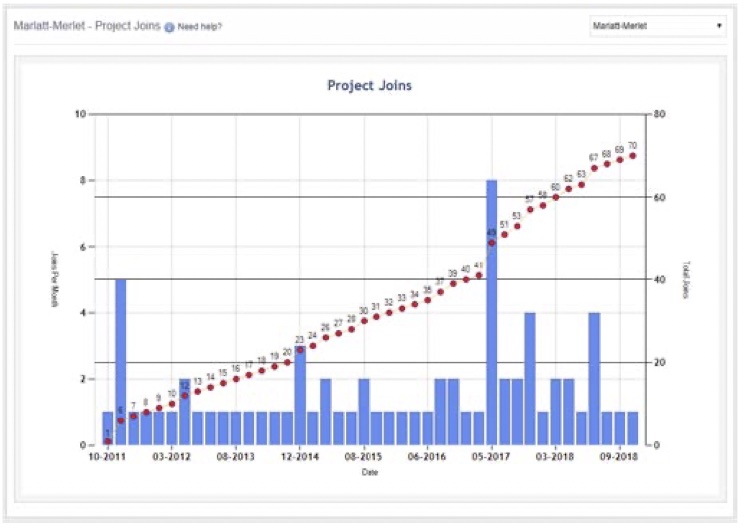
Table 1: Project statistics
| Statistic (17 December 2018) | Count |
|---|---|
| Total members | 71 |
| Big Y | 3 |
| Y-DNA 111 markers | 6 |
| Y-DNA 67 markers | 25 |
| Y-DNA 37 markers | 37 |
| Y-DNA 25 markers | 37 |
| Y-DNA 12 markers | 37 |
| Distinct confirmed Y-DNA haplogroups | 7 |
| Family Finder (autosomal) | 35* |
| mtDNA | 15 |
| Unreturned kits | 16 |
* These are the numbers reported by Family Tree DNA. My own records show that 59 members have taken autosomal tests, some of them transferred in from other labs.
Marlatt is the most common surname among members, followed by Mellott and Malott. Six members are related to the Melat family of Pennsylvania.
Table 2: Surnames of project members
| Surname of project member | Count |
|---|---|
| Marlatt | 23 |
| Mellott | 12 |
| Malott | 9 |
| Melat | 6 |
| Marlett | 3 |
| Marlette | 2 |
| Merlet | 2 |
| Mullet | 1 |
| Mollett | 1 |
What the project has accomplished
These were all group efforts that could not have been realized without the support of project members and the wider research community. Your contributions are truly advancing the state of knowledge of the family.
- Determined the haplogroup, ancient origins and early migration paths of the family.
- Identified the Y-DNA characteristics of the Marlatt, Marlett and MarLett group; of the Malott and Mellott group; and of the descendants of John Malott, born about 1722–26.
- Observed that John Marlatt (b. 1760–66, brother of William b. 1770), Abraham (b. 1773) and Robert Melat (b. 1799) all share a distinctive DNA marker with a descendant of Josias Merlet (b. ca 1645). More research is needed to confirm that all these men descend from Josias.
- Established that two members with the surnames Gordon and Welsh are from the Marlatt bloodline.
- Found that there may have been a break in the Marlatt bloodline between Abraham Marlatt (b. 1732) and George Marlatt (b. 1815).
- Determined, from Y-DNA, that John Marlatt (b. 1794) was unlikely to be the son of Abraham Marlatt (b. 1756–59), son of Abraham Marlatt (b. ca 1723) and Martha Vail.
- Established autosomal DNA groups for Thomas Marlett (b. 1698), John Marlatt (b. 1711), Abraham Marlatt (b. 1761), the father of John (b. 1760–66) and William (b. 1770), Abraham Marlatt (b. 1773), Joseph Marlatt (b. 1777), Robert Melat (b. 1799), John Marlatt (b. 1794), John Malott (b. 1722–26), Peter Malott (b. 1728), Benjamin Malott (b. 1734), Theodore Malott (b. ca 1775–83) and the Merlets.
- Observed possible autosomal connections among Abraham Marlatt (d. 1839), John Marlatt (b. 1794) and Jacob Marlatt (b. ca 1802), supporting the idea that they were sons of the same father.
- Located records indicating that Gedeon Merlet’s parents were most likely Josias Merle/Marles and Jeanne Robb.
- Determined from land records dated about 1685, 1693 and 1699 that the wife of Josias Merlet (b. 1645) was named Jane or Jean. Their son George was born about 1685, so she was likely his mother.
- Identified John Milat/Melat, in the 1800 census of New York City’s Ward 7, as a candidate for the father of John Marlatt (b. ca 1762–66) of Mansfield, New Jersey. The surnames Voorhis, Drake, Bird, Brown, Gardiner, Cregar, Hart and Parks are common to both families.
- Identified William Melette, in the 1810 census of Shenango Township, Crawford County, Pennsylvania, as a candidate for the father of Robert Melat (b. 1799), for eleven separate reasons. Further work is needed to confirm it.
- Showed from baptism records of Christ Church, Ballston Spa, New York, that the Gideon Marlatt born 15 April 1753, who married Anne Vanderipe and is buried in the Marlatt Cemetery at Jasper, New York, was not the Gideon baptized in 1754 as the son of Abraham Marlatt and Martha Vail.
- Traced, with the help of family letters written in 1851–52 by the historian Lewis Vail, a probable line from Richard Marlatt of Hunterdon County, New Jersey, and his wife Nelly (a daughter of Abraham Marlatt and Martha Vail) through Berkeley County, Virginia, to Abraham Marlatt of Coshocton County, Ohio (d. 1839) and John Marlatt (b. 1794). Vail was recalling conversations from 30 years before, so parts of this remain uncertain.
- Won approval, on 1 January 2019, of an application to the Ohio Genealogical Society’s First Families of Ohio, proving the paternal lineage of William P. Marlatt back to Josias Marles (b. ca 1600) with 113 supporting documents and both conventional and DNA research.
- Determined that Mary “Polly” Marlatte (1796–1864) of Warren County, New Jersey, who married Benjamin Reeder in 1816, was the daughter of William Marlatt (b. 1770) and Elizabeth Brown; and that Lydia Ann Marlatt (b. 1818, Penfield, New York), who married Thomas Aylesworth, may have been a daughter of Abraham Marlatt (b. 1785, Piscataway).
- Located a list of people drawing provisions at Detroit on 12 July 1784 that names Sarah Melot, widow, and five children: Kath’r (21), Peter (15), Blanch (9), Hezek’h (7, possibly a mistake for Keziah) and Theod’r (5).
- Wrote or drafted research papers on the families of George Marlatt (b. ca 1685), Paul Marlatt (b. ca 1716), Joseph (1752–1813) and Samuel (1796–1875) Marlatt, John Marlatt (b. 1762–66), Abraham Marlatt and Elizabeth Lane, the Marlatts of western Pennsylvania, Dirck Marlatt (chr. 1708), Gideon Marlatt (b. 1753), Abraham Marlatt and Elizabeth Furman, the will of Abram Merlett (1777), Richard and Leah (Beller) Marlatt of Berkeley County, Virginia, John and Catherine (Hammersley) Marlatt of Ohio, the probate of Abraham Morlatt of Coshocton County (1839), Abraham and Mary (Maple) Marlatt, Burgoyne Marlatt (b. 1784), Peter Malott (b. ca 1727) and his eleven children, and Jean Pierre Malott (b. 1658). Together they cite more than 2,500 references.
- Helped many family researchers extend their lineages, and administered the project: setting it up, sending announcements, helping members join, answering questions and writing this report.
B. Prehistory of the Marlatt-Merlet family
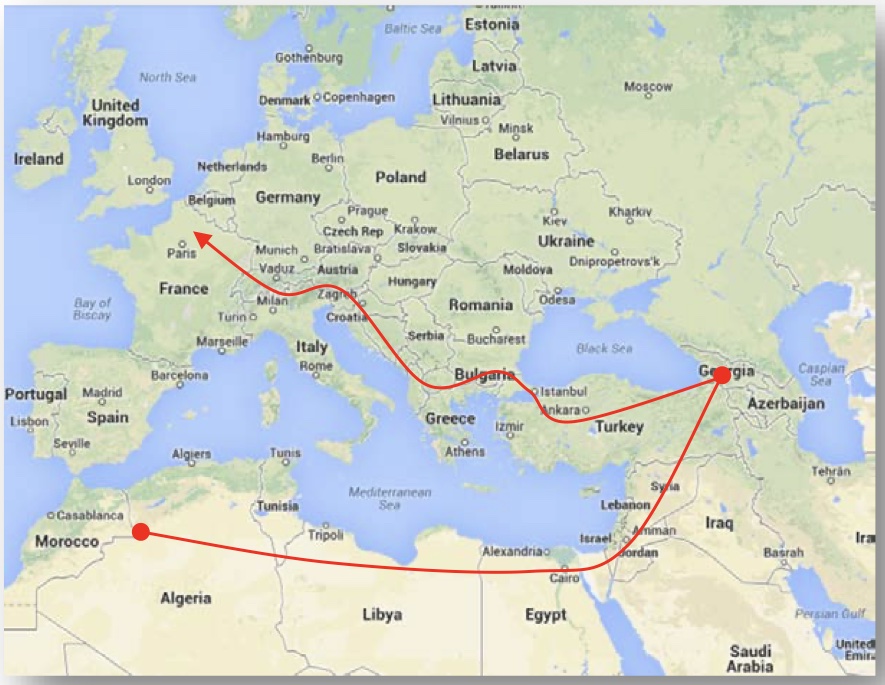
Anthropology and genetic genealogy have been instrumental in tracing the origins and migration routes of the Merlet family (Marlatt, Marlett, Melat, Malott, Mellott…) and of mankind as a whole. By analyzing DNA samples from indigenous people around the world, scientists have determined that mankind first evolved in Africa and then migrated to the Middle East, Asia, Australia, Europe and the rest of the globe. The earliest fossils of modern man, found in Ethiopia, are about 200,000 years old. Genetic research shows that all men living today share a common male ancestor born between 120,000 and 200,000 years ago, and studies in 2011 and 2012 support the idea that he lived in north-western Africa, though where in Africa man originated is still debated.
A chromosome is a thread-like structure in the nucleus of most living cells that carries genetic information in the form of genes. The Y chromosome determines a child’s sex; it is carried only by men and passed from father to son. Occasionally the order of its genetic building blocks changes from one generation to the next, and these mutations can be used as markers to track paternal lines.
Haplogroups are clans of people who share a set of genetic markers and a common ancestor. They are named by letters, A through S, and their markers by a letter and number in order of discovery (for example, M42). Testing shows that the male Marlatts, Marletts, Melats, Malotts and Mellotts are in haplogroup G, defined by the markers M168, M89 and M201.
Marker M168 first appeared in a man born 50,000 to 60,000 years ago, probably in northeastern Africa; about 85% of the world’s population descends from him. Our ancestors then probably looked much like modern African hunter-gatherers. Two to five thousand years later, marker M89 appeared in a man born either in northeastern Africa or the Middle East. The likely route out of Africa was across the Bab-el-Mandeb Strait on the Red Sea, the shortest crossing to a new continent: about 12 miles today, and perhaps less during the ice age, when sea levels were lower. There is evidence these early people ate seafood gathered by beachcombing, and harsh climates and dwindling food may have pushed them across the strait in search of new beaches.
About 30,000 years ago, marker M201 first arose in a man born in the Middle East, probably south of the Caucasus Mountains and perhaps near Lake Van, though possibly as far east as the Himalayan foothills.
Our co-administrator, Greg O. Marlatt, tested into haplogroup G2a. Haplogroup G2, defined by the mutation P287, is thought to have originated in Anatolia (modern Turkey) and is found most often in Europe and the Middle East, with a concentration in central Italy spreading north into the Swiss Alps; people in this group are very likely descendants of the Etruscans. G2a, defined by P15, seems to have originated in the Caucasus.
Herodotus claimed the Etruscans came from Lydia, in Anatolia, sent by their king to find a better land after a drought, a tale modern historians long doubted. But testing of Neolithic remains has now proven that G2a was one of the lineages of the farmers and herders who migrated from Anatolia into Europe between 9,000 and 6,000 years ago, bringing sheep and goats first domesticated south of the Caucasus about 12,000 years ago. That may explain why haplogroup G is most common in mountainous areas. Ancient skeletons from Talheim in Germany, Languedoc-Roussillon in southern France and Catalonia in Spain all confirm that Neolithic European farmers belonged to G2a.
Ötzi the Iceman, Europe’s oldest human mummy, who lived in the Italian Alps about 5,300 years ago, was also G2a. He carried a longbow, a quiver of fourteen arrows, a flint knife and a copper axe, and his last two meals were chamois and red deer, with bread made from processed grain. He was probably a hunter whose people also farmed wheat and barley. Agriculture had emerged in the Middle East about 10,000 years ago, and carbon dating shows farming communities in southeastern Europe by 7,000 years ago and northeastern Europe by 5,000. G2a may also be connected with the Cardium Pottery culture, known for pottery pressed with seashells, which stretched from the Adriatic to the east coast of Spain between 7,000 and 3,500 years ago.
Although far from definitive, our early ancestors may have followed a path like this one:
Table 3: Notional migration route of the Marlatt-Merlet family (haplogroup G2a)
| Lived this many years ago | Location |
|---|---|
| 120,000–200,000 | Northwestern Africa |
| 50,000–60,000 | Northeastern Africa |
| 45,000–55,000 | Middle East |
| 30,000 | South of the Caucasus Mountains |
| 6,000–9,000 | Anatolia (modern Turkey) |
| 6,000–9,000 | Central Italy or the Swiss Alps |
| 3,500–7,000 | Southern Germany, the Italian Alps, southern France, or northeastern Spain |
| 400 | Roucy, France |
Subclade testing is being used to narrow down where our ancient ancestors lived. A subclade is a subgroup of a haplogroup, defined by SNPs (single nucleotide polymorphisms): a difference in a single DNA building block. A few members have taken SNP tests, which extends the project’s tree to:
M201 (haplogroup G) > P287 > P15 > L1259 > L30 > CTS5762 > P303 > L140 > L497 > CTS9737 > Z725 > Z3158 > Z726 > CTS4803 > S2808
The Z726, CTS4803 and S2808 mutations occurred at about the same time, some 3,500 to 4,000 years ago, probably in the same place. If you have taken a Y-DNA test and your surname is Marlatt, Marlett, MarLett, Melat, Malott or Mellott, you probably have these same SNPs.
C. Immigrant ancestor of the family: Gedeon Merlet, born about 1624
Conventional genealogical research shows that Gedeon Merlet was probably the progenitor and immigrant ancestor of the Marlatts, Marletts, Malotts, Mellotts and related families in the United States. Gedeon, son of Josias Marles and Jeanne Robb, lived at Roucy, France, as a young man. (Greg Marlatt notes that Roucy may have been a temporary refuge for the family, since the Count of Roucy was a Huguenot.) He married Margariet Martijn in the Walloon Church at Leiden, Holland, on 21 August 1644, and three of their children were baptized there. The family lived briefly in Paris, returned to Leiden by 1652, and by 1653 had moved to Mannheim, Germany, where three more sons were baptized in the French church.
Gedeon, his wife and four sons sailed from Amsterdam on De Purmerlander Kerck on 12 October 1662 and reached New Amsterdam (now New York) by 18 February 1663. He owned land on Staten Island and lived there for much of his adult life, including 256 and 243 acres on the south side of the island and 30 acres of salt meadow at the mouth of Fresh Kill. Under English rule he was appointed constable by Governor Francis Lovelace in 1671, and in 1674, during the Dutch reoccupation, magistrate by Governor Colve. By 1684 he appeared among the first settlers of Piscataway, New Jersey, and an order of 20 March 1684, granting his sons Josias and Paulus a survey of their inherited land, shows that he had died by then.
Timeline of Gedeon Merlet
This timeline is also on its own page.
| 1621–28 | The archives at The Hague call Gedeon Merlette a “carpenter, young man from Roussy” in December 1643: old enough to have learned a trade, young enough to be called a young man. If he was 17 to 22 in 1643, he was born 1621–28, or about 1624.Letter from C. W. Delforterie, Centraal Bureau voor Genealogie, The Hague, to Lois Hall, 9 July 1974. |
|---|---|
| December 1643 | “Received into the membership of the Church of Leide – December, 1643: Merlette, Gedeon, surnamed La Plante, according to the records of the Church of Tergoude.” The church at Tergoude (Gouda, South Holland) was founded in 1642 and abolished in 1818. A French version of the same entry reads “Gideon Merlette dit laPlanse.”Letter from J. M. Charensol, Pastor, Bibliothèque Wallonne, Leiden, to Mrs. Josef Finck, 17 September 1965; letter from Sara Katerine “Sally” Fox Smith, 1 December 1979. |
| 6 August 1644 | Betrothal entry (translated): “Gedeon Merleth, carpenter from de Rousy, dwelling in Stantstraet [Sand Street], accompanied by Philip Merleth, his uncle, … with Margriet Martijn from Limbouch, accompanied by Jenne Martijn, her cousin.”Letter from A. J. Versprille, Gemeente-Archief van Leiden, to Mrs. Josef Finck, 14 August 1965; Dutch Betrothal Book N, p. 114. |
| 21 August 1644 | Gedeon Merleth and Margariet Martijn were married in the Walloon Church in Leiden.Mary Malott Everhart, Peter Malott of Maryland and His Descendants (1996), p. 12a. |
| 17 September 1645 | Josias, son of Gedeon Merlette, baptized in the Walloon Church at Leiden. He may have been named for his grandfather, thought to be Josias Marles.Versprille letter, 14 August 1965. |
| 11 November 1646 | Marie, daughter of Gideon Merlette, baptized in the Walloon Church at Leiden.Versprille letter, 14 August 1965. |
| 26 July 1648 | Esechias, son of Gedeon Merlette and Marguerite Martin, baptized in the Walloon Church at Leiden. One witness was Paul Merlette, thought to be Gedeon’s brother.Versprille letter, 14 August 1965. |
| 1651 | The family left Leiden after 1648, lived in Paris, and was received back into the Leiden church in December 1651 “by testimony of the church of Paris.”Charensol letter, 1965; Fox Smith letter, 1979. |
| 23 October 1652 | “Member at Leide 23 October 1652, Gedeon Merlet and his wife.”Fox Smith letter, 1979. |
| 14 September 1653 | Gedeon Marlet and Marguerite Martin baptize their son Paul at Mannheim, Germany. His godfather was Paul Marlet, thought to be Gedeon’s brother.Summary of Mannheim records from the Huguenot Historical Society, New Paltz, New York, sent by Eva G. Malott, 1986. |
| 20 February 1655 | Paul Marles, son of Josias Marles and Jeanne Robb of “Rossy in Champagne,” married Elizabeth Moreau in the French church of Mannheim. This record is the main evidence that Josias and Jeanne were also Gedeon’s parents.Copy of the Mannheim marriage record sent by E. R. Cordtz, 1986. |
| 26 January 1656 | Abraham, son of Gedeon Marlette and Marguerite Martin, born at Mannheim; baptized 3 February.Mannheim records, Huguenot Historical Society. |
| September 1657 | Paul Marlet and Elisabeth Moreau baptize a son named Gedeon at Mannheim, with Gedeon Marlet as godfather: another sign that Paul and Gedeon were brothers.Mannheim records, Huguenot Historical Society. |
| 18 April 1658 | Jean Pierrat, son of Gedeon Merlet and Marguerite Martin, born at Mannheim; baptized 2 May.Mannheim records, Huguenot Historical Society. |
| February 1661 | Gedeon and his wife are again members at Leiden, “coming from Hanau.”Delforterie letter, 1974. |
| 12 October 1662 | De Purmerlander Kerck (The Purmerland Church), Captain Benjamin Barentsz, sails from Amsterdam with “Gideon Merlitt, wife and four children, 15, 8, 6, and 4 years old.” One later history says the family came from Artois in the “Purmerland Castle,” but kerk means church, and Artois was probably the origin of a fellow passenger, Nicolaes Du Pui.Carl Boyer, Ships Passengers of New York and New Jersey 1600–1825, p. 130; Lorine McGinnis Schulze, “Ships’ Lists,” Olive Tree Genealogy; Staten Island and Its People, vol. 2, p. 925. |
| 18 February 1663 | The ship arrives at New Amsterdam.Schulze, “Ships’ Lists.” |
| 19 March 1663 | Gedeon and six fellow passengers petition the Director General and Council of New Netherland. They say they were moved to come by “the printed New Netherlands conditions,” and ask for suitable land, seed grain, and provisions for six months, promising to repay what is advanced to them.New York Colonial Manuscripts, vol. 10, part 2, p. 49 (translated from Dutch), extract sent by Mike Horton, 1997. |
| 1 April 1663 | “Gidion Marlet” joins the Reformed Dutch Church in the City of New York, with about 19 others.New York Genealogical and Biographical Record, vol. 9, no. 2 (April 1878), p. 76. |
| 15 March 1664 | The Leiden church still lists Gedeon and his wife, noting they “parted from Leiden” on this date. No return voyage is known; this may just be slow record keeping.Everhart (1996); Fox Smith letter, 1979; Marlatt, Melott, Mallott Past and Present newsletter, April 1995. |
| 1671–72 | Gideon Marlet is constable on Staten Island, appointed at Dover on 20 April 1671 under the English governor, Francis Lovelace. On 16 January 1671/72 he takes the inventory of the estate of Walraven Letin of Dover.Abstracts of Wills, City of New York, 1665–1707, vol. 1, p. 24; Charlotte Megill Hix, Staten Island Wills and Letters of Administration, p. 109. |
| 26 April 1671 | “Gideon Marlette was called before the council.”Calendar of Council Minutes 1668–1783, p. 13. |
| 14 February 1674 | During the brief Dutch reoccupation of the colony, Governor Colve names Gideon Marlet a magistrate of Staten Island.Documents Relating to the Colonial History of the State of New York, vol. 2, p. 681. |
| 1675–76 | Surveys of 256 acres on the south side of Staten Island for Gideon Marlett and his sons, and a patent of 243 acres plus 30 acres of salt meadow at the mouth of Fresh Kill to “Gideon Marlett and his two sons, Joshua and Paulus.”Calendar of N.Y. Colonial Manuscripts, Indorsed Land Papers (1864), pp. 65–69. |
| 1681 | “Gidion Marlett” appears among the first settlers of Staten Island in the Richmond County records.Orra Eugene Monnette, First Settlers of Ye Plantations of Piscataway and Woodbridge (1930), pp. 124–125. |
| 25 August 1681 | Mary Marshall and Ann Marlett drown when their canoe overturns. Ann’s parents aren’t named; Gedeon, Josias and Paulus are all possibilities.Abstracts of Wills, City of New York, Liber 19 B, p. 427. |
| 5 December 1681 | A Staten Island court orders Gidion Marlett to pay Peter Nowe a debt of 150 guilders.Richmond County Records, p. 7. |
| 1684 | “Marlet (Marlett-Marlott-Merlett), Gideon” is listed among the first settlers of Piscataway, New Jersey.Monnette, First Settlers, p. 95. |
| 20 March 1684 | The council grants the petition of Josias and Paulus Marlitt for a survey and division of their inherited land, so Gedeon had died by this date.Calendar of Council Minutes 1668–1783, p. 37. |
| 7 December 1685 | Mary Murlet, widow, marries John Tailler at Woodbridge, New Jersey. She is thought to be Gedeon’s widow, a second wife (recorded on this site as Mary Taylor).Joseph W. Dally, Woodbridge and Vicinity (1873), Appendix E, p. 348. |
How his name was spelled
Across these records, Gedeon and Gideon are the most common spellings of his first name, and Merlet, Merlette and Marlett of his surname. That may help when searching online databases.
Table 5: Most common spellings of Gedeon Merlet’s name, by number of occurrences in the records above
| Given name | Times recorded | Surname | Times recorded |
|---|---|---|---|
| Gedeon | 19 | Merlette | 9 |
| Gideon | 17 | Merlet | 8 |
| Gidion | 3 | Marlett | 8 |
| Jejedon | 1 | Marlet | 6 |
| Marlette | 3 | ||
| Merleth, Merlit | 2 each | ||
| Marles, Marlott, Merlett, Marlitt, Merlitt, Murlet | 1 each |
D. Summary of Y-DNA test results
Y-DNA testing traces a man’s patriline, his father, his father’s father and so on, and shows whether two men share a common male ancestor. In a project like this one, it also reveals the DNA characteristics of the different branches of the family, which can help you focus your research on the branches that matter most to you.
Humans have 23 pairs of chromosomes: 22 pairs of autosomes and one pair of sex chromosomes. Women have two X chromosomes; men have one X, inherited from their mother, and one Y, inherited from their father. Because Y-DNA rarely changes from father to son, two male descendants of Gedeon Merlet who inherited his Y-DNA will have similar Y-DNA profiles. The occasional changes add up over many generations, and the amount of difference can be used to roughly estimate how long ago two men’s common ancestor lived.
Labs report Y-DNA as STR markers (short tandem repeats), counting how many times a short DNA sequence repeats at each of 12, 25, 37, 67 or more locations on the Y chromosome. That set of values is a man’s haplotype. A mutation usually changes a value by one or two, and the genetic distance between two men is the sum of the differences. On a 67-marker test, a distance of 0 means a very close relationship; 3 to 6 means related, but more distantly; 10 or more means not related within the genealogical time frame of 500 to 1,000 years. A value that changes in one branch may be passed down unchanged for several generations, which can help tell branches of the family apart.
Twenty-six members have taken Y-DNA tests. The results fall into three groups:
- Marlatt, Marlett and MarLett men who trace their lines to Josias Merlet (b. 1645) or Abraham Marlatt (b. 1656).
- Malott and Mellott men who trace their lines to Jean Pierre Malott (b. 1658).
- Men whose lines have not yet been traced back to Gedeon.
One caveat: formal lineage proofs haven’t been provided for each of these lines. They are generally consistent with those in the public domain, but may change as knowledge grows.
For groups 1 and 2, the most common value of each marker (the mode) was calculated. These modal haplotypes are probably very close to those of Josias and Abraham (group 1) and of Jean Pierre (group 2). Highlighted values differ between the two groups.
Table 7: Modal haplotypes for group 1 (Marlatt, Marlett, MarLett) and group 2 (Malott, Mellott)
Markers 1–12
| Marker | 393 | 390 | 19/394 | 391 | 385a | 385b | 426 | 388 | 439 | 389-1 | 392 | 389-2 |
|---|---|---|---|---|---|---|---|---|---|---|---|---|
| Marlatt, Marlett, MarLett | 13 | 22 | 15 | 10 | 14 | 15 | 11 | 13 | 12 | 12 | 11 | 29 |
| Malott, Mellott | 14 | 22 | 15 | 10 | 14 | 14 | 10 | 13 | 11 | 12 | 11 | 29 |
Markers 13–25
| Marker | 458 | 459a | 459b | 455 | 454 | 447 | 437 | 448 | 449 | 464a | 464b | 464c | 464d |
|---|---|---|---|---|---|---|---|---|---|---|---|---|---|
| Marlatt, Marlett, MarLett | 18 | 9 | 9 | 11 | 11 | 23 | 16 | 21 | 31 | 12 | 13 | 13 | 14 |
| Malott, Mellott | 16 | 9 | 9 | 11 | 11 | 23 | 16 | 21 | 30 | 12 | 13 | 13 | 13 |
Markers 26–37
| Marker | GATA H4 | YCAIIa | YCAIIb | 456 | 607 | 576 | 570 | CDYa | CDYb | 442 | 438 | |
|---|---|---|---|---|---|---|---|---|---|---|---|---|
| Marlatt, Marlett, MarLett | 11 | 11 | 20 | 20 | 15 | 13 | 16 | 18 | 35 | 36 | 11 | 10 |
| Malott, Mellott | 11 | 11 | 20 | 20 | 15 | 12 | 15 | 18 | 37 | 40 | 11 | 10 |
Markers 38–47
| Marker | 531 | 578 | 395S1a | 395S1b | 590 | 537 | 641 | 472 | 406S1 | 511 |
|---|---|---|---|---|---|---|---|---|---|---|
| Marlatt, Marlett, MarLett | 11 | 8 | 15 | 16 | 8 | 11 | 10 | 8 | 11 | 11 |
| Malott, Mellott | 11 | 8 | 16 | 16 | 8 | 11 | 10 | 8 | 11 | 11 |
Markers 48–60
| Marker | 425 | 413a | 413b | 557 | 594 | 436 | 490 | 534 | 450 | 444 | 481 | 520 | 446 |
|---|---|---|---|---|---|---|---|---|---|---|---|---|---|
| Marlatt, Marlett, MarLett | 14 | 22 | 22 | 14 | 10 | 12 | 12 | 13 | 9 | 14 | 21 | 22 | 19 |
| Malott, Mellott | 12 | 22 | 22 | 13 | 10 | 12 | 12 | 13 | 8 | 12 | 21 | 22 | 19 |
Markers 61–67
| Marker | 617 | 568 | 487 | 572 | 640 | 492 | 565 |
|---|---|---|---|---|---|---|---|
| Marlatt, Marlett, MarLett | 12 | 11 | 13 | 11 | 11 | 11 | 12 |
| Malott, Mellott | 12 | 11 | 13 | 11 | 11 | 11 | 12 |
A surprising result
Seventeen of the 67 markers differ between the two groups, a genetic distance of 24. As explained above, anything 10 or more on 67 markers means the two groups are not related, or are only very distantly related. In other words, the descendants of Josias and Abraham are not closely related to the descendants of Jean Pierre, even though they are all in haplogroup G.
This is surprising, because baptism records show that Josias, Abraham and Jean Pierre were all sons of Gedeon Merlet. It suggests that a non-paternal event (an adoption, an unrecorded second marriage, or a child whose biological father was someone other than the recorded one) occurred somewhere in the Marlatt line, in the Malott line, or in both.
Group 1 has six members: one descended from Josias and five from Abraham. Both subgroups match the group mode closely, which suggests that Josias and Abraham had the same father, most likely Gedeon. Group 2 has eleven members, all descending through Theodorus Melot (b. 1694) and his father Jean Pierre: five through Theodorus’s son John (b. ca 1722–26), three through Joseph (b. ca 1735–39), two through Peter (b. ca 1728) and one through Benjamin (b. ca 1734). Their distances from the group mode range from 0 to 5, so all probably descend from Theodorus. If there was a break in the Malott-Mellott line, it happened either between Gedeon and Jean Pierre, or between Jean Pierre and Theodorus.
Members not yet linked to Gedeon
With the two group haplotypes established, the results of group 3 members can be compared with them. Several appear related to Josias or Abraham.
Table 8: Group 3 members (not yet linked to Gedeon) compared with groups 1 and 2
| Kit | Lineage | Closest to | Genetic distance |
|---|---|---|---|
| 48768 | Abraham Gordon b. 1796, married Frances Jacobs about 1825, Helena, Phillips Co., Arkansas | Group 1 | 2 |
| 237191 | Robert Melat b. 1799, m. Elizabeth Kiefer > William > Jesse > … | Group 1 | 4 |
| 205005 | Abraham Marlatt b. ca 1773 > William H. b. ca 1810 > Andrew b. ca 1841 > Harold A. B. b. ca 1893 | Group 1 | 1 |
| 867695 | Gideon b. ca 1624 > Abraham b. 1656 > Derick b. 1708 > Abraham b. 1733 > Abraham b. 1761 > George b. 1786 > George b. 1815 > Thomas b. 1860 | No match | — |
| 260712 | John Marlatt b. 1762–66 > John b. ca 1792 > Jacob b. ca 1825 > John B. b. 1858 > Louis Eugene b. 1887 | Group 1 | 3 |
| 316153 | John Marlatt b. 1762–66 > John b. 1794 > Jacob b. 1822 > John B. b. 1856 > Clyde b. 1883 | Group 1 | 4 |
Marlatt, Marlett and MarLett group
The table below shows the group 1 members, with the distance of each from the group mode. The markers where a member differs from the mode are the most useful, because they may identify a particular branch. Marker DYS456 is an interesting example. Only one group 1 member has a value of 16 there, and he is the one who descends from Josias Merlet. But several group 3 members, not yet linked to Gedeon, also have a 16:
Table 9: Group 1 members
| Kit | DNA family group | Lineage | Distance from group mode |
|---|---|---|---|
| 687871 | Thomas Merlet b. ca 1698 | Gideon b. ca 1624 > Abraham b. 1656 > Thomas b. ca 1698 > Mark b. 1734 > Enoch b. 1765 > John Sutphin b. 1796 > Elias James b. 1828 > Peter Eugene b. 1854 > Clyde Henry b. 1888 > Herman Eugene b. 1910 | 5 |
| 250150 | George Marlatt b. ca 1706 | Gedeon b. ca 1624 > Abraham b. 1656 > Joris/George b. 1706 > Abraham b. 1732 > Peter MarLett b. 1765 > Abraham MarLett b. 1786 > Benjamin Franklin MarLett b. 1824 > Royal Norman MarLett b. 1851 > Frank Henry MarLett b. 1877 | 3 |
| 632635 | Derick Marlatt b. ca 1708 | Gideon b. ca 1624 > Abraham b. 1656 > Derick b. 1708 > Abraham b. 1733 > Richard b. 1762 > John b. 1793 > John William b. 1831 > Ora b. 1871 > Wilbur b. 1896 | 1 |
| 211264 | Derick Marlatt b. ca 1708 | Gideon b. ca 1624 > Abraham b. 1656 > Dirck b. ca 1708 > Dirck b. ca 1743 > Abraham b. ca 1773 > John b. 1794 > Isaac b. 1818 > Perry b. 1847 > Isaac b. 1878 | 1 |
| 423002 | John Marlatt b. ca 1711 | Gideon b. ca 1624 > Abraham b. 1656 > John b. ca 1711 > Gideon b. 1753 > Mathias b. 1779 > Christopher b. 1812 > Stephen b. ca 1838 > … | 4 |
| 116991 | Josias Merlet b. ca 1645 | Gedeon b. ca 1624 > Josias b. 1645 > George b. ca 1685 > John b. ca 1721 > Joseph b. 1752 > John b. 1777 > George b. 1816 > Andrew Post b. 1863 | 3 |
Table 10: Group 3 members with a value of 16 at marker DYS456
| Kit | Lineage | Earliest known ancestor lived in |
|---|---|---|
| 237191 | Robert Melat b. 1799, m. Elizabeth Kiefer > William > Jesse > … | Pennsylvania |
| B45624 | Robert Melat b. 1799, m. Elizabeth Kiefer > John Ralston b. 1827 > George Ellsworth b. 1861 > Ernest James b. 1886 | Pennsylvania |
| 205005 | Abraham Marlatt b. ca 1773 > William b. ca 1810 > Andrew b. ca 1841 > Harold A. B. b. ca 1893 | Warren County, New Jersey |
| 260712 | John Marlatt b. 1762–66 > John b. ca 1792 > Jacob b. ca 1825 > John B. b. 1858 > Louis Eugene b. 1887 | Warren County, New Jersey |
| 316153 | John Marlatt b. 1762–66 > John b. 1794 > Jacob b. 1822 > John B. b. 1856 > Clyde b. 1883 | Warren County, New Jersey |
Could the descendants of Robert Melat (b. 1799) of Pennsylvania and the Warren County, New Jersey, Marlatts related to John Marlatt (b. ca 1762–66) descend from Josias? With only one tested descendant of Josias, that conclusion would be premature. But if more of Josias’s descendants test and also show a 16 at DYS456, it will gain weight. It may be worth noting that John Marlatt (b. ca 1762–66) and his brother William (b. 1770), and Abraham Marlatt (b. 1773) and his cousin Paul (b. 1772), were all contemporaries in Warren County. Abraham and Paul moved to Canada, while John and William stayed. The name Paul may have been handed down from Paul Marlatt (b. ca 1716), a descendant of Josias, which tends to support the idea.
The table can also test a hypothesis. I once believed my own ancestor, John Marlatt (b. 1794), was the son of Abraham Marlatt (b. 1756–59), son of Abraham (b. ca 1723) and grandson of Thomas Merlet (b. ca 1698). But my haplotype (kit 211264) was different enough from that of the descendant of Thomas (kit 687871) to call it into question.
Malott and Mellott group
In this group, marker DYS388 is especially noteworthy. Two kits (222750 and 354704) have a value of 15 there, and a third on the same line (856568) has 14; everyone else has 13. All three descend from Theodore Malott (b. 1775–83) and his father Joseph Malott (b. 1735–59). Theodore is thought to have married Catherine Wigle about 1799 in Essex County, Ontario. His lineage is debated: some researchers place his father Joseph as a son of Peter Malott (b. 1728), others as a son of Theodore (b. 1694). Either way, a DYS388 value of 14 or 15 may point to the branch of the Malott family that made its way to Canada after being attacked by Indians at Fish Creek on the Ohio River between 1778 and 1780.
Table 11: Group 2 members
| Kit | DNA family group | Lineage | Distance from group mode |
|---|---|---|---|
| 220468 | Peter Malott b. 1728 | Gedeon Merlet b. ca 1624 > Jean Pierre Malot b. 1658 > Theodorus Melot b. 1694 > Peter Malott b. 1728 > Theodore “Dory” Malott b. 1755 > Prather Malott b. 1790 > Delos C. Malott b. ca 1824 > William Samuel Malott b. 1861 > George Dewey Malott b. 1899 | 1 |
| 433837 | Peter Malott b. 1728 | Gideon Merlet > Jean Pierre Merlet > Theodorus Malott > Peter Malott Sr. > Peter Malott Jr. > Hiram Malott > … | 1 |
| 101949 | Benjamin Malott b. 1734 | Gedeon Merlette > Jean Pierre Malott b. 1658 > Theodore Malott b. 1693 > Benjamin Malott b. 1734 > Elias b. 1759 > Hiram b. 1810 > William b. 1851 > Hiram b. 1879 | 1 |
| 222750 | Joseph Malott b. 1735–59 | Joseph Malott b. 1759 > Theodore b. 1783 > William b. 1824 > Alanson b. 1865 > Alvin b. 1888 > … | 5 |
| 354704 | Joseph Malott b. 1735–59 | Joseph Malott b. 1759 > Theodore b. 1783 > Thomas Harmon b. 1818 > Milo b. 1842 > Fredrick b. 1887 > Wilfrid b. 1897 | 4 |
| 856568 | Joseph Malott b. 1735–59 | Gedeon Merlet b. ca 1624 > Jean Pierre Malot b. 1658 > Theodorus Mellott b. 1694 > Joseph Mellott/Malott b. ca 1759 > Theodore b. 1775 > William J. b. 1824 > Leonard Coatsworth b. 1843 > Rueben Leonard b. 1881 | 2 |
| 228939 | John Malott b. 1722–26 | Gideon > Jean > Theodorus > John > Theodore > Jacob > Benjamin > Samuel > … | 0 |
| 232655 | John Malott b. 1722–26 | Gedeon > Jean > Theodorus > John > John > Stillwell > Charles > Milton Irvin > … | 0 |
| — | John Malott b. 1722–26 | Gedeon Merlet b. ca 1624 > Jean Pierre Malot b. 1658 > Theodorus Melot b. 1694 > John Mellott b. 1725 > Obediah b. 1755 > John Hollow Mellott b. 1779 > Michael b. 1826 > Lewis b. 1870 > … | 1 |
| B2664 | John Malott b. 1722–26 | Gedeon La Plante Merlet b. ca 1624 > Jean Pierre Malot b. 1658 > Theodorus Mellott b. 1694 > John M. Mellott b. ca 1725 > Jacob b. 1762 > John Andrew b. ca 1787 > John b. ca 1829 > Charlie b. ca 1855 > Benjamin b. 1889 > … | 1 |
| 220403 | John Malott b. 1722–26 | Gedeon > Jean > Theodore > John > Jacob > John > William > Olney > … | 2 |
The first line in this table is the line of the site owner’s family: through Peter Malott, Theodore “Dory” Malott, Prather Malott, Delos C. Malott and William Samuel Malott to George Dewey Malott.
Y-DNA testing has helped the project estimate the haplotypes of the family’s progenitors, identify members of the family, find where breaks in the bloodline occurred, tell the branches apart, and give clues to which branch a test taker comes from. As more men test, the branches of the family tree will be better defined, leading ultimately to a fully developed genetic tree for the family.
E. Summary of autosomal DNA test results
Autosomal DNA tests (called Family Finder at Family Tree DNA) find cousins on all of your family lines who share ancestors with you going back six generations or so. They also estimate your ethnic mix, and their chromosome browsers show which segments of which chromosomes you share with each match. With techniques such as triangulation, that information can identify an unknown ancestor or confirm a lineage.
Autosomal DNA is the 22 pairs of non-sex chromosomes. A child inherits half of each parent’s DNA, so on average each grandparent contributes 25%, each great-grandparent 12.5%, and so on. Beyond the parents there is considerable variation, and after enough generations you no longer carry DNA from every ancestor. That is why distant cousins may share none at all.
Table 12: Average share of DNA received from one ancestor
| Ancestor | Average share of your DNA from that one ancestor |
|---|---|
| Parent | 50% |
| Grandparent | 25% |
| Great-grandparent | 12.5% |
| 2nd great-grandparent | 6.25% |
| 3rd great-grandparent | 3.125% |
| 4th great-grandparent | 1.563% |
| 5th great-grandparent | 0.781% |
The amount of DNA you share with a match, measured in centiMorgans (cM), roughly predicts your relationship: the higher the number, the closer the relationship. The ranges for different relationships overlap, so use judgement, and your match’s family tree, to choose the best fit.
An example of triangulation
Two of our members, call them SM and AM, share 105 cM. That could fit several relationships, but it is closest to the average for second cousins once removed (112 cM, with a range of about 30–215). Their family trees agree:
- George Marlatt b. 1815 > SM’s grandfather > SM’s father > SM
- George Marlatt b. 1815 > AM’s great-grandfather > AM’s grandfather > AM’s mother > AM
That makes them second cousins once removed. But can we confirm that the DNA they share actually came from George? Yes, by triangulation: finding three or more people who all share the same DNA segment on the same chromosome. If each matches the other two on that segment, and two of them trace back to a common ancestor, the third very likely descends from that ancestor too, unless they are related some other way.
Both SM and AM match a woman we’ll call LB: SM shares 171 cM with her, and AM 76 cM. (Matches under about 7 cM are often false.) On SM’s chromosome browser, LB’s and AM’s segments on chromosome 7 overlap by 14.5 cM, and AM’s browser confirms that AM and LB share that same stretch. So all three share the same segment. LB hadn’t posted a lineage, only that her mother was a Marlatt, but conventional research then traced her line back to George Marlatt (b. 1815). The exercise confirmed SM’s lineage, confirmed SM’s relationship to AM, and extended LB’s tree. For more on triangulation, Blaine Bettinger’s The Family Tree Guide to DNA Testing and Genetic Genealogy is highly recommended.
Family Tree DNA also lets you filter matches by name or ancestral surname, and its “In Common With” button narrows your list to people who match both you and a chosen match.
DNA family groups
Project members’ records were reviewed for their reported lineages and for matches carrying the family surnames. Where two or more people appear to share a common ancestor, they form a DNA family group named for that ancestor. Many of the matches do seem to descend from the named ancestor, but some probably match the test taker through other lines. Triangulation hasn’t yet been done on each group to confirm them; that will be an interesting study for the future.
Table 14: DNA family groups (the report’s list of potential descendants by name is omitted here)
| DNA family group | Probable lineage |
|---|---|
| Abraham Marlatt b. 1733 | Gideon b. ca 1624 > Abraham b. 1656 > Derick b. 1708 > Abraham b. 1733 > Richard b. 1762 > John b. 1793 |
| Abraham Marlatt b. 1761 | Gideon > Abraham b. 1656 > Derick b. 1708 > Abraham b. 1733 > Abraham b. 1761 |
| Abraham Marlatt b. 1773 | Abraham Marlatt b. 1773 (not yet linked further back) |
| Benjamin Malott b. 1734 | Gedeon b. ca 1624 > Jean Pierre Malot b. 1658 > Theodorus b. ca 1694 > Benjamin b. 1734 |
| John Marlatt b. 1711 | Gedeon b. 1624 > Abraham b. 1656 > John b. 1711 |
| John Marlatt b. 1794 | Gideon b. ca 1624 > Abraham b. 1656 > Dirck b. ca 1708 > Dirck b. ca 1743 > Abraham b. 1773 > John b. 1794 |
| John Mellott b. 1722–26 | Gedeon b. ca 1624 > Jean Pierre Malot b. 1658 > Theodorus b. 1694 > John b. ca 1722–26 |
| Joseph Marlatt b. 1777 | Joseph Marlatt b. 1777 |
| Joseph Marlatt b. 1790 | Joseph Marlatt b. 1790 |
| Merlet | Merlet |
| Mollett | Mollett |
| Mullet | Hans Mollat b. ca 1750 > Johannes b. 1771 > Nicholas Mullet b. 1815 |
| Peter Malott b. 1728 | Gedeon b. ca 1624 > Jean Pierre Malot b. 1658 > Theodorus b. ca 1694 > Peter b. 1728 |
| Robert Melat b. 1799 | Robert Melat b. 1799 |
| Theodore Malott b. ca 1775–83 | Gedeon b. ca 1624 > Jean Pierre Malot b. 1658 > Theodore b. 1694 > Joseph b. 1735–59 > Theodore b. ca 1775–83 |
| Thomas Merlet b. 1698 | Gedeon b. ca 1624 > Abraham b. 1656 > Thomas b. ca 1698 |
| Father of John Marlatt b. 1762–66 and William Marlatt b. 1770 | John Marlatt b. 1762–66 and William Marlatt b. 1770 |
| Abraham Gordon b. 1796 | Abraham Gordon b. 1796 |
Together with Y-DNA and conventional research, autosomal testing will allow the family tree to be developed and confirmed all the way back to the family’s progenitor. Based on the evidence so far, these are the male grandchildren (and a few great-grandchildren) of Gedeon Merlet who likely had male descendants. No sons of Paulus are known; only Josias, Abraham and Jean Pierre are known to have had sons who carried the family name forward.
Figure 11: Male descendants of Gedeon Merlet who likely carried on the family name
George Marlatt b. ca 1720
John Marlatt b. ca 1721
Gedeon Marlet b. ca 1700
George Marlet b. 1706
Derck Marlet b. 1708
Jan Marlet b. 1711
Theodore Malott b. ca 1725–27
Peter Malott b. 1728
Benjamin Malott b. 1734
Joseph Malott b. ca 1735–39
F. What is the next step?
Focus of future research
The top priority is to grow the project’s membership, both to develop haplotypes for each branch of the family and to identify the shared autosomal segments of each DNA family group.
- Characterize each major branch with Y-DNA. At least two tested men are needed from each of these sons:
- Sons of George Merlet (b. ca 1685): Paul (b. ca 1716), George (b. ca 1720) and John (b. ca 1721).
- Sons of Abraham Marlatt (b. 1656): Thomas (b. 1698), Gedeon (b. 1700), George (b. 1706), Dirck (b. 1708) and John (b. 1711).
- Sons of Theodore (b. 1694): John (b. ca 1722–26), Theodore (b. ca 1724–27), Peter (b. 1728), Benjamin (b. 1734), Joseph (b. 1735–39) and Thomas (b. ca 1740).
- Characterize these family groups with Y-DNA and autosomal testing:
- Pennsylvania Marlatts: Daniel (b. 9 Jan 1772, New Jersey), William Melette (b. ca 1766–74), Joseph (b. ca 1777, New Jersey), George (b. ca 1775–84, Pennsylvania), John (b. ca 1784) and Robert Melat (b. 1799).
- Warren County, New Jersey Marlatts: Abraham (b. ca 1752–58), John (b. ca 1760–66), William (b. 1770), Paul (b. 1772) and Abraham (b. 1773).
- Virginia Marlatts: Derck (b. ca 1745), Abraham (b. 1732), Abraham Morlat (father of John b. 1794), Abraham (b. ca 1761), Richard (b. ca 1762), Joseph (b. 1790), John (b. 1794) and Gideon Morlatt.
- Monmouth County, New Jersey Marlatts: John (b. 1711), Dirck (b. ca 1745), John (b. ca 1748–52), Samuel (b. ca 1750) and Gideon (b. 1753).
- Canadian Malotts: Joseph (b. 1735–39), Peter (b. 1765), David (b. 1777) and Theodore (b. ca 1779).
- Kentucky Malotts: Joseph (d. before 1803) and his sons Isaac and David.
- Help members extend their lineages back to Gedeon Merlet.
- Develop well-documented family group sheets for each of the main families above.
How you can help
- If you’re not a member, consider taking a DNA test and joining the Marlatt-Merlet project at Family Tree DNA.
- If you are a member, take an autosomal test (men and women) and a 67-marker Y-DNA test (men who carry the family surname), if you haven’t already.
- If you tested autosomal DNA at another lab, consider transferring your results to Family Tree DNA.
- Invite other descendants of Gedeon Merlet to test and join. Check your match list now and then for new matches with the family surnames (Marlatt, Marlett, Melat, Malott, Mellott, Merlet and so on) and invite them.
- Post your family tree on Family Tree DNA and keep it up to date, and fill in your earliest known ancestors and surnames in your account settings. Be sure to name a beneficiary for your account.
- Share this report with your family and fellow researchers.
- Learn more about genetic genealogy; Blaine Bettinger’s book is an excellent start.
- Consider uploading your autosomal data to GEDmatch to find more matches and use its advanced tools.
Thank you for your involvement in the Marlatt-Merlet DNA Project.
Bill Marlatt
Marlatt-Merlet DNA Project Administrator