Huguenot history
The Huguenots: Why Our Family Left France
Long before they were Malotts, Mellotts and Marlatts, our ancestors were the Merles of Roucy, a village in the Champagne region of northern France. They were Huguenots, French Protestants, and their faith is the reason the family left France, took refuge in Holland, and finally crossed to America.
Who the Huguenots were
The Protestant Reformation began in Germany around 1517 with Martin Luther and reached France within a few years. In France it took the form taught by John Calvin, and its followers came to be called Huguenots. They belonged to the Reformed Church, which held that salvation came through personal faith, and that ordinary people could read and interpret the Bible for themselves without a priest standing between them and God.
Where the name “Huguenot” came from is uncertain. One old explanation, repeated by Colonel James Tompkins Watson in 1908, traces it to a word used in Touraine for people who walk about at night, because for generations the only safe places for Huguenots to worship were caves, fields and forests after dark.
Many Huguenots were craftsmen, merchants, printers and professionals, and their emphasis on reading the Bible made them an unusually literate group. That success, and the way their congregations looked after one another, bred suspicion and resentment among their Catholic neighbors.
One faith, one law, one king
To a 16th-century French person, religion was not a private matter. An old saying summed up the ideal: une foi, une loi, un roi, one faith, one law, one king. The French crown had been bound to the Catholic Church for a thousand years; the king was styled “the Most Christian King”. Heresy was treated as treason, and allowing a rival faith was thought to invite God’s anger and the collapse of society. As early as 1536 a royal edict was issued against the “heretics”, and persecution continued as the movement grew.
The Wars of Religion, 1562–1598
In March 1562 the Duke of Guise, leader of the Catholic party, stopped at the town of Vassy on a Sunday. A quarrel between his men and Huguenots worshipping in a barn nearby ended with his troops firing on the unarmed congregation and killing many of them. The massacre set off more than thirty years of intermittent civil war, fought in eight rounds between the Catholic party and Huguenot armies led by noble “protectors” such as the Prince de Condé and Admiral Gaspard de Coligny. Each war ended in a peace treaty that satisfied no one, and the fighting soon began again.
The worst moment came in August 1572. The Huguenot leaders had gathered in Paris for the wedding of the young Protestant prince Henri of Navarre to the king’s sister, Marguerite. Days later Admiral Coligny was shot and wounded, and in the early hours of 24 August, St. Bartholomew’s Day, soldiers broke into his lodgings and killed him. The killing spread through the city as mobs turned on their Protestant neighbors, and over the following weeks to towns across France. Thousands died. Henri of Navarre survived only by agreeing to become a Catholic, and spent the next four years as a prisoner at court.
The massacre destroyed a generation of Huguenot leaders, and many survivors gave up their faith. Those who held on became more organized and more defiant, running their own churches, schools, garrisons and armies, a “state within a state”.
The Edict of Nantes
Henri of Navarre eventually escaped, returned to his faith, and in 1589 became heir to the throne as Henri IV. To end the wars and win Paris, he converted to Catholicism himself. Then, on 13 April 1598, he signed the Edict of Nantes. It let Protestants live anywhere in the kingdom without being questioned or forced to act against their conscience, allowed Reformed worship in named towns and on the estates of Protestant nobles, and opened public offices to Protestants. Catholicism stayed the official religion, but for the first time a French king had accepted that his subjects need not all share one faith to live in peace.
This is the France our Merle ancestors knew. Josias Marle or Merle was born at Roucy in 1600, two years after the Edict, and married Jeanne Robbe there around 1618. Their sons Gideon and Paulus were born at Roucy in the 1620s and 1630s.
The peace breaks down
The peace did not last. After Henri IV was assassinated in 1610, the crown began whittling away Huguenot rights, and a series of Huguenot revolts in the 1620s ended with the fall of their stronghold, La Rochelle, in 1628. By 1644 Gideon had left France for Leiden, in the Dutch Republic, where he married Marie Martijn Martin in the Walloon Church, the French-speaking Protestant congregation that served refugees like them. In 1662 the family sailed on to New Netherland. That part of the story is told in Across the Atlantic in 1662.
Gideon got out in time. On 18 October 1685 Louis XIV revoked the Edict of Nantes. Protestant churches were torn down, pastors were banished, and those who refused to convert faced the galleys, prison or death. Leaving the country was forbidden, yet huge numbers fled anyway, over mountain passes, hidden in casks, or in the holds of merchant ships. (The original collection puts the number at 400,000; estimates vary widely.) France lost many of its most skilled craftsmen and merchants.
Refuge abroad
The refugees scattered across Protestant Europe: to the Netherlands, the German states, England, Switzerland, and even as far as Russia and South Africa. A story told by Colonel Watson has Louis XIV ordering the city of Geneva to expel its Huguenots. The citizens obeyed with great ceremony, escorting the exiles out through one city gate, and then quietly brought them back in through another.
Many continued on to America. Huguenots had reached Florida as early as 1562, though that colony was destroyed by Spanish troops in 1565. Later, large numbers settled in New York, New Jersey, Pennsylvania, Virginia and the Carolinas, and their descendants blended into American life. The Merles, arriving in 1663, were among the early ones.
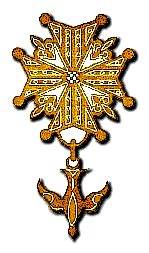
The Huguenot Cross
The Huguenot Cross has become the emblem of Huguenot descendants around the world. No one knows exactly when it came into use, but it was already worn before 1685. Every part of it carries meaning:
- The cross. Its four arms are the petals of an open lily of France, forming a Maltese cross. They stand for the four Gospels.
- The eight points. Each arm ends in two rounded points, eight in all, for the eight Beatitudes.
- The fleurs-de-lis. Four of them join the arms, standing for the mother country of France.
- The twelve points. The rounded points on the four arms and the four fleurs-de-lis add up to twelve, for the twelve Apostles.
- The hearts. The open spaces between each fleur-de-lis and its neighboring arms form hearts, recalling the seal of John Calvin.
- The dove. A dove hangs from the lower arm, representing the Holy Spirit and the Church. In times of persecution, a teardrop took its place.
Important dates in Huguenot history
| c. 1517 | Martin Luther begins the Protestant Reformation in Germany; the new ideas soon reach France. |
|---|---|
| 1533 | John Calvin flees Paris. |
| 1536 | A royal edict against the “heretics”; Calvin becomes pastor in Geneva. |
| 1550s | Calvinism spreads through France, winning thousands of converts. |
| c. 1555 | The first Huguenot church is founded in a private home in Paris. |
| 25 May 1559 | First national synod of the French Reformed Church meets in Paris. |
| 1 March 1562 | Massacre at Vassy starts the French Wars of Religion. |
| 1 May 1562 | Huguenot explorers reach the St. Johns River in Florida, the first Huguenot expedition to North America. |
| 1565 | Spanish troops destroy the Huguenot colony at Fort Caroline, Florida. |
| 24 August 1572 | St. Bartholomew’s Day Massacre in Paris, spreading to the provinces. |
| 1585 | Protestants ordered to convert or leave France. |
| 13 April 1598 | Henri IV signs the Edict of Nantes, ending the wars and granting limited freedom of worship. |
| 1644 | Gideon La Plante Merle, of Roucy, marries in the Walloon (French Protestant) Church at Leiden, Holland. |
| 1662–63 | Gideon and his family sail from Amsterdam in October 1662 and land at New Amsterdam in February 1663. |
| 18 October 1685 | Louis XIV revokes the Edict of Nantes. Persecution resumes and the great exodus begins. |
| 28 November 1787 | The Edict of Toleration partly restores Protestants’ civil rights in France. |
Further reading
These books were recommended in the original collection. Many can be found through public, genealogical and state libraries.
- Baird, Charles W. History of the Huguenot Emigration to America. 2 vols. 1885; reprinted Baltimore: Genealogical Publishing Co., 1991.
- Brock, R. A. Documents, Chiefly Unpublished, Relating to the Huguenot Emigration to Virginia. 1886; reprinted Baltimore: Genealogical Publishing Co., 1979.
- Buisseret, David. Henry IV. Boston: George Allen & Unwin, 1984.
- Butler, Jon. The Huguenots in America: A Refugee People in New World Society. Cambridge: Harvard University Press, 1983.
- Cabell, Priscilla Harriss. Turff & Twigg. Vol. 1, The French Lands. Richmond, 1988.
- Cameron, Euan. The European Reformation. Oxford: Clarendon Press, 1991.
- Coudy, Julien, ed. The Huguenot Wars. Translated by Julie Kernan. Philadelphia: Chilton, 1969.
- Currer-Briggs, Noel, and Royston Gambier. Huguenot Ancestry. Phillimore, 1985.
- Diefendorf, Barbara B. Beneath the Cross: Catholics and Huguenots in Sixteenth-Century Paris. Oxford University Press, 1991.
- Dodge, Guy Howard. The Political Theory of the Huguenots of the Dispersion. Columbia University Press, 1947.
- Gannon, Peter Steven, ed. Huguenot Refugees in the Settling of Colonial America. New York: The Huguenot Society of America, 1985.
- Goodbar, Richard L., ed. The Edict of Nantes: Five Essays and a New Translation. The National Huguenot Society, 1998.
- Grant, A. J. The Huguenots. London: Thornton Butterworth, 1934.
- Gwynn, Robin D. Huguenot Heritage: The History and Contributions of the Huguenots in Britain. 2nd ed. Brighton: Sussex Academic Press, 2001.
- Holt, Mack P. The French Wars of Religion, 1562–1629. Cambridge University Press, 1995.
- Kingdon, Robert M. Myths About the St. Bartholomew’s Day Massacres, 1572–1576. Harvard University Press, 1988.
- Knecht, R. J. The Rise and Fall of Renaissance France. London: Fontana Press, 1996.
- Lavender, Abraham D. French Huguenots: From Mediterranean Catholics to White Anglo-Saxon Protestants. Peter Lang, 1989.
- Mentzer, Raymond A., Jr. Blood & Belief: Family Survival and Confessional Identity Among the Provincial Huguenot Nobility. Purdue University Press, 1994.
- Museum of London and the Huguenot Society of London. The Quiet Conquest: The Huguenots, 1685–1985. London, 1985.
- Rothrock, George A. The Huguenots: A Biography of a Minority. Chicago: Nelson Hall, 1979.
- Scouloudi, Irene, ed. Huguenots in Britain and Their French Background, 1550–1800. Macmillan, 1987.
- Weiss, M. Charles. History of the French Protestant Refugees from the Revocation of the Edict of Nantes to Our Own Days. New York: Stringer & Townsend, 1854.
- Whitehead, A. W. Gaspard de Coligny, Admiral of France. London: Methuen, 1904.