17th-century immigrants
The Purmerland Church: The Ship That Brought Our Family
In the winter of 1662–63 a Dutch merchant ship called De Purmerlander Kerck carried Gideon Merlet, his wife and four sons from Amsterdam to New Amsterdam. Here is what the surviving records say about the ship, its voyages and the people who sailed with them.
A ship named for a village church
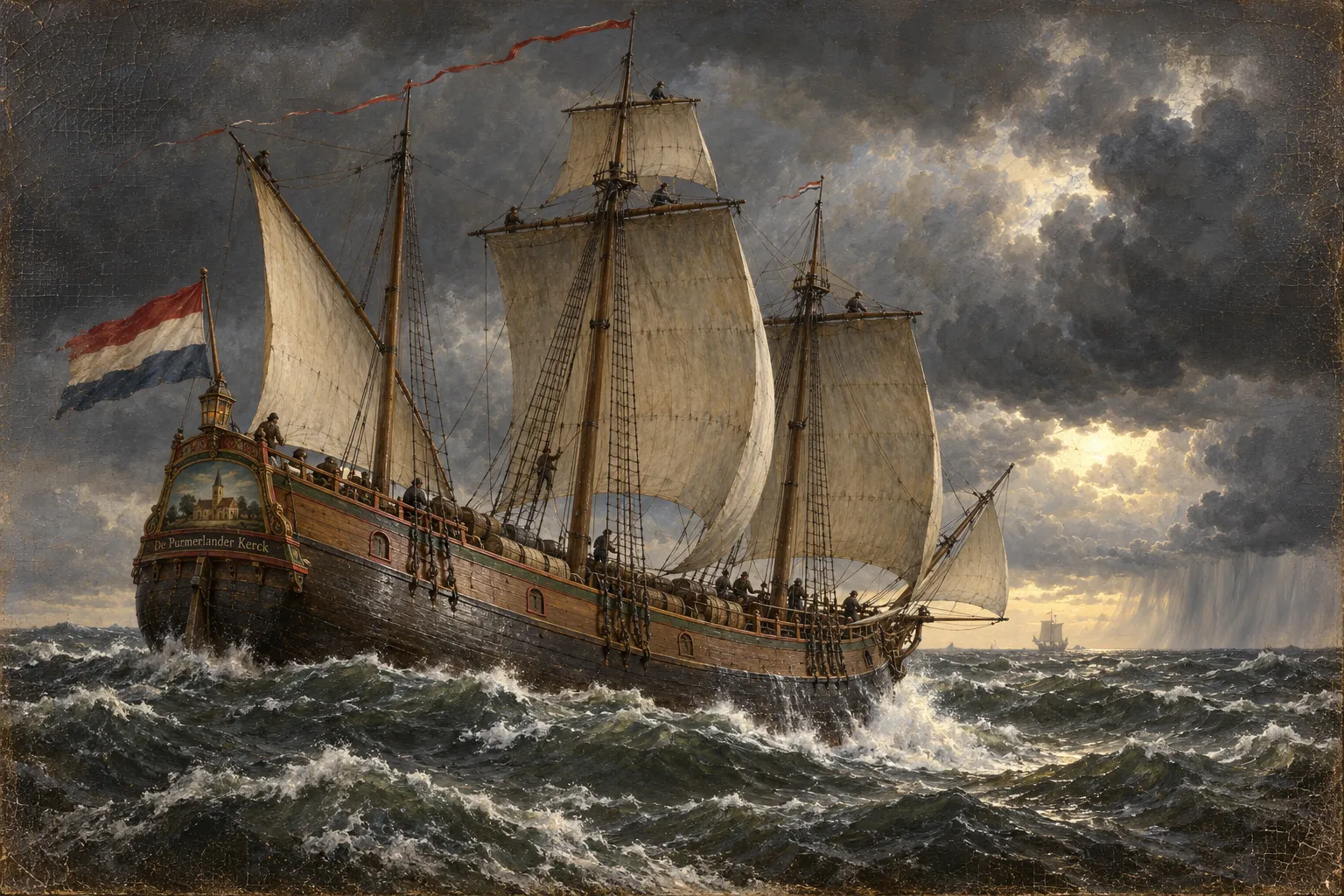
De Purmerlander Kerck means “the Purmerland Church.” Purmerland is a small village a few miles north of Amsterdam, and Dutch ships were often named for the home town of an owner or investor. Clerks of the time spelled the name several ways: Purmerlander Kerck, Permerlander Kerck, Purmerender Kerck, and in English records simply “the Purmerland Church.” One later history calls it the “Purmerland Castle,” but kerck means church.
It should not be confused with the Purmerland, a Dutch East India Company ship of 1663 that sailed to Asia.
On the New Netherland run
The ship appears in the records on at least three voyages to New Netherland in three years, which suggests it was used regularly on the run to the colony:
| Voyage | Skipper | Route |
|---|---|---|
| Nov 1661 – Feb 1662 | Dirck Jacobsz de Vries | From the Texel roadstead to New Amstel (today’s New Castle, Delaware), the City of Amsterdam’s colony on the Delaware River, with about 46 colonists, among them a surgeon. The list was certified “on the Ship ‘The Purmerland Church’, the 17th day of November, 1661.” |
| Oct 1662 – Feb 1663 | Benjamin Barentsz | Amsterdam to New Amsterdam, with Gideon Merlet and his family. |
| Sept – Dec 1663 | not recorded | Amsterdam to the Delaware (South) River, arriving 3 December 1663 with about 150 people, including the colony’s director, Alexander d’Hinoyossa. |
The crossing of 1662–63
The passenger list is dated 12 October 1662 at Amsterdam, under Captain Benjamin Barentsz (also written “Bartense”). Family histories of fellow passenger Jacques Cossart say the ship actually cleared Amsterdam two days later, on 14 October.
It did not reach New Amsterdam, today’s New York City, until 18 February 1663. A crossing of four months, through the storms of a North Atlantic winter, was long even by the standards of the day, when many voyages took about two months. Nothing is recorded of what delayed it.
Gideon’s family is listed as “Gideon Merlitt, wife and 4 children, 15, 8, 6 and 4 years old.” Their daughter Marie stayed behind in Holland. The ages don’t quite match the boys’ baptisms: Josias was about 17, not 15, and Paulus about 9, not 8. The full story of the family’s journey is in Across the Atlantic in 1662.
Which way did they sail?
No log survives for this voyage, so the ship’s exact track is unknown. But the routes Dutch ships used to reach New Netherland are well documented. Between 1609 and 1664 more than 150 ships made about 250 voyages to the colony, almost all of them from the anchorage off Texel, north of Amsterdam, and the crossing took anywhere from 50 to 120 days or more.
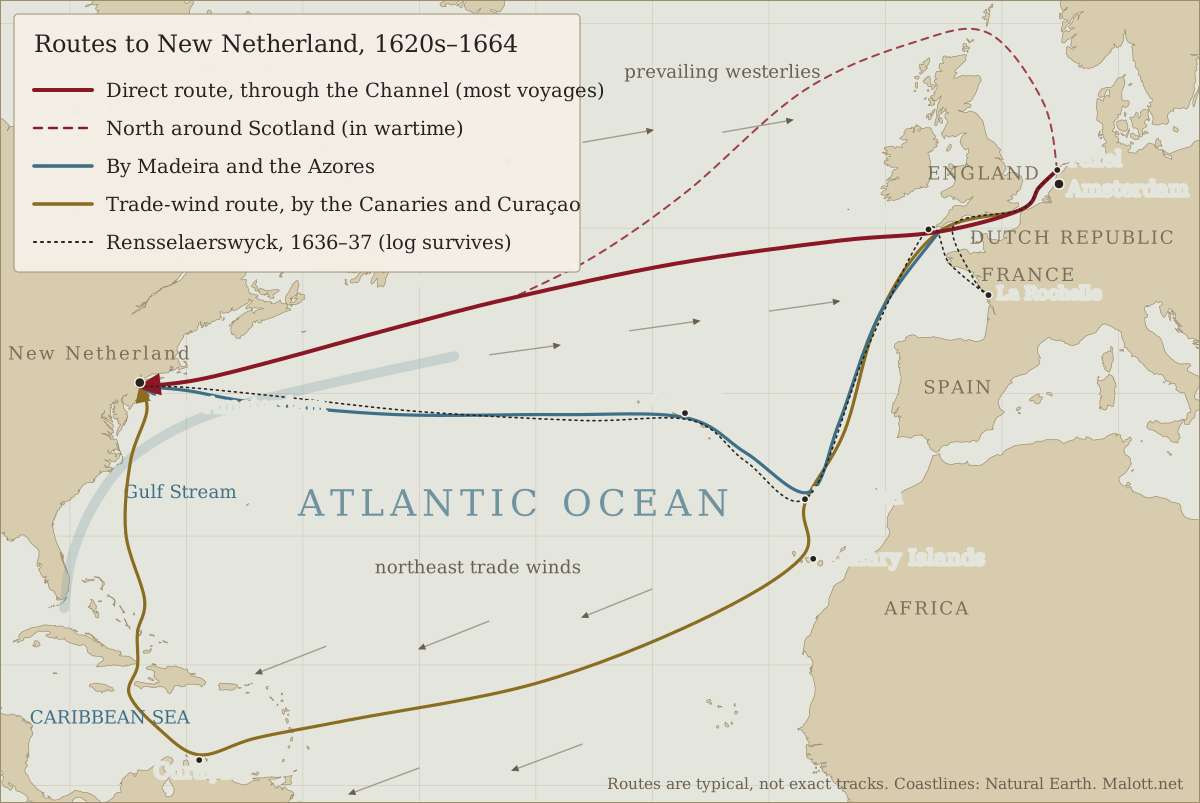
- The direct route. Out through the English Channel and due west across the North Atlantic, past the Newfoundland Banks and down the coast to Sandy Hook. It was the shortest way and the one most ships took, but it meant beating into the prevailing westerly winds, and in winter into the worst of the North Atlantic’s storms. In wartime ships sometimes went north around Scotland instead of risking the Channel.
- By Madeira and the Azores. South past Spain and Portugal to Madeira, west to the Azores, then across the middle of the ocean.
- The trade-wind route. South to Madeira or the Canary Islands, then west on the northeast trade winds to the Caribbean, often calling at the West India Company’s island of Curaçao, and north with the Gulf Stream along the American coast. It was far longer, but the winds were kinder and the weather warmer.
A close parallel survives in the log of the ship Rensselaerswyck, which left Texel on 8 October 1636 and did not reach New Amsterdam until 4 March 1637, a winter voyage of five months. Storms held it in several English ports and at La Rochelle and the Scilly Isles before it went south to Madeira and the Azores and finally crossed; three children were born aboard along the way.
The Purmerland Church’s four months at sea, twice a normal direct crossing, fit either story: a direct crossing battered and delayed by winter storms, or a southern swing to find fairer winds. Either way, for Gideon, Marie and four boys aged about 4 to 17, it was a long, cold and dangerous winter at sea.
Who sailed with them
Fifteen households, about 55 people, are recorded on the voyage. Several, like the Merlets, were French-speaking Protestants from what is now northern France and Belgium: Nicolaes Du Pui from Artois and Ernou Du Tois from Ryssel (Lille) among them. Names and ages are as the clerk wrote them.
| Passenger | From | Traveling with |
|---|---|---|
| Claes Paulusz | Ditmarsen | wife |
| Nicolaes Du Pui | Artois | wife, children 6, 5 and 2 |
| Ernou Du Tois | Ryssel (Lille) | wife, child 14 |
| Gideon Merlitt | — | wife, children 15, 8, 6 and 4 |
| Louis Lackman | — | wife, children 6, 4 and 2 |
| Jacques Cossaris | — | wife, children 5 and 1½ |
| Jan de Conchilier | — | alone |
| Jan Bocholte | — | wife, children 13, 9, 8, 4 and 1 |
| Jacob Colff | Leyden | wife, children 5 and 3 |
| Judith Jansz., a young unmarried woman | Leyden | alone |
| Carsten Jansen | — | alone |
| Ferdinandus DeMulder | — | alone |
| Isaac Verniele | — | wife, 4 children all over 20 |
| Abelis Setskoorn | — | alone |
| Claes Jansen Van Heyningen | — | alone |
After landing
A month after arriving, on 19 March 1663, Gideon and six of his fellow passengers petitioned the Director General and Council of New Netherland. They said the colony’s printed conditions for settlers had moved them to come, and asked for land, seed grain and provisions for six months. Jacques Cossart’s family records the same petition, “he and six of his traveling companions,” and the 1865 calendar of the colony’s records confirms it, naming all seven. See The Company’s Offer.
On 1 April 1663 Gideon joined the Reformed Dutch Church in New Amsterdam with about nineteen others, the Cossarts among them. The Merlets went on to settle on Staten Island.
What the ship looked like
No painting or drawing of De Purmerlander Kerck is known. Ordinary merchant ships were rarely painted on their own; artists favored warships, East Indiamen and harbor scenes. Most Dutch cargo ships of the time were fluyts: three-masted, round-sterned and narrow-decked, built to carry as much as possible with a small crew. The Purmerland Church was very likely one of them, though no record gives its type.
Records in Europe
Most records of the old Dutch West India Company, which ran New Netherland until 1674, no longer exist; the bulk of its archive was sold off as waste paper in 1821. The passenger lists survive only as later extracts. The best remaining source in the Netherlands is the Amsterdam City Archives (Stadsarchief Amsterdam), whose WIC-opvarenden project is indexing the people who sailed on company ships as they appear in Amsterdam notary records. Contracts or freight agreements for this ship or its captain may yet turn up there.