The Revolutionary frontier
Captured on the Ohio: The Malott Family’s Ordeal of 1780
In the last years of the American Revolution, a Maryland family set out by flatboat for a new life in Kentucky. They never arrived. What happened on the Ohio River split the family in two, and sent one half of it to Canada, where its descendants live to this day.
Leaving Maryland
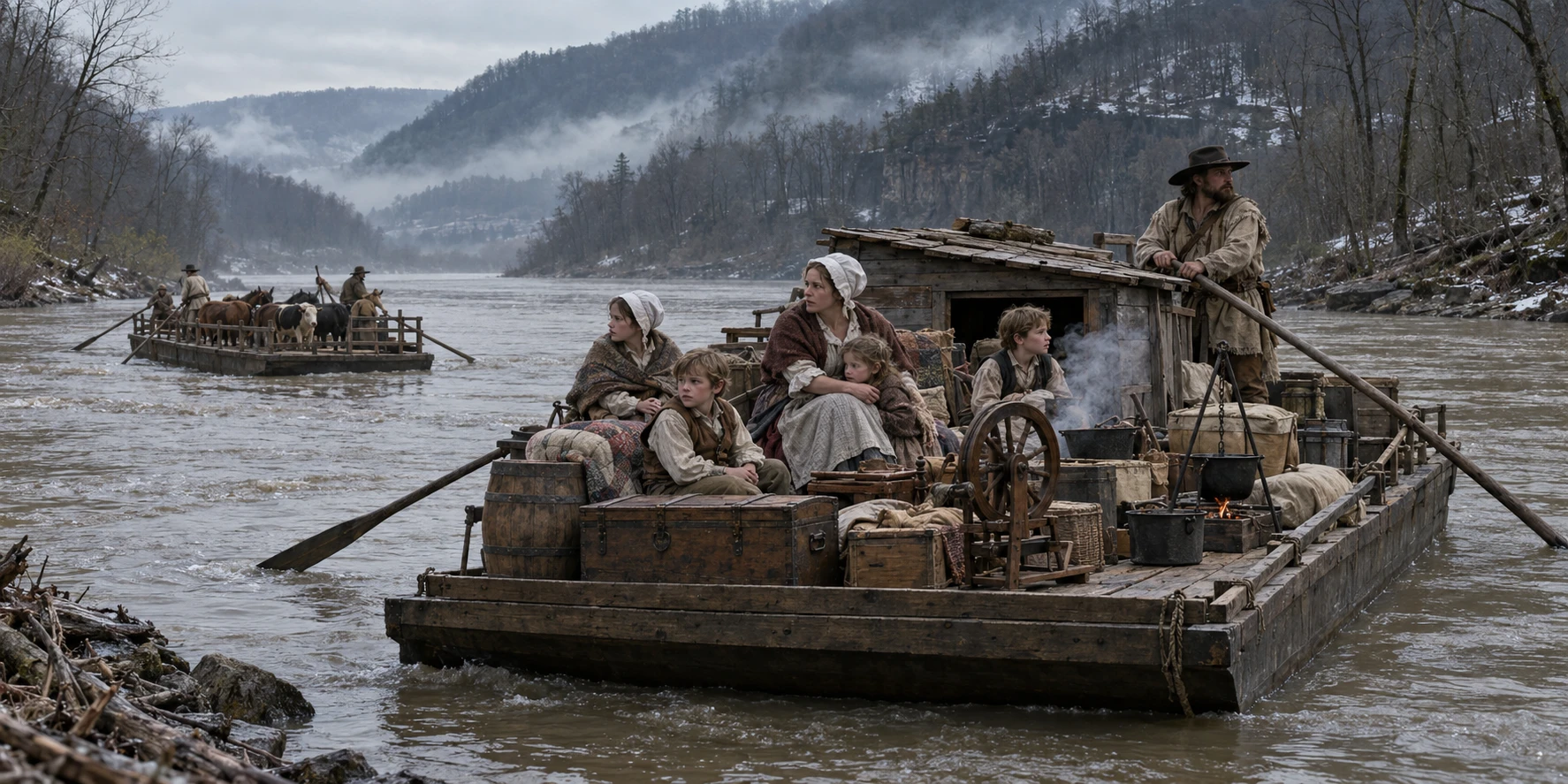
Peter Malott was born about 1727 and had farmed for more than twenty years near Hagerstown, Maryland, where he leased land on the Conococheague Manor in 1754. With his wife, Sarah, he raised a large family. By the late 1770s, like thousands of other families, they were looking west, to the rich new lands of Kentucky.
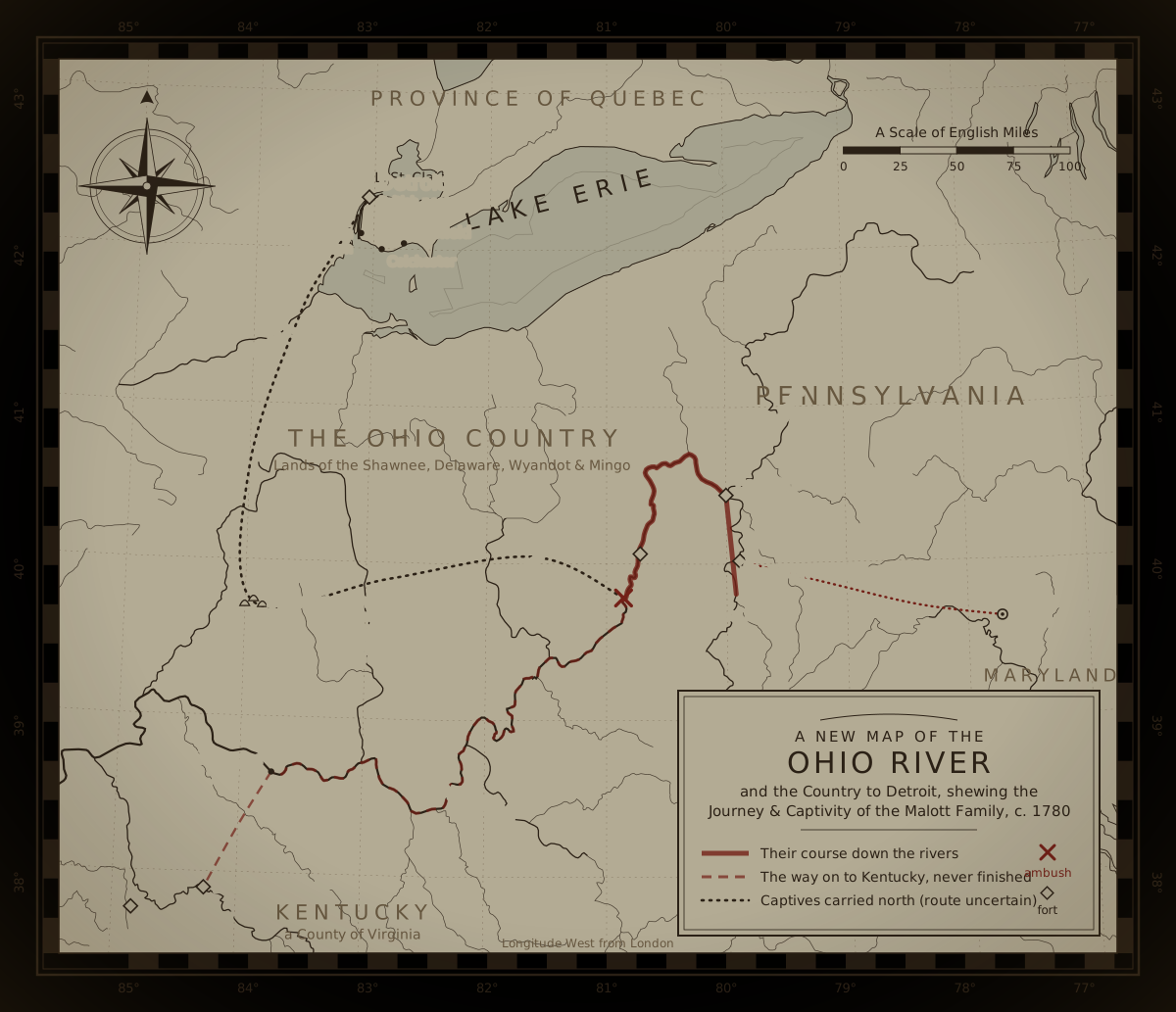
The way to Kentucky ran down the Ohio River. On the Monongahela River the Malotts joined a man named Reynolds and fitted out two flatboats. Peter and two other men took charge of one, loaded with the family’s cattle and horses. The other, under Reynolds, carried the families: Sarah and most of the children.
Ambush at Fish Creek
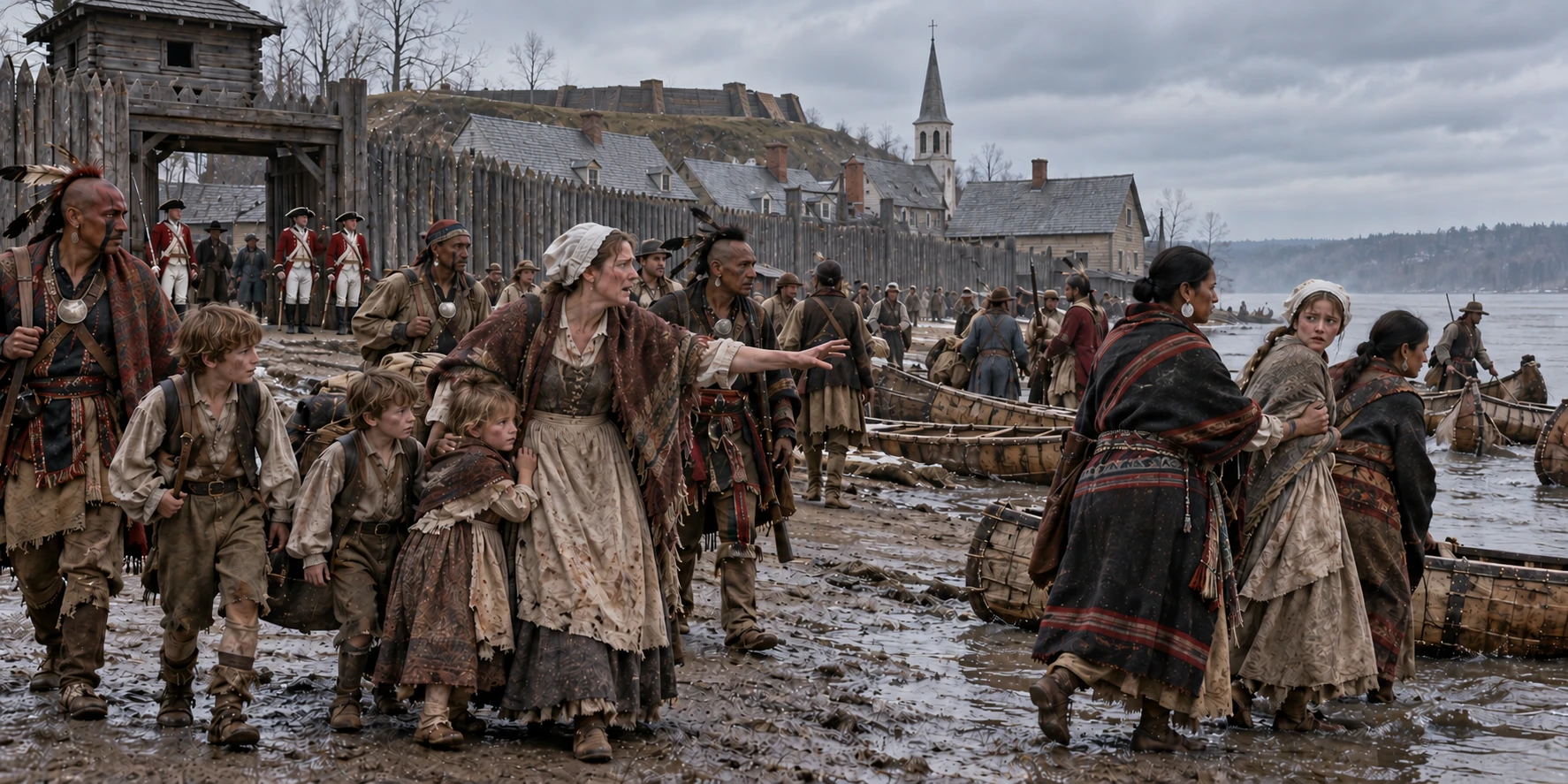
It was early spring, in March. The sources disagree on the year, anywhere from 1778 to 1780, and one gives the date as 22 March 1780. The boats had passed Wheeling and were near the mouth of Fish Creek, in what is now West Virginia, running close to shore in a bend of the river, when Indians hidden on the bank opened fire.
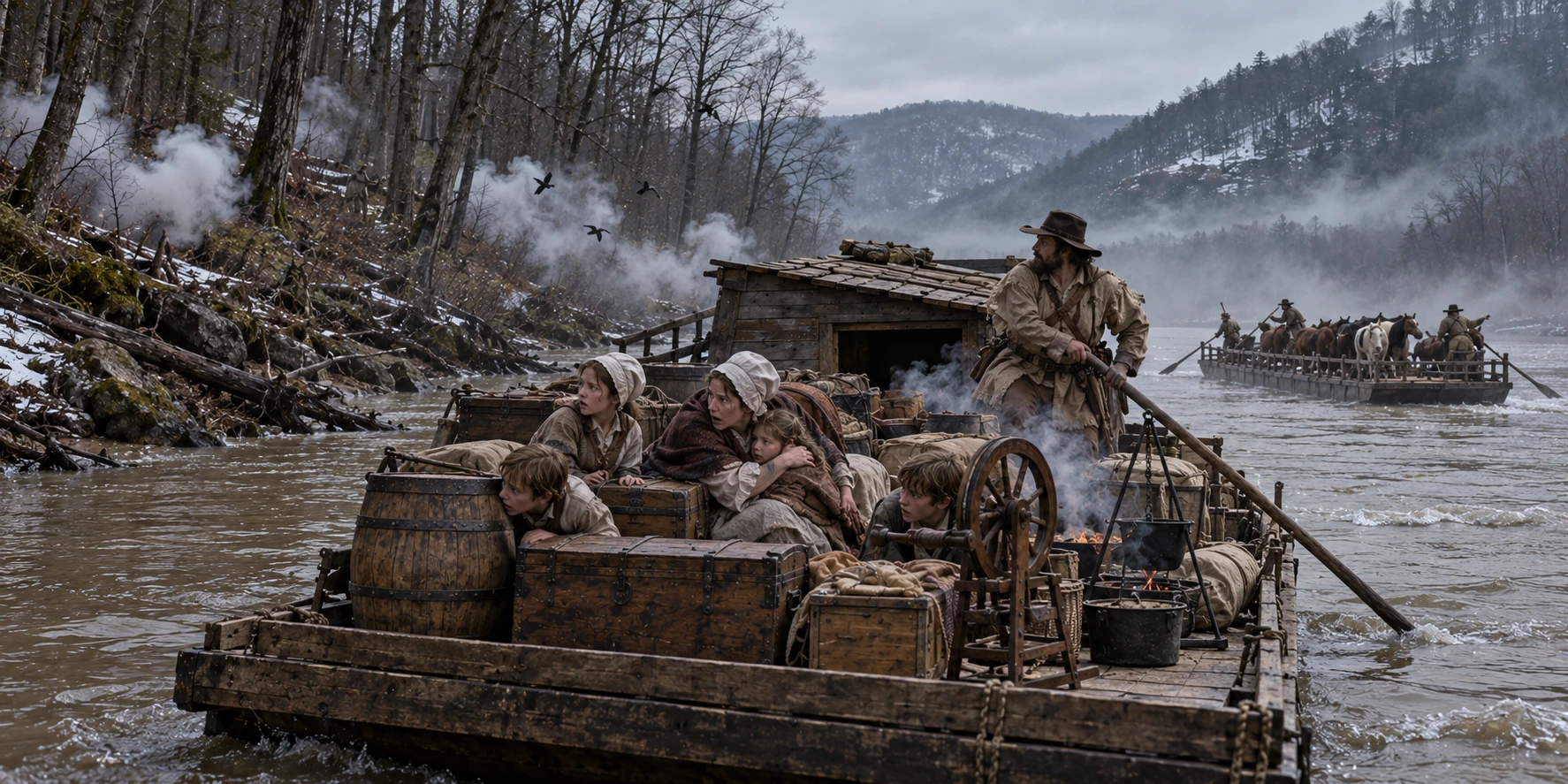
Reynolds was killed, and so was a small child. The warriors took the family boat. The stock boat, with Peter aboard, got away. So did at least one of the boys: according to a family account given in 1849, young William was with his father on the cattle boat.
This was no isolated attack. During the Revolution the Ohio was a war zone. Shawnee and other nations, fighting to keep settlers off their lands and supplied by the British at Detroit, struck boats and frontier settlements again and again. Captives were often carried north to Detroit, where some were adopted into Indian families and others were ransomed by the British.
Taken to Detroit
Sarah and about five of her children were led north through the Ohio country to Detroit. There, in August 1782, a British ration roll lists “Sarah Melot,” a widow, with five children. She believed her husband was dead. He believed the same of her.
Her daughter Catherine, about fourteen at the time of the capture, was kept by the Shawnee, and lived among them for about four years.
Catherine and Simon Girty
Simon Girty was one of the most notorious men on the American frontier, and one of the best documented. His life is told in the Dictionary of Canadian Biography, which notes that the family name may once have been Geraghty. He was born in 1741 at Chambers’ Mill, near Harrisburg, Pennsylvania, the son of Simon Girty and Mary Newton. His father was killed when he was small. About 1756 a war party captured the whole family; his stepfather was burned at the stake, and Simon spent the next three years among the Senecas of the upper Ohio, the people the British called Mingos. He came home speaking their language, and in time Delaware and Shawnee as well.
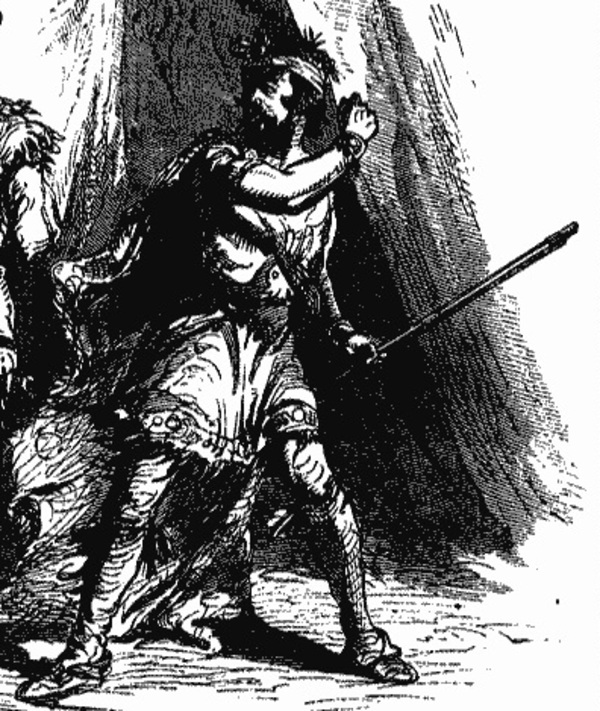
After his release he traded in the Ohio valley, interpreted for the colonial authorities at Fort Pitt, and held a lieutenant’s commission in the Pennsylvania militia. In the spring of 1778 he slipped out of Pittsburgh with two loyalists, Alexander McKee and Matthew Elliott, and made his way to Detroit, where the British Indian Department took him on as interpreter to the Six Nations. A man who knew him remembered him as six feet tall, with a large head and large black eyes. In 1779 he was with the war party that ambushed an American supply convoy on the Ohio, and in the summer of 1780 he went on Captain Henry Bird’s raid into Kentucky, which took more than three hundred prisoners. In 1782 he was present when the captured American colonel William Crawford was tortured to death near Upper Sandusky, and the Americans’ hatred of him dates largely from that day. To them he became a traitor, “the White Savage.”
The dates brush close to our story. The biography places Girty in the Shawnee country through the winter of 1779–80, returning to Detroit in March 1780, the same month one source gives for the ambush at Fish Creek. Nothing in the record puts him at Fish Creek, and the family never said he was there. It shows only how small the world of the Ohio frontier was.
By the family’s account, Girty got Catherine away from the Shawnee by saying he only wanted to take her to visit her mother, and promising to bring her back. Instead he married her. The wedding took place in August 1784 at the mouth of the Detroit River, performed by a German preacher; she was about eighteen or nineteen, and he was over forty. The Dictionary of Canadian Biography confirms the marriage, to “Catharine Malott,” in August 1784, though it describes her as a captive of the Delawares rather than the Shawnee.
Girty’s side of the story, as his modern biographers tell it, is gentler. After the war one of his duties was finding captives who had been adopted by the Indian nations and returning them to their families, and Catherine, they say, was one of the captives he brought back. In that telling she was an independent young woman who caught his eye, and the attraction was mutual. Which version is nearer the truth, or whether both are partly true, is not known.
After the war Girty and other officers of the Indian Department took up land at what is now Amherstburg, Ontario, and it was there, in Malden Township, that he and Catherine made their farm. Many Indian families settled nearby and worked on the officers’ farms. Girty was at most of the councils around Detroit in these years, and with McKee and Elliott he watched the defeat of the Indian confederacy at Fallen Timbers in 1794. When the British gave up Detroit in 1796 he stayed on the department’s payroll at four shillings and eightpence a day, but his active years were over.
Catherine and Simon had five children between 1785 and 1797: an infant daughter who died, Ann, Thomas, Sarah and Prideaux. (The biography counts “at least two sons and a daughter.”) The marriage was not a happy one. The family remembered that Girty drank hard and was brutal, and Catherine left him for years, living with her brother Peter before the two were reconciled. The biography bears out the drinking: it calls his capacity for drink legendary, his manners rough and his temper uncertain, and quotes Captain Bird’s verdict of 1780 that “Simon Girty is useless.”
Girty’s health was failing well before then. In 1800 he broke his leg in a fall from his horse and walked with a limp for the rest of his life, and when William Clark, of Lewis and Clark, met him in 1804, he found him rheumatic and nearly blind.
In the War of 1812 the Indian Department took some of Girty’s corn to feed its Indian allies. There had been a price on his head since Crawford’s death, and when the British under Major-General Henry Procter retreated from the Detroit frontier in the autumn of 1813, he went with them, and is said to have sheltered with a band of Mohawks. American troops occupied the farm that was Catherine’s home and were ready to burn it, the story goes, when Girty’s old friend Simon Kenton, the Kentucky frontiersman whose life Girty had once saved from the stake, stopped them. Girty came home about 1816, nearly blind and dependent on the wife he had so often quarrelled with and on their children, and spent his last days telling stories of his past in his favourite tavern. He died in his bed at Amherstburg on 18 February 1818 and was buried on his farm. Catherine outlived him by more than thirty years, and died at Colchester, Ontario, on 2 January 1852, about eighty-eight years old.
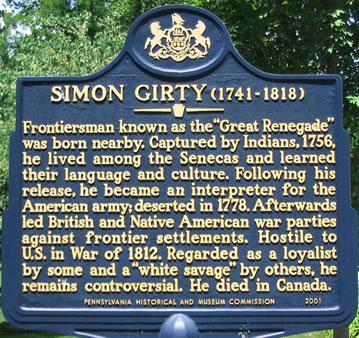
The biography’s author, Douglas Leighton, ends with a warning against the legend. Many of the stories of Girty’s cruelty were wartime propaganda, he writes, and the wars between the western nations and the new United States were caused not by men like Girty but by settlers’ hunger for land and the failure of their government to keep its agreements with the Indian nations. Two centuries on, Pennsylvania’s own marker near his birthplace still sums him up as a loyalist to some and a “white savage” to others.
A son goes home to Maryland
Back in Maryland, Peter Malott bought back his old homestead and married again, to a woman named Rachel. Years later his son Peter, one of the children captured on the Ohio and now a grown man, travelled back to Maryland to learn what had become of his father. He found him alive, with a young new wife.
The elder Peter never reunited with Sarah. She died in Canada about 1796. He died in Washington County, Maryland, on 22 May 1806, and his will of 1804 names eleven children, among them Theodore “Dory” Malott, the Revolutionary War fifer from whom the owner of this site descends. Dory was a grown man serving in the Maryland militia by then, and does not appear to have been on the boats.
The Canadian Malotts
The children taken to Detroit stayed on the British side of the new border. A county history records that three brothers, Peter, Theodore and David, and two sisters, Catherine and Delilah, were at Detroit by 1783.
- Peter married Mary Jones, who as a girl had herself spent years as a captive among the Wyandot. They lived a year on Grosse Ile, near Detroit, then traded a cow for an old soldier’s land claim in Gosfield Township, on the shore of Lake Erie, and farmed there for the rest of their lives. Peter died in 1815; Mary lived until 1845. They were buried on their homestead.
- Theodore took up land in Gosfield Township, married Catherine Wigle, raised a large family, and died at Kingsville, Ontario, in 1836.
- Delilah married Philip Wright.
- David settled near St. Catharines, Ontario, where his descendants spelled the name Marlotte.
Catherine’s own descendants, through her Girty children, stayed in Essex County too. In 1932 enough of them gathered at Lakeside Park in Kingsville, Ontario, to hear an address on their ancestor Simon Girty, later printed by F. X. Chauvin. Some of Girty’s descendants have argued that he was secretly working for the Americans all along, a theory his biographers reject.
From these families come the Malotts of Essex County, Ontario. They are cousins of every Malott on the American side, separated by one morning on the Ohio River.
How we know
Much of this story survives because of Lyman C. Draper, a Wisconsin historian who spent a lifetime collecting the memories of frontier families. Between 1846 and 1864 he interviewed Catherine’s children and grandchildren, among them her daughter Sarah (Girty) Munger and her grandson Joseph Munger, and wrote down what they remembered. His notes, the Draper Manuscripts, are now at the Wisconsin Historical Society. In 1893 Catherine’s granddaughter, Nancy Ann Sanford, swore a statement about the family as well.
William P. Marlatt gathered these accounts, along with land records, wills, pension files, county histories and the work of many other researchers, into his study of the family, where each source’s version is laid side by side.
What is still uncertain
- The year. Accounts range from 1778 to 1780.
- Whose children they were. Some sources say the family on the Ohio was that of Peter’s younger brother Joseph, not Peter himself. Catherine and her brother Peter both told their families that their father was Peter, and Catherine’s daughter insisted on it, “not Joseph, as some have stated,” but others in the family said Joseph.
- Sarah’s maiden name. Different sources suggest Tracy, Harmon or Crossley. None is proven.
- How Catherine and Girty came together. Her family remembered that he tricked her away from the Shawnee with a promise to take her to her mother; his biographers say he returned her from captivity and that the two were drawn to each other.
- Who held Catherine. The family remembered that she lived among the Shawnee; the Dictionary of Canadian Biography calls her a captive of the Delawares. The two nations lived close together and often acted together, and either could be right.
- Who was on which boat. Exactly which children were captured, and which escaped with their father, is not certain.
The full evidence is in Bill Marlatt’s study, Families of Peter Malott and Joseph Malott.