History and lore
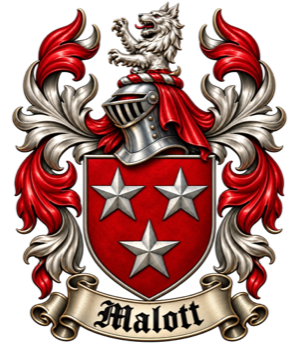
The Marlatt arms, a red shield with three silver stars, hang today at the French Church du Saint-Esprit in New York, a congregation built up by Huguenot refugees like Gedeon; they are the source of the crest on this site. In May 2012 a group of his descendants hosted a celebration there, marking 350 years since the family set out for the New World.
Read the full article: Our Family Crest and the French Church du Saint-Esprit
The Marlatt-Merlet DNA Project, begun in 2011, has tested 71 people who believe they descend from Gedeon. The records it gathered trace him as a carpenter from Roucy in Leiden in 1643, in Paris and Mannheim in the 1650s, and on Staten Island as constable (1671) and magistrate (1674). He had died by March 1684. The project’s Y-DNA results show his descendants belong to haplogroup G2a.
Read the full report: The Marlatt-Merlet DNA Project: Summary Report
Gideon grew up at Roucy in a Huguenot family, as the crown was taking back the freedoms the Edict of Nantes had given French Protestants. The Huguenot stronghold of La Rochelle fell in 1628, and by 1644 he had left France for Leiden. He escaped long before Louis XIV revoked the Edict in 1685, when huge numbers of Huguenots were forced to flee.
Read the full article: The Huguenots: Why Our Family Left France
A Huguenot refugee from Roucy in Champagne, Gideon lived for years in Leiden, Holland, before answering the Dutch West India Company’s printed offer of land to settlers in New Netherland (read more). He sailed from Amsterdam with his wife and four sons aboard Der Permerlander Kerck on 12 October 1662, reaching New Amsterdam in February 1663. The family crossed on credit: the Company’s ledger charges “Gideon Merlitt” 175½ guilders for their passage and food on the voyage, roughly seven months’ wages for a carpenter like Gideon, and never records the debt as paid (see the ledger entry). That April he joined the Dutch Reformed Church. He settled on Staten Island, where land records show him and his sons holding 243 acres on the south side of the island and 30 acres of salt meadow at the mouth of Fresh Kill. A 1907 map of the island’s colonial patents shows where they lay: the farm inland from Great Kills, roughly where the Great Kills and Eltingville neighborhoods are today, and the meadow on the north bank at the mouth of Fresh Kills. Both were re-patented to Paul Richards in 1694, after the family moved to New Jersey (see the map).
Read the full article: Across the Atlantic in 1662: The Merle Family Comes to New Netherland
On Staten Island Gideon served as constable under the English in 1671–72 and as a magistrate during the Dutch return of 1674, when a point of land on the bay was already known as “Gideon Marlet’s point.” By 1684 he was among the first settlers of Piscataway, New Jersey, and he had died by March of that year.
Read the full article: The Staten Island Years: Gideon’s Family in the New World, 1663–1685