
History and lore
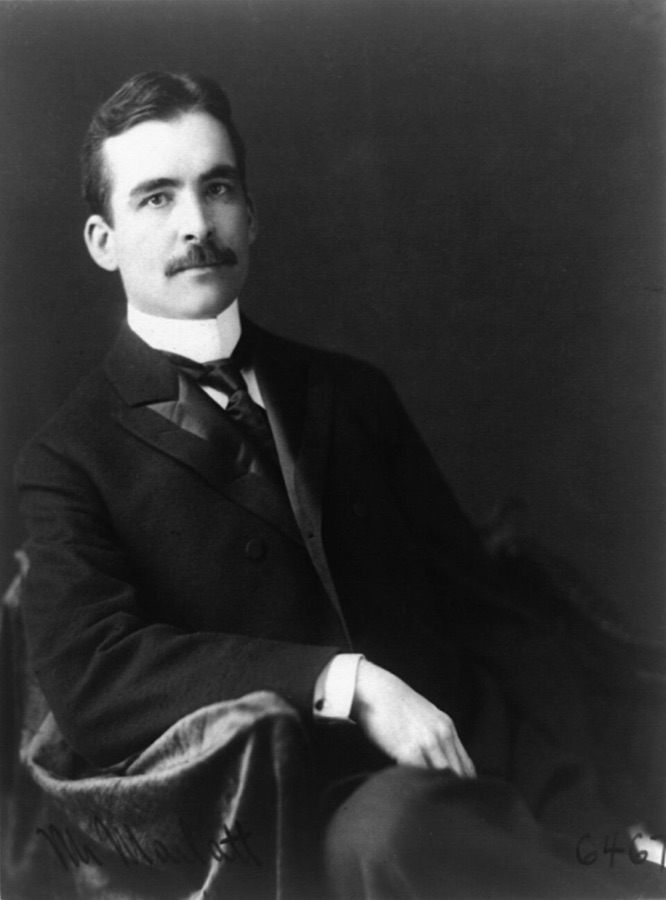
Charles Marlatt studied at the Kansas college his father had helped to found, where his friend and classmate was David Fairchild, later the country’s most famous plant explorer; Marlatt was best man at Fairchild’s wedding. Both men joined the U.S. Department of Agriculture in 1889, and in time they found themselves on opposite sides of a great argument: Fairchild wanted America to import the world’s plants, and Marlatt feared the insects and diseases that came with them.
On a 1901–02 honeymoon through Japan and China, paid for himself, Marlatt searched for the native home of the San Jose scale, an insect then devastating American orchards. He spent five months in Japan, visiting 42 provinces, then went by way of Shanghai north to Chefoo, Tientsin and Peking, and concluded that the scale came from the mountain frontier of northern China. Wherever it was found, a small ladybug, Chilocorus similis, was feeding on it. He mailed boxes of the beetles home; nearly all died on the way or in the first winter, but two survived, and from them the department bred some five thousand the next summer, one of the earliest American attempts to fight a pest with its natural enemy. The ladybug never took hold in the end. His first wife, Florence, caught an illness on the trip and died in 1903. In January 1910, as acting chief of the Bureau of Entomology, he inspected the 2,000 cherry trees Tokyo had sent as a gift to Washington, found them infested, and recommended they be destroyed; President Taft had them burned on the Washington Monument grounds. A clean shipment of 3,000 trees arrived in March 1912, and they are the cherry trees of the Tidal Basin today.
The episode helped him win the Plant Quarantine Act of 20 August 1912, the first federal law to keep foreign plant pests out of the country, and he became the first chairman of the board that enforced it. He was chief of the Bureau of Entomology from 1927 until he retired in 1933. His 1907 maps of the periodical cicada broods introduced the Roman-numeral brood numbers still used today, and cicadas are carved into the banister of the house he built on 16th Street in Washington.
He built that house, at 1521 16th Street NW, in 1908, and designed the carved insects, birds and animals throughout its main floor himself. The family kept it until 1970, when it was sold to the government of the Soviet Union, which used it for its embassy’s commercial office and for offices of the KGB. Today it is the Marlatt Mansion, the main building of the Institute of World Politics, a graduate school; the Library of Congress holds its original architectural drawings.
Marlatt wrote a great deal for farmers and householders as well as for scientists: government bulletins on the San Jose scale, insecticides, cockroaches, silverfish and house ants, A Manual of Dangerous Insects Likely to Be Introduced in the United States (1917), and radio talks in the early 1930s with titles like “Insect War.” A year before he died he published his diary of the 1901–02 journey as An Entomologist’s Quest (1953).