Born about 1770 in Frederick County, Maryland. Died 14 January 1834 in Washington County, Maryland. A farmer, militia colonel and magistrate, elected to county office months before his death, and a slaveholder: an undated sheriff’s sale of his property lists fifteen enslaved people.
Washington County, Marylandlieutenant-colonel commanding the Tenth Regiment of Maryland militia, in General Samuel Ringgold’s Second Brigade, as the county raised its quota for the War of 1812
Married
19 April 1814
Washington County, Maryland, to Sarah Ensmingeran Ensminger family record gives the same date
Sheriff’s sale
between 1814 and about 1832
Washington County, Marylandhis enslaved people, livestock and crops advertised for sale at his house to satisfy creditors; see the note below
Office
1823
Washington County, Marylandqualified as a justice of the peace
Lodge
22 May 1827
Williamsport, MarylandSenior Warden and a charter member of Friendship Lodge No. 84, A.F. and A.M.
Public life
1827
Washington County, Marylandnamed for the second district to the county committee assisting the engineers of the Baltimore and Ohio Railroad (24 July) and to the Washington County Canal Association, raising subscriptions for the Chesapeake and Ohio Canal (22 September)
Household
16 November 1827
Washington County, MarylandThomas McQuinney, 89, an Irish-born soldier of the Revolution, died “at the residence of Col. Daniel Malott”
Election
1828
Washington County, Marylandcandidate for the Assembly on the Adams (“Administration”) ticket, which lost to the Jackson ticket
Office
1833
Washington County, Marylandelected to county office in the autumn: sheriff by the printed lists, the Legislature by one account; see the note below
Research note: a sheriff’s sale, and slavery in the family
This is the first record on this site of a member of the family holding people in slavery. It is set down here as the notice gives it.
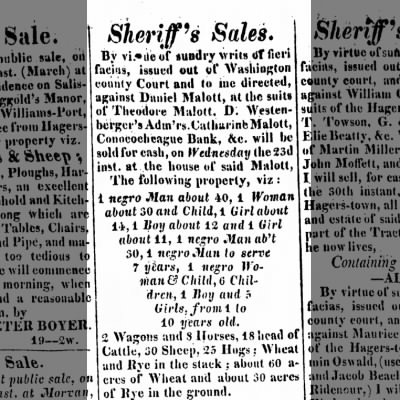
An undated newspaper notice headed “Sheriff’s Sales” announces that, under writs from the Washington County Court “against Daniel Malott, at the suits of Theodore Malott, D. Westenberger’s Adm’rs, Catharine Malott, Conococheague Bank, &c.,” his property would be sold for cash “on Wednesday the 23d inst. at the house of said Malott.” The first property listed is fifteen people:
a man about 40
a woman about 30 and her child
a girl about 14, a boy about 12 and a girl about 11
a man about 30
a man “to serve 7 years,” that is, due his freedom at the end of that term
a woman and her six children, a boy and five girls, from one to ten years old
None of them is named. What became of them, and whether the mothers and children were sold together, is not known.
The rest of the list shows a large farm: two wagons and eight horses, eighteen cattle, thirty sheep, twenty-five hogs, wheat and rye in the stack, and about sixty acres of wheat and thirty of rye in the ground.
The sheriff’s sale notice. A Washington County, Maryland, newspaper; its title and date are not yet identified.
What is not yet known. The clipping carries no newspaper title or date. It names the Conococheague Bank of Williamsport, whose banking house was built in 1814 and which had given way to a new bank by 1832, so the sale falls between those years. Daniel was not yet sheriff; the sale was held by one of his predecessors. Daniel Malott, son of Peter, is the only man of that name known in Washington County then, and the identification rests on that. The Theodore and Catharine Malott who sued him were surely relations, but which ones is not established: his brother Dory was a Theodore and had been in Ohio since 1805, his sister Catherine was in Canada, and there were nephews and nieces of both names.
Daniel recovered from the sale: within a few years he was again a leading man of his district, and in 1833 he was elected to county office. Slavery was legal in Maryland until 1864, and Washington County farmers of his standing commonly held enslaved workers.
Source: newspaper clipping, “Sheriff’s Sales,” Washington County, Maryland, supplied by Mark Malott; newspaper and date to be identified.
Research note: Colonel Malott’s public life, and where he may lie
Two county histories fill in his career. In 1812 he commanded the Tenth Regiment of militia as lieutenant-colonel, and he was “Col. Daniel Malott” for the rest of his life. He qualified as a justice of the peace in 1823. In 1827 he helped found the Masonic lodge at Williamsport and sat on the county committees for the two great projects of the day, the Baltimore and Ohio Railroad and the Chesapeake and Ohio Canal. In 1828 he ran for the Assembly as a supporter of President Adams and lost in the Jackson landslide.
Sheriff or legislator? The printed lists of Washington County sheriffs, and the Maryland State Archives, give “1833, Daniel Malott.” But Williams’s narrative says: “In January, 1834, Col. Daniel Malotte, who had just been elected to the Legislature, died, and Col. Wm. Fitzhugh, who was next highest on the poll, succeeded him.” The two do not agree, and no newspaper of the time has yet been checked. Either way, he died within weeks of winning office.
A possible burial place. He is recorded only as buried at Hagerstown. Williams describes the graveyard of an old Episcopal chapel in “Chapel Woods,” near the College of St. James south of Hagerstown, and says that “the last interments in the graveyard were those of the Malotte family, who were buried there between 1830 and 1840.” Daniel, who died in 1834, may be one of them. By Williams’s time the stones had been pulled up and piled in a fence corner to make room for the plough.
His wife. Sarah Ensminger is said to have died in Illinois, where she was buried with the family of their daughter Eliza. Unsourced family trees give her dates as 1792–1874.
Sources: J. Thomas Scharf, History of Western Maryland (Philadelphia, 1882), vols. 1 and 2; Thomas J. C. Williams, A History of Washington County, Maryland (1906); Maryland State Archives, list of Washington County sheriffs; a typed Ensminger family genealogy, page 17, supplied by Mark Malott; William P. Marlatt, Families of Peter Malott and Joseph Malott (2002).
History and lore
Daniel was an executor of his father’s will, and later its only surviving executor. He was a lieutenant-colonel of militia in the War of 1812 and was elected to county office in 1833. A marriage in 1804 to Susannah Blew is claimed for him by some sources, but may belong to his nephew Daniel, a son of Dory.