Born 7 December 1755 about five miles from Hagerstown, Maryland, then in Frederick County and later Washington County. Revolutionary War soldier, who wintered at Valley Forge. Died 10 March 1845 in Brown County, Ohio.
About five miles from Hagerstown, Maryland (then Frederick County; Washington County from 1776)his own sworn date, from a record in his father’s Bible; some records give 7 November
Military
from 1776
Revolutionary War: private and fifer, Marylandenlisted at Hagerstown, Maryland, in 1776; six enlistments, 2 years 7 months in all, under Captains John Reed and James Smith (Colonel Joseph Smith), Captain Andrew Hines (Colonel Otho Williams), Colonel Rollins and Colonel Richard Davis
Pension
1832–1833
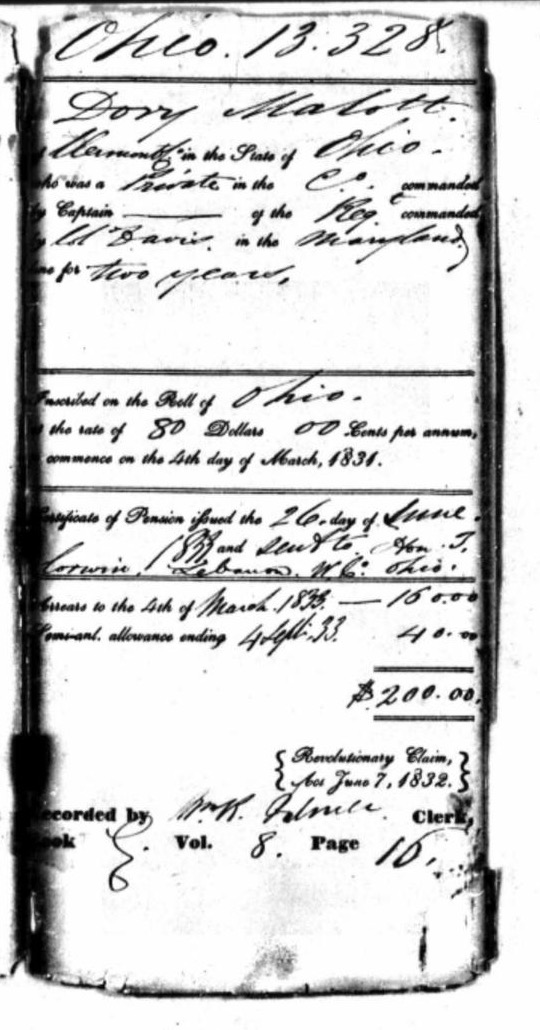
Declared his service in open court at Batavia, Clermont County, 6 November 1832; granted pension certificate no. 13,328 on 26 June 1833, $80 a year from 4 March 1831 (file S.2737)
Married
about 1780
Washington County, Maryland, to Ann Lane
Residence
1805
Moved from his father’s farm in Washington County, Maryland, to Williamsburg Township, Clermont County, Ohio
Died
10 March 1845
Brown County, Ohio
Buried
Greenbush Cemetery, Green Township, Brown County, Ohio
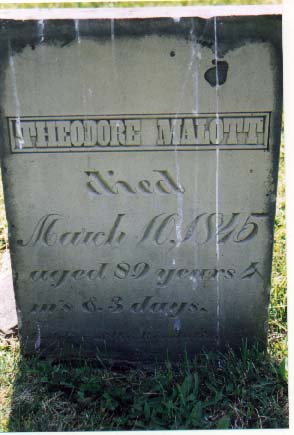
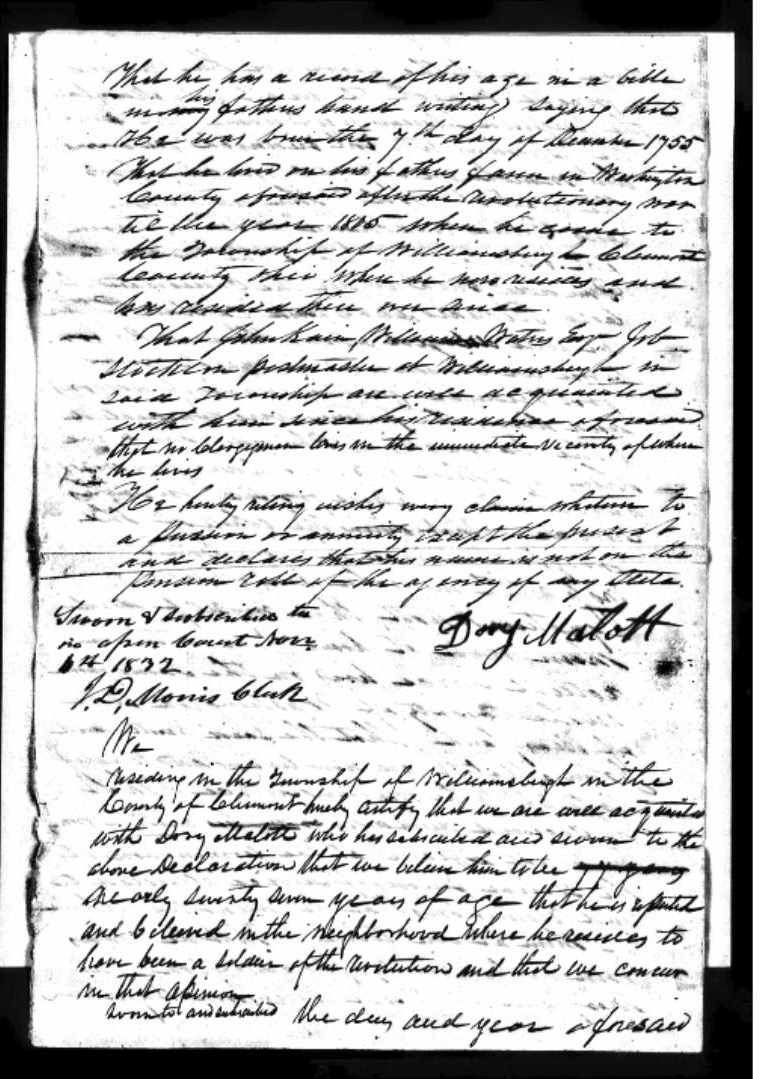
Dory’s own pension declaration of 1832 settles a long-standing question. He swore that he had “a record of his age in a bible in his father’s hand writing” giving his birth as 7 December 1755, which agrees with the Lane family history and with the reviewer’s “12” noted on the 1965 headstone application. Two other sources point to November: the 1965 application itself gives 7 November, and his original headstone, which gave his age at death on 10 March 1845 as “89 years 4 months & 3 days,” works back to 7 November. His father’s Bible, as he described it under oath, is the best evidence, so this site now gives 7 December 1755.
Sources: U.S., Revolutionary War Pension and Bounty-Land Warrant Application Files, 1800–1900, file S.2737, “Malott, Dory or Theodore,” Maryland (National Archives microfilm M804), viewed on Ancestry; U.S., Headstone Applications for Military Veterans, 1861–1985, application dated 16 July 1965 (Form DA 1815), viewed on Ancestry; photograph of the original headstone posted to a public member tree on Ancestry.
In his own words: the pension declaration of 1832
An artistic depiction of a young Maryland militia fifer and drummer in the winter camp at Valley Forge, 1777–78, created with generative AI. Dory was about 21 that winter and served as a fifer, by family tradition and his grave marker. This is an imagined scene of the time and place, not a picture of Dory, whose likeness is unknown.
On 6 November 1832, at the age of nearly 77, Dory Malott stood in open court at Batavia, the seat of Clermont County, Ohio, before Judge George P. Torrence, and swore to the story of his service in the Revolution, in order to claim a pension under the new Act of Congress of 7 June 1832. A clerk wrote down his account, and he signed it. It is the only record we have of Dory telling his own story, and it survives in his pension file at the National Archives. In summary, he said:
1776, six months. At Hagerstown he volunteered as a private under Colonel Joseph Smith and Captain James Smith. As soon as wagons and provisions could be found they marched to join General Washington’s army at Coryell’s Ferry on the Delaware, meeting on the way British prisoners taken at Trenton and Princeton. They crossed into New Jersey, followed the army toward its winter quarters at Morristown, spent the rest of the winter at Quibbletown, and were discharged there in March by Thomas Johnson, governor of Maryland.
1777, about three months. Back home, he, his brother John and a neighbor were pressed into service by Colonel John Rawlings and sent to Hagerstown and Fort Frederick, “employed in butchering for the prisoners” held there.
October 1777, six months. Drafted at Hagerstown, he marched to Lancaster for arms and on to join Washington’s army at Whitemarsh, outside British-held Philadelphia. He remembered a day of fighting there while his company stood under arms half a mile from the battle. When cold weather came the army marched to Valley Forge, crossing the Schuylkill on a bridge made of baggage wagons, and there, he said, “we were ordered to build huts.” Later that winter his company joined the Pennsylvania militia on the Schuylkill until they were discharged by Baron de Kalb, commander of the Maryland Line.
1779–1780, about five and a half months. A member of a minute company, he was called out on two days’ notice to guard prisoners at Fort Frederick.
Catching Tories, three and a half weeks. Under Colonel Richard Davis he helped round up more than 180 Tories and take them to the Frederick County jail; at their trial, he recalled, three were convicted and hanged. This was the Frederick Tory plot of 1781, when three men were executed.
Six months more. He marched at an hour’s notice into Virginia to meet British prisoners from the Albemarle barracks, met them at the Shenandoah ferry, and helped guard them to Fort Frederick, “suffering much for the want of food,” and later on to the barracks at Philadelphia.
Through it all, he said, he messed with his brother John and their neighbor Ignatius Knott, and between tours the three lived on the same farm in Washington County. He had received written discharges from his officers, “and remembers that he burnt the whole of them at one time.” After the war he stayed on his father’s farm until 1805, when he moved to Williamsburg Township in Clermont County. His brother John and Ignatius Knott swore that they had served with him and that the three had been messmates. In May 1833, “by reason of old age and the consequent loss of memory,” he amended his claim to at least two years and three months of service, and that June he was granted a pension of $80 a year.
The file also holds an earlier, unsuccessful claim. In June 1828, signing himself Theodore Malott, he applied under another act as a soldier of the Continental Line, a private in Captain John Reed’s company of the 6th Maryland Regiment. The Treasury could not find his name on the Maryland Line lists, and the claim was set aside. A neighbor, William Waters, wrote with that application that Theodore had once drawn a pension but was “so patriotic” that he gave it up for the duration of the War of 1812, that he believed his papers had been burned, and that he was now old and in need.
Dory appears once more in the records of the pension office. On 3 November 1838, at about 82, he swore before a Brown County justice of the peace that he had known his brother John and John’s wife Elizabeth “from the time of their marriage,” in 1784, and that they had lived together as man and wife until John’s death that February, so that Elizabeth could claim a widow’s pension. He signed it, again, “Dory Malott.”
The last page of his declaration, sworn in open court on 6 November 1832, with his signature, “Dory Malott.” It records his birth on 7 December 1755 from his father’s Bible and his move to Clermont County in 1805. National Archives, pension file S.2737, via Ancestry.His pension record: Ohio certificate no. 13,328, issued 26 June 1833 at $80 a year from 4 March 1831, under the Act of 7 June 1832. National Archives, pension file S.2737, via Ancestry.
Source: U.S., Revolutionary War Pension and Bounty-Land Warrant Application Files, 1800–1900, file S.2737, “Malott, Dory or Theodore,” Maryland (National Archives microfilm M804), viewed on Ancestry. Quotations are from the declarations of 6 November 1832 and May 1833, the 1828 application, and William Waters’s letter of 19 June 1828. The Tory trial: Frederick County, Maryland, 1781.
Research note: his children, from two sources
A Lane family history lists seven children of Theodore and Anne (Lane) Malott: Daniel (born 30 August 1780), Edna (about 1782), Peter (about 1788), Prather (1790/1792), Samuel R., Theodore (about 1794) and Hollender Ann (about 1796). It gives Theodore’s birth as 7 December 1755 and his death as 10 March 1845 in Brown County, Ohio. Bill Marlatt’s study largely agrees but differs in details: it gives Daniel’s birth as 1 August 1780 and Peter’s as 1787, adds a daughter Sarah, mentions a Peter born about 1797 who married Ann Smith, and names a second wife, Millie (Amelia). Neither source cites the record behind its list.
Sources: A Lane family history, page 23, entry 2 (“Anne Lane”), submitted by Virginia Parmenter; viewed on Ancestry; William P. Marlatt, Families of Peter Malott and Joseph Malott (2002).
History and lore
Dory served in the Maryland militia through much of the Revolution, by family tradition and his 1965 grave marker as a fifer; in his own account he was a private, and he wintered with Washington’s army at Valley Forge (see his pension declaration above). He married Ann Lane about 1780, moved to Clermont County, Ohio, in 1805, and died on 10 March 1845. His gravestone at Greenbush Cemetery, Green Township, Brown County, records his service. His father’s 1804 will names him as “Dory Melott.” He signed his pension declaration “Dory Malott” in 1832 and “Theodore Malott” in 1828; his brother John could only make his mark.
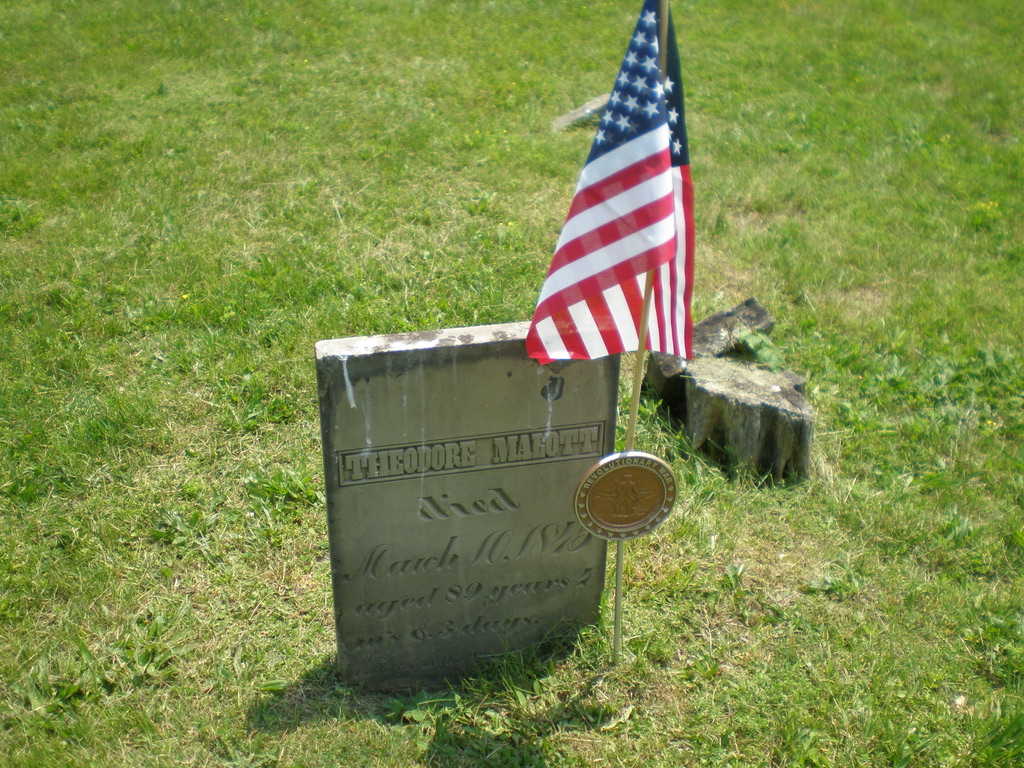
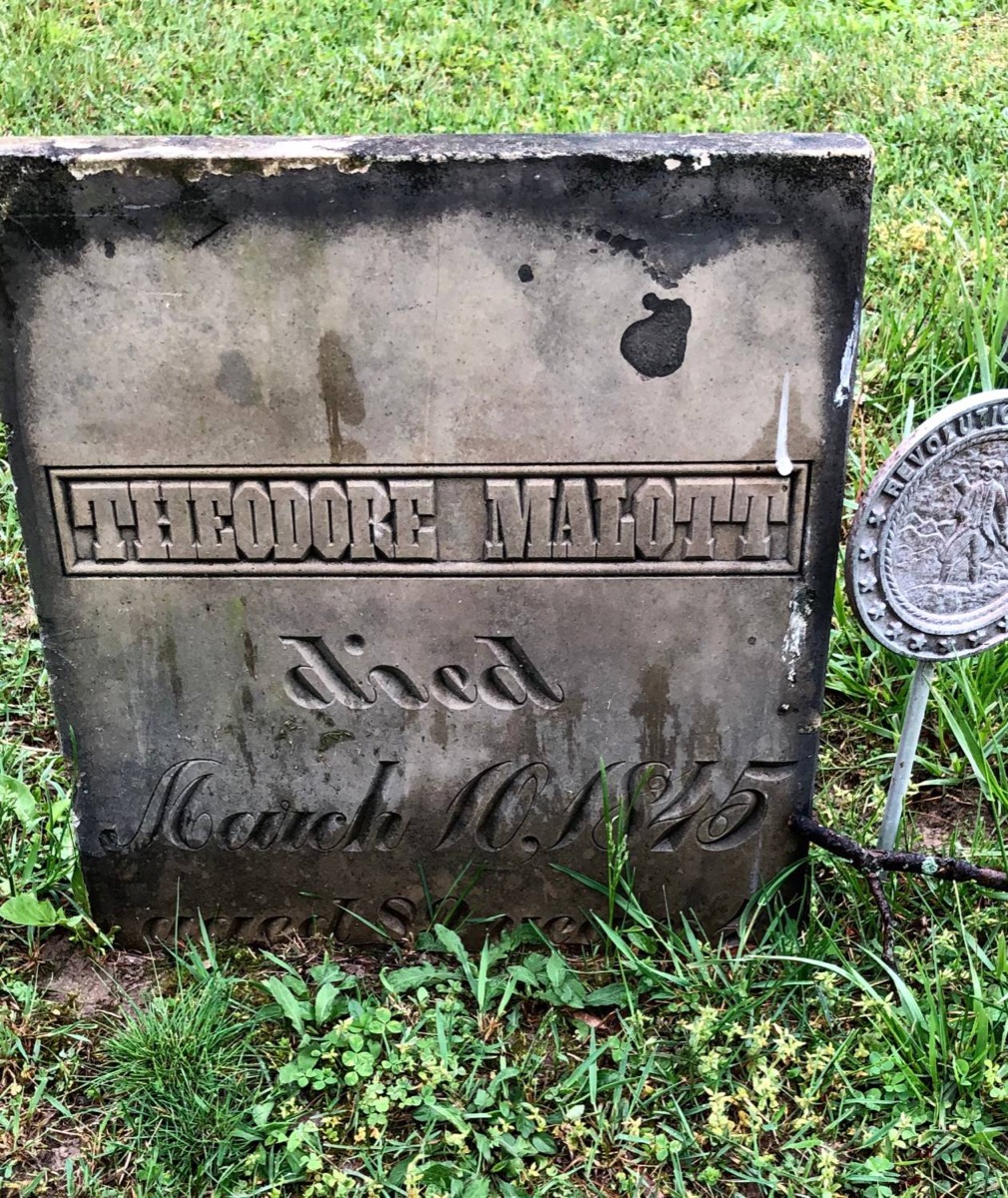
There are two stones at Theodore’s grave in Greenbush Cemetery. The upright headstone is a reproduction of the original stone placed when he died in 1845. The Daughters of the American Revolution paid to have the graves of Revolutionary War soldiers honored, and Hirons Memorial Works of Mount Orab did the work. The stone of those days wore away quickly, and out of respect the original headstone was buried at the grave.
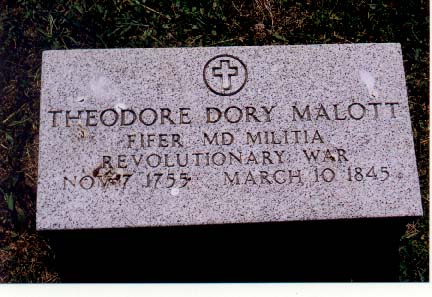
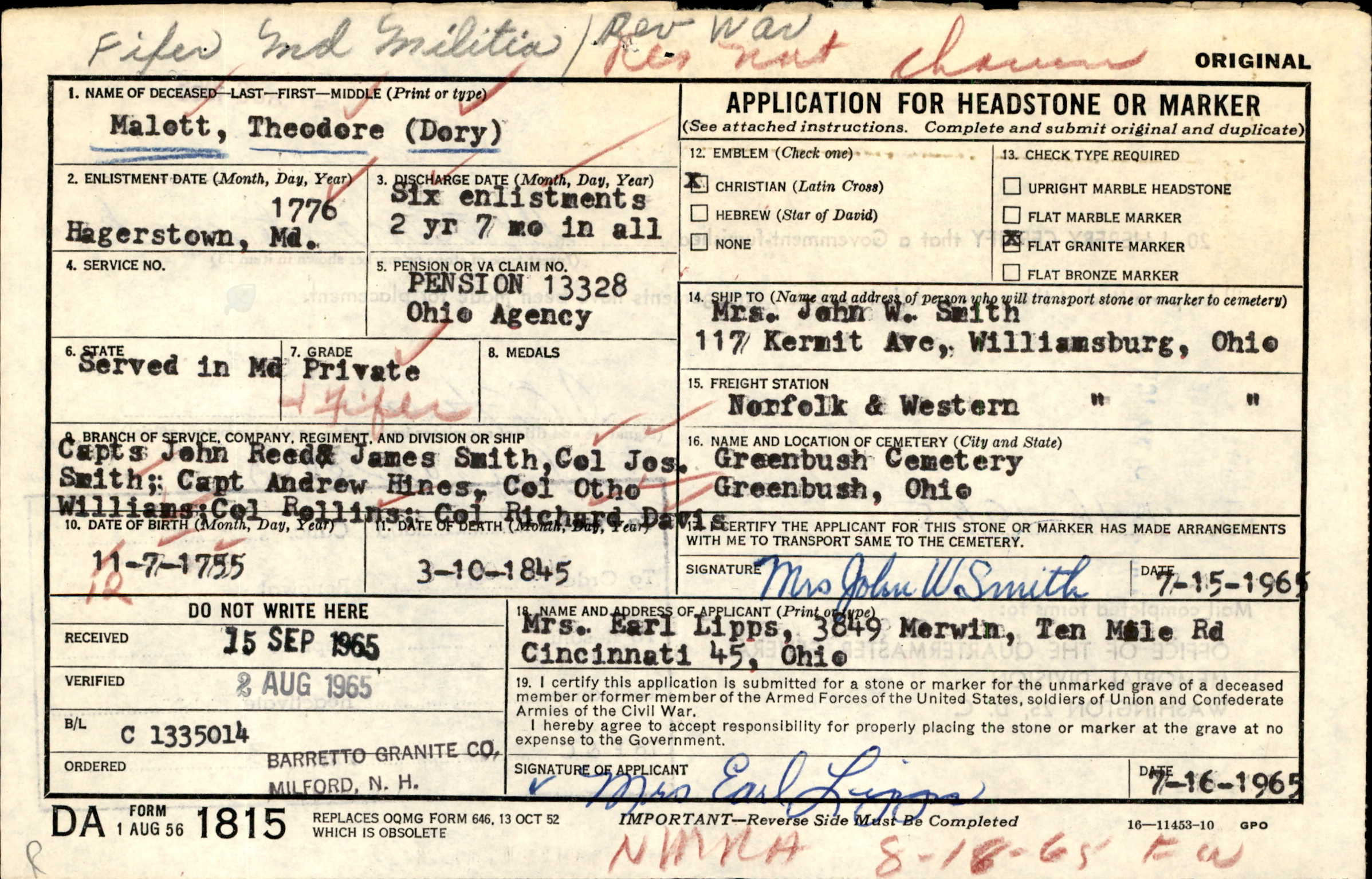
The flat granite foot stone, recording his service as a fifer in the Maryland militia, is a government veteran’s marker. Two women of the family, from Cincinnati and Williamsburg, applied for it in July 1965; the Army verified his service that August, and the marker, with a Latin cross, was cut by the Barretto Granite Company of Milford, New Hampshire, and shipped to Williamsburg to be set at the grave.
His grandson Delos C. Malott, a Civil War soldier, is buried in the same cemetery.
The headstone, a reproduction of the original 1845 stone, with a flag and a Revolutionary War medallion.A closer view of the headstone lettering.The modern granite foot stone. It gives his birth as Nov. 7, 1755; the 1845 headstone, “aged 89 years 3 m’s & 3 days,” works out to 7 December 1755, the date in his pension file.The headstone and its Revolutionary War medallion, in a recent photograph.The 1965 application for his government foot stone, which records his Revolutionary War service, his pension number and his officers. From U.S., Headstone Applications for Military Veterans, 1861–1985.